Kaplaneris Nikolaos, Kaltenhӓuser Felix, Sirvinskaite Giedre, Fan Shuang, De Oliveira Tiago, Conradi Lena-Christin, Ackermann Lutz
Institut für Organische und Biomolekulare Chemie, Georg-August-Universität Göttingen, Tammannstraße 2, 37077 Göttingen, Germany.
Clinic of General, Visceral and Pediatric Surgery, University Medical Center Göttingen, Robert-Koch-Straße 40, 37075 Göttingen, Germany.
Sci Adv. 2021 Feb 26;7(9). doi: 10.1126/sciadv.abe6202. Print 2021 Feb.
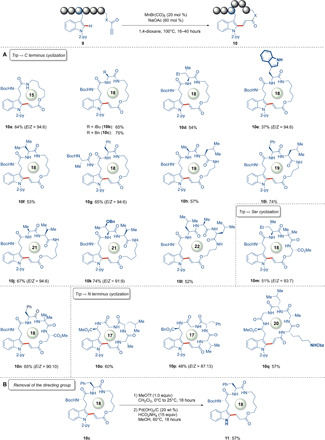
Bioorthogonal late-stage diversification of structurally complex peptides bears enormous potential for drug discovery and molecular imaging. Despite major accomplishments, these strategies heavily rely on noble-metal catalysis. Herein, we report on a manganese(I)-catalyzed peptide C─H hydroarylation that enabled the stitching of peptidic and sugar fragments, under exceedingly mild and racemization-free conditions. This convergent approach represents an atom-economical alternative to traditional iterative peptide synthesis. The robustness of the manganese(I) catalysis regime is reflected by the full tolerance of a plethora of sensitive functional groups. Our strategy enabled an expedient access to challenging cyclic peptides by a modular late-stage macrocyclization of structurally complex peptides.
结构复杂肽的生物正交后期多样化在药物发现和分子成像方面具有巨大潜力。尽管取得了重大成就,但这些策略严重依赖于贵金属催化。在此,我们报道了一种锰(I)催化的肽C─H氢芳基化反应,该反应能够在极其温和且无消旋化的条件下将肽片段和糖片段连接起来。这种汇聚方法是传统迭代肽合成的一种原子经济替代方法。锰(I)催化体系的稳健性体现在对大量敏感官能团的完全耐受性上。我们的策略通过对结构复杂肽进行模块化后期大环化,实现了便捷地获得具有挑战性的环肽。