Faculty of Psychology, Mercator Research Group-Structure of Memory, Ruhr-University Bochum, Bochum 44780, Germany.
German Center for Neurodegenerative Diseases (DZNE), Magdeburg 39120, Germany.
eNeuro. 2021 Mar 22;8(2). doi: 10.1523/ENEURO.0440-20.2020. Print 2021 Mar-Apr.
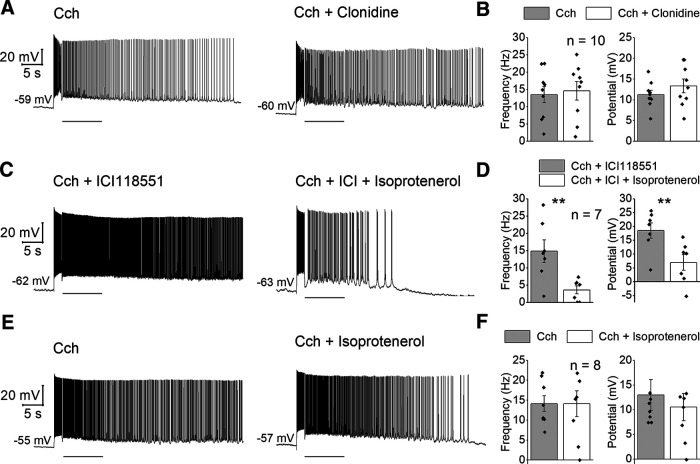
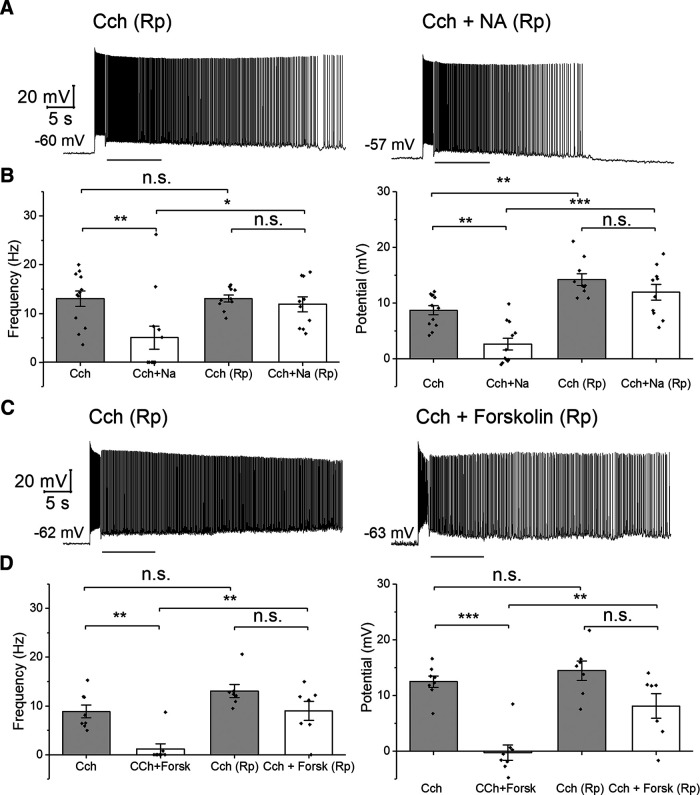
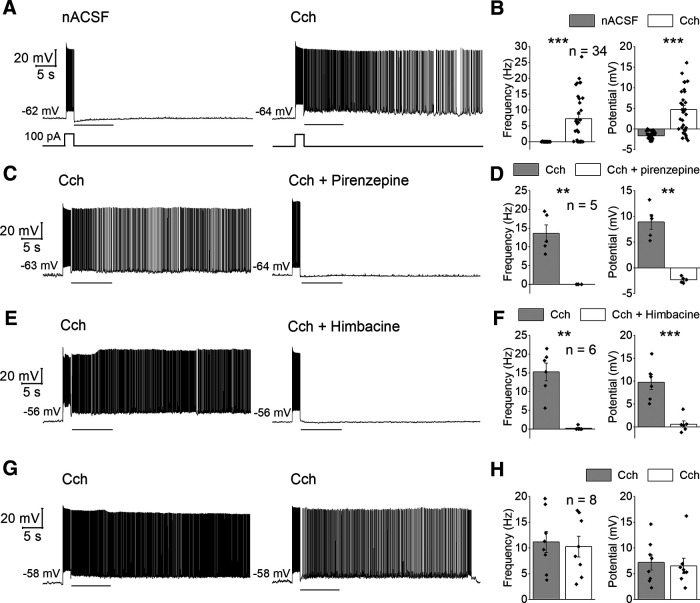
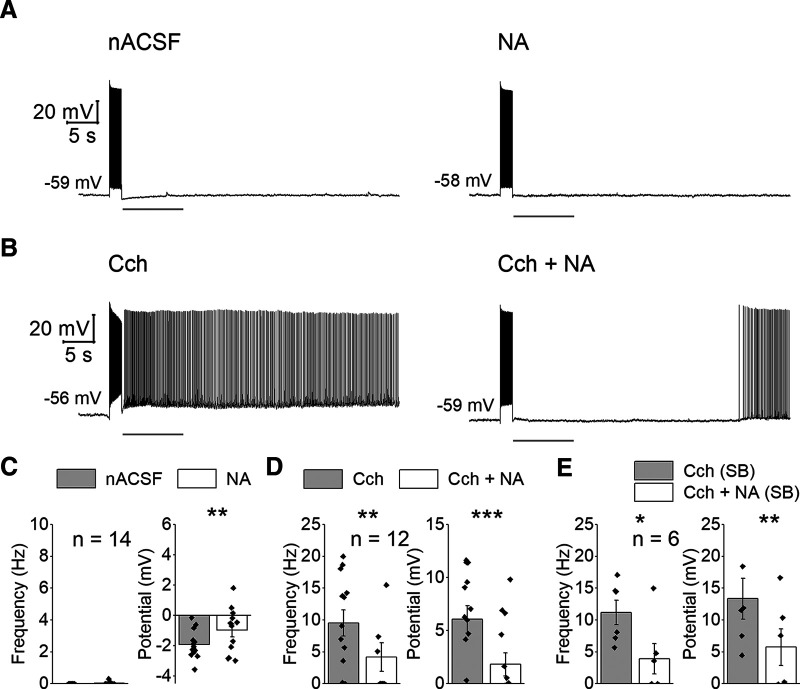
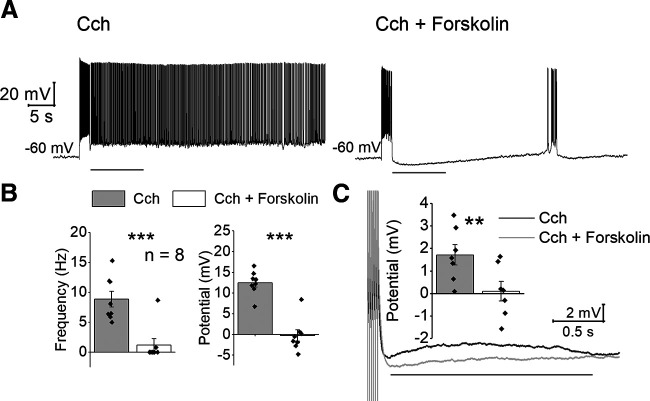
Persistent firing is believed to be a cellular correlate of working memory. While the effects of noradrenaline (NA) on working memory have widely been described, its effect on the cellular mechanisms of persistent firing remains largely unknown. Using intracellular recordings, we demonstrate that persistent firing is supported by individual neurons in hippocampal CA1 pyramidal cells through cholinergic receptor activation, but is dramatically attenuated by NA. In contrast to the classical theory that recurrent synaptic excitation supports persistent firing, suppression of persistent firing by NA was independent of synaptic transmission, indicating that the mechanism is intrinsic to individual cells. In agreement with detrimental effects of cAMP on working memory, we demonstrate that the suppressive effect of NA was through cAMP-PKA pathway. In addition, activation of β1 and/or β3 adrenergic receptors, which increases cAMP levels, suppressed persistent firing. These results are in line with working memory decline observed during high levels of NA and cAMP, which are implicated in high stress, aging, and schizophrenia.
持续放电被认为是工作记忆的细胞相关性。虽然去甲肾上腺素(NA)对工作记忆的影响已被广泛描述,但它对持续放电的细胞机制的影响在很大程度上仍是未知的。使用细胞内记录,我们证明了 CA1 锥体神经元中的单个神经元通过胆碱能受体激活支持持续放电,但 NA 可显著减弱其作用。与支持持续放电的经典理论相反,NA 对持续放电的抑制作用与突触传递无关,表明该机制是细胞内固有的。与 cAMP 对工作记忆的有害影响一致,我们证明 NA 的抑制作用是通过 cAMP-PKA 途径实现的。此外,激活β1 和/或β3 肾上腺素能受体(增加 cAMP 水平)可抑制持续放电。这些结果与高浓度 NA 和 cAMP 期间观察到的工作记忆下降一致,这与高压力、衰老和精神分裂症有关。