Cancer Immunology Discovery, Pfizer Inc, San Diego, California, USA.
Cancer Immunology Discovery, Pfizer Inc, San Diego, California, USA
J Immunother Cancer. 2021 Feb;9(2). doi: 10.1136/jitc-2020-002045.
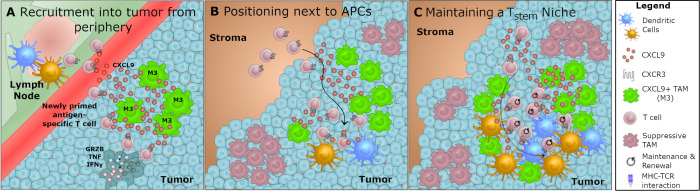
Tumor-associated macrophages (TAMs) are among the main contributors to immune suppression in the tumor microenvironment, however, TAM depletion strategies have yielded little clinical benefit. Here, we discuss the concept that TAMs are also key regulators of anti-PD(L)-1-mediated CD8 T cell-dependent immunity. Emerging data suggest that expression of the chemokine CXCL9 by TAMs regulates the recruitment and positioning of CXCR3-expressing stem-like CD8 T (T) cells that underlie clinical responses to anti-PD(L)-1 treatment. We evaluate clinical and mechanistic studies that establish relationships between CXCL9-expressing TAMs, T and antitumor immunity. Therapies that enhance anti-PD(L)-1 response rates must consider TAM CXCL9 expression. In this perspective, we discuss opportunities to enhance the frequency and function of CXCL9 expressing TAMs and draw on comparative analyzes from infectious disease models to highlight potential functions of these cells beyond T recruitment.
肿瘤相关巨噬细胞(TAMs)是肿瘤微环境中免疫抑制的主要贡献者之一,然而,TAM 耗竭策略在临床上获益甚微。在这里,我们讨论了一个概念,即 TAMs 也是抗 PD-(L)-1 介导的 CD8 T 细胞依赖性免疫的关键调节剂。新出现的数据表明,TAMs 表达趋化因子 CXCL9 调节 CXCR3 表达的干细胞样 CD8 T(T)细胞的募集和定位,这些细胞是对抗 PD-(L)-1 治疗产生临床反应的基础。我们评估了临床和机制研究,这些研究建立了表达 CXCL9 的 TAMs、T 和抗肿瘤免疫之间的关系。增强抗 PD-(L)-1 反应率的疗法必须考虑 TAM CXCL9 的表达。在这篇观点文章中,我们讨论了增强表达 CXCL9 的 TAMs 的频率和功能的机会,并借鉴传染病模型的比较分析来强调这些细胞除了 T 细胞募集之外的潜在功能。