Gunasekeran Dinesh Visva, Tseng Rachel Marjorie Wei Wen, Tham Yih-Chung, Wong Tien Yin
Singapore Eye Research Institute (SERI), Singapore National Eye Center (SNEC), Singapore, Singapore.
Yong Loo Lin School of Medicine, National University of Singapore (NUS), Singapore, Singapore.
NPJ Digit Med. 2021 Feb 26;4(1):40. doi: 10.1038/s41746-021-00412-9.
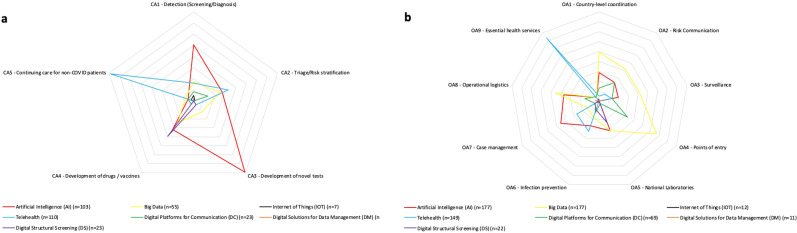
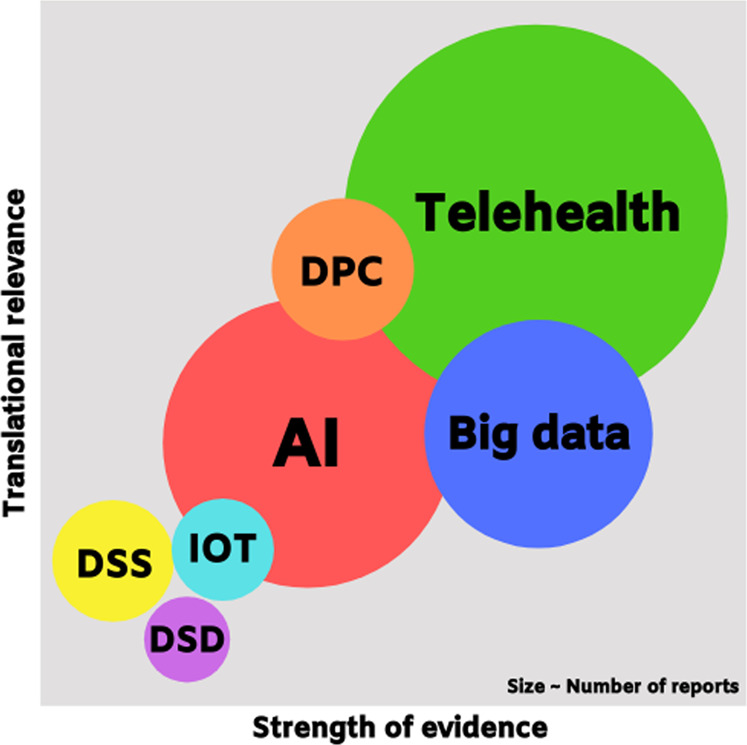
The coronavirus disease 2019 (COVID-19) pandemic has overwhelmed healthcare services, faced with the twin challenges in acutely meeting the medical needs of patients with COVID-19 while continuing essential services for non-COVID-19 illnesses. The need to re-invent, re-organize and transform healthcare and co-ordinate clinical services at a population level is urgent as countries that controlled initial outbreaks start to experience resurgences. A wide range of digital health solutions have been proposed, although the extent of successful real-world applications of these technologies is unclear. This study aims to review applications of artificial intelligence (AI), telehealth, and other relevant digital health solutions for public health responses in the healthcare operating environment amidst the COVID-19 pandemic. A systematic scoping review was performed to identify potentially relevant reports. Key findings include a large body of evidence for various clinical and operational applications of telehealth (40.1%, n = 99/247). Although a large quantity of reports investigated applications of artificial intelligence (AI) (44.9%, n = 111/247) and big data analytics (36.0%, n = 89/247), weaknesses in study design limit generalizability and translation, highlighting the need for more pragmatic real-world investigations. There were also few descriptions of applications for the internet of things (IoT) (2.0%, n = 5/247), digital platforms for communication (DC) (10.9%, 27/247), digital solutions for data management (DM) (1.6%, n = 4/247), and digital structural screening (DS) (8.9%, n = 22/247); representing gaps and opportunities for digital public health. Finally, the performance of digital health technology for operational applications related to population surveillance and points of entry have not been adequately evaluated.
2019年冠状病毒病(COVID-19)大流行使医疗服务不堪重负,面临着双重挑战:既要紧急满足COVID-19患者的医疗需求,又要继续为非COVID-19疾病提供基本服务。随着控制住初始疫情爆发的国家开始出现疫情反弹,在人群层面重新塑造、重新组织和转变医疗保健并协调临床服务的需求迫在眉睫。人们已经提出了各种各样的数字健康解决方案,尽管这些技术在现实世界中的成功应用程度尚不清楚。本研究旨在回顾人工智能(AI)、远程医疗和其他相关数字健康解决方案在COVID-19大流行期间医疗运营环境中用于公共卫生应对的应用情况。进行了一项系统的范围综述,以识别潜在相关报告。主要发现包括大量关于远程医疗各种临床和运营应用的证据(40.1%,n = 99/247)。尽管大量报告调查了人工智能(AI)的应用(44.9%,n = 111/247)和大数据分析(36.0%,n = 89/247),但研究设计的缺陷限制了可推广性和转化应用,这凸显了进行更务实的现实世界调查的必要性。对物联网(IoT)(2.0%,n = 5/247)、通信数字平台(DC)(10.9%,27/247)、数据管理数字解决方案(DM)(1.6%,n = 4/247)和数字结构筛查(DS)(8.9%,n = 22/247)的应用描述也很少;这代表了数字公共卫生领域的差距和机遇。最后,数字健康技术在与人群监测和入境点相关的运营应用方面的表现尚未得到充分评估。