Golinelli Davide, Boetto Erik, Carullo Gherardo, Nuzzolese Andrea Giovanni, Landini Maria Paola, Fantini Maria Pia
Department of Biomedical and Neuromotor Sciences, University of Bologna, Bologna, Italy.
Department of Italian and Supranational Public Law, University of Milan, Milan, Italy.
J Med Internet Res. 2020 Nov 6;22(11):e22280. doi: 10.2196/22280.
The COVID-19 pandemic is favoring digital transitions in many industries and in society as a whole. Health care organizations have responded to the first phase of the pandemic by rapidly adopting digital solutions and advanced technology tools.
The aim of this review is to describe the digital solutions that have been reported in the early scientific literature to mitigate the impact of COVID-19 on individuals and health systems.
We conducted a systematic review of early COVID-19-related literature (from January 1 to April 30, 2020) by searching MEDLINE and medRxiv with appropriate terms to find relevant literature on the use of digital technologies in response to the pandemic. We extracted study characteristics such as the paper title, journal, and publication date, and we categorized the retrieved papers by the type of technology and patient needs addressed. We built a scoring rubric by cross-classifying the patient needs with the type of technology. We also extracted information and classified each technology reported by the selected articles according to health care system target, grade of innovation, and scalability to other geographical areas.
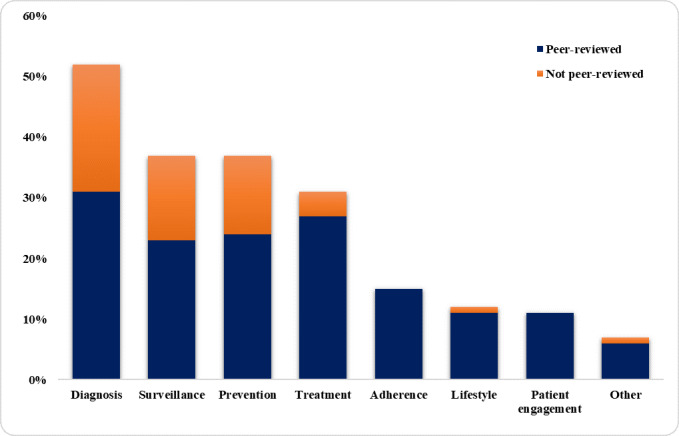
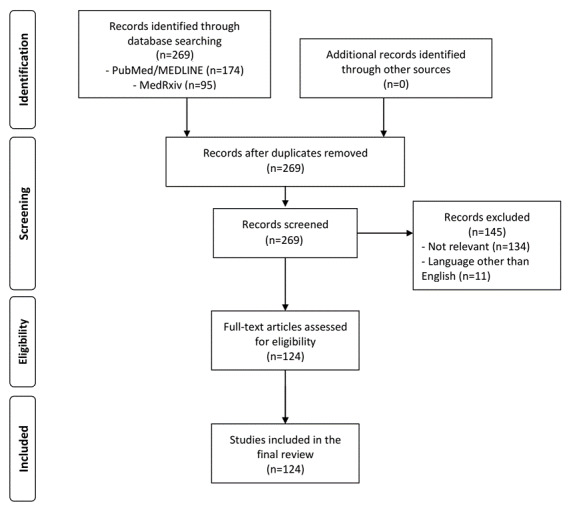
The search identified 269 articles, of which 124 full-text articles were assessed and included in the review after screening. Most of the selected articles addressed the use of digital technologies for diagnosis, surveillance, and prevention. We report that most of these digital solutions and innovative technologies have been proposed for the diagnosis of COVID-19. In particular, within the reviewed articles, we identified numerous suggestions on the use of artificial intelligence (AI)-powered tools for the diagnosis and screening of COVID-19. Digital technologies are also useful for prevention and surveillance measures, such as contact-tracing apps and monitoring of internet searches and social media usage. Fewer scientific contributions address the use of digital technologies for lifestyle empowerment or patient engagement.
In the field of diagnosis, digital solutions that integrate with traditional methods, such as AI-based diagnostic algorithms based both on imaging and clinical data, appear to be promising. For surveillance, digital apps have already proven their effectiveness; however, problems related to privacy and usability remain. For other patient needs, several solutions have been proposed, such as telemedicine or telehealth tools. These tools have long been available, but this historical moment may actually be favoring their definitive large-scale adoption. It is worth taking advantage of the impetus provided by the crisis; it is also important to keep track of the digital solutions currently being proposed to implement best practices and models of care in future and to adopt at least some of the solutions proposed in the scientific literature, especially in national health systems, which have proved to be particularly resistant to the digital transition in recent years.
新冠疫情推动了许多行业乃至整个社会的数字化转型。医疗保健机构通过迅速采用数字解决方案和先进技术工具来应对疫情的第一阶段。
本综述的目的是描述早期科学文献中报道的数字解决方案,以减轻新冠疫情对个人和卫生系统的影响。
我们通过使用适当的检索词在MEDLINE和medRxiv上检索2020年1月1日至4月30日与新冠疫情相关的早期文献,以查找有关使用数字技术应对疫情的相关文献。我们提取了论文标题、期刊和出版日期等研究特征,并根据所涉及的技术类型和患者需求对检索到的论文进行分类。我们通过将患者需求与技术类型交叉分类构建了一个评分标准。我们还提取了信息,并根据医疗保健系统目标、创新等级以及在其他地理区域的可扩展性,对所选文章报道的每项技术进行分类。
检索到269篇文章,其中124篇全文文章经筛选后被评估并纳入综述。大多数所选文章涉及数字技术在诊断、监测和预防方面的应用。我们报告称,这些数字解决方案和创新技术大多是针对新冠疫情的诊断提出的。特别是,在综述文章中,我们发现了许多关于使用人工智能(AI)驱动的工具进行新冠疫情诊断和筛查的建议。数字技术在预防和监测措施方面也很有用,例如接触者追踪应用程序以及对互联网搜索和社交媒体使用情况的监测。涉及数字技术用于增强生活方式或患者参与度的科学贡献较少。
在诊断领域,与传统方法相结合的数字解决方案,如基于成像和临床数据的基于AI的诊断算法,似乎很有前景。对于监测而言,数字应用程序已经证明了其有效性;然而,与隐私和可用性相关的问题仍然存在。对于其他患者需求,已经提出了一些解决方案,如远程医疗或远程健康工具。这些工具早已存在,但这个历史时刻实际上可能有利于它们最终大规模采用。值得利用危机带来的推动力;跟踪当前提出的数字解决方案以在未来实施最佳实践和护理模式,并采用科学文献中提出的至少一些解决方案也很重要,特别是在国家卫生系统中,近年来这些系统对数字化转型表现出特别的抵触。