Intensive Care Department, Hospital Garcia de Orta, Almada, Portugal.
MiCo, Consulting & Research, Denens, Switzerland.
J Clin Monit Comput. 2021 Oct;35(5):1229-1234. doi: 10.1007/s10877-021-00677-1. Epub 2021 Feb 27.
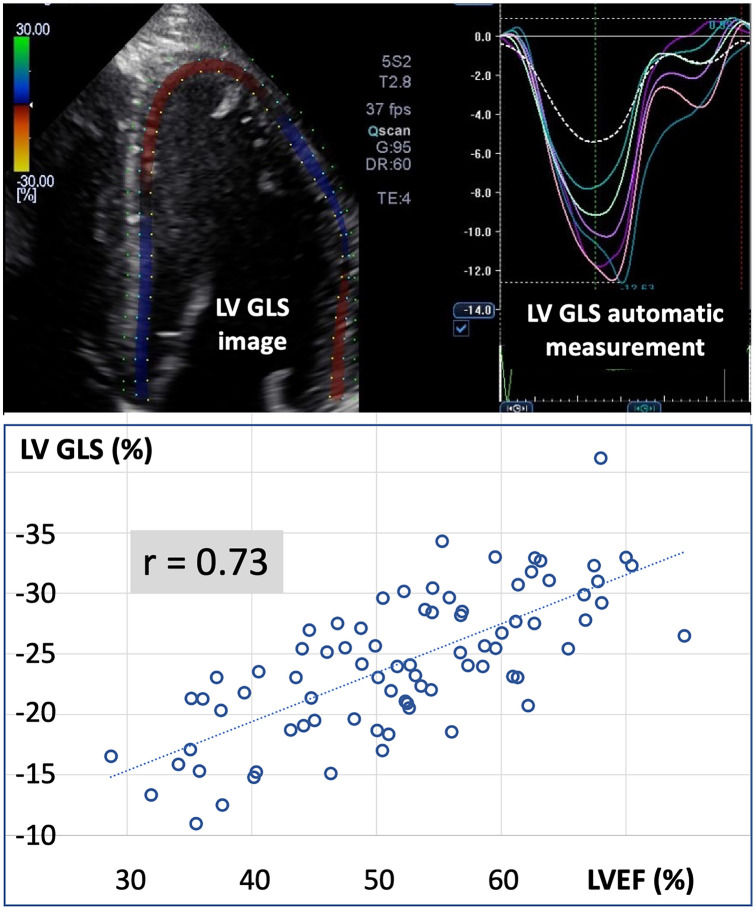
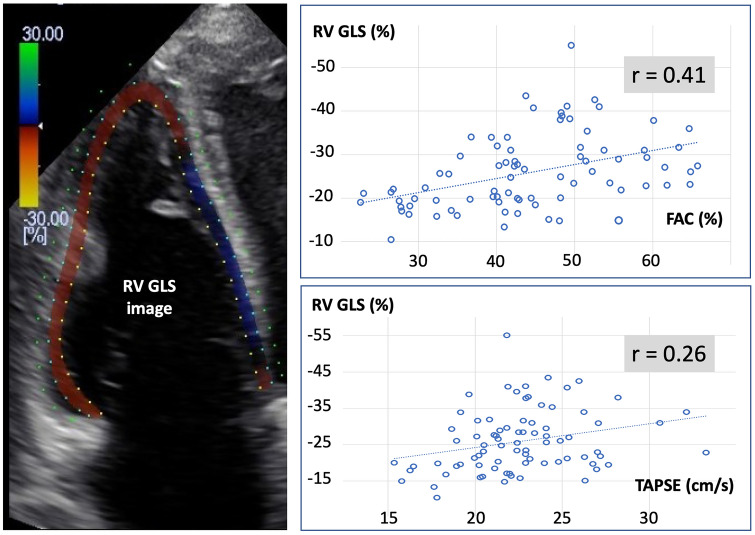
Strain echocardiography enables the automatic quantification of the global longitudinal strain (GLS), which is a direct measure of ventricular shortening during systole. In the current context of overwhelmed ICUs and clinician shortage, GLS has the advantage to be quick and easy to measure by non-experts. However, little is known regarding its value to assess bi-ventricular systolic function in critically ill COVID-19 patients. Therefore, we designed a study to compare right and left ventricular GLS with classic echo-Doppler indices of systolic function, namely the ejection fraction for the left ventricle (LVEF) and the fractional area change (FAC), the tricuspid annular plane systolic excursion (TAPSE), and the tissue Doppler velocity of the basal free lateral wall (S') for the right ventricle. Eighty transthoracic echocardiographic evaluations done in 30 ICU patients with COVID-19 were analyzed. We observed a fair relationship (r = 0.73, p < 0.01) between LVEF and left ventricular GLS. The GLS cut-off value of - 22% identified a LVEF < 50% with a sensitivity of 63% and a specificity of 80%. All patients with a GLS > - 17% had a LVEF < 50%. Although statistically significant, relationships between FAC (r = 0.41, p < 0.01), TAPSE (r = 0.26, p < 0.05) and right ventricular GLS were weak. S' was not correlated with right ventricular GLS. In conclusion, left ventricular GLS was useful to assess left ventricular systolic function. However, right ventricular GLS was poorly correlated with FAC, TAPSE and S'. Further studies are needed to clarify what is the best method to assess right ventricular systolic function in ICU patients with COVID-19.
应变超声心动图能够自动量化整体纵向应变(GLS),这是心室在收缩期缩短的直接测量指标。在当前 ICU 人满为患和临床医生短缺的情况下,GLS 的优势在于非专业人员可以快速、轻松地测量。然而,对于评估 COVID-19 危重症患者的双心室收缩功能,其价值知之甚少。因此,我们设计了一项研究,比较右心室和左心室 GLS 与经典超声心动图收缩功能指标,即左心室射血分数(LVEF)和左心室的分数面积变化(FAC)、三尖瓣环平面收缩期位移(TAPSE)和右心室基底部游离侧壁的组织多普勒速度(S')。对 30 例 COVID-19 危重症患者的 80 次经胸超声心动图评估进行了分析。我们观察到 LVEF 与左心室 GLS 之间存在良好的相关性(r = 0.73,p < 0.01)。GLS 截断值为-22%时,LVEF<50%的灵敏度为 63%,特异性为 80%。所有 GLS > -17%的患者 LVEF<50%。尽管具有统计学意义,但 FAC(r = 0.41,p < 0.01)和 TAPSE(r = 0.26,p < 0.05)与右心室 GLS 之间的关系较弱。S'与右心室 GLS 不相关。总之,左心室 GLS 有助于评估左心室收缩功能。然而,右心室 GLS 与 FAC、TAPSE 和 S'相关性较差。需要进一步的研究来阐明在 COVID-19 危重症患者中评估右心室收缩功能的最佳方法。