Strober Bruce, Kotowsky Nirali, Medeiros Rose, Mackey Rachel H, Harrold Leslie R, Valdecantos Wendell C, Flack Mary, Golembesky Amanda K, Lebwohl Mark
Yale University, New Haven, CT, USA.
Central Connecticut Dermatology Research, Cromwell, CT, USA.
Dermatol Ther (Heidelb). 2021 Apr;11(2):529-541. doi: 10.1007/s13555-021-00493-0. Epub 2021 Feb 27.
Generalized pustular psoriasis (GPP) is a rare, severe, and potentially life-threatening systemic and chronic autoinflammatory disease characterized by sterile, neutrophilic pustules. The standard of care for GPP varies by region, with limited information and experience of flares and their treatment. Our aim was to establish current unmet needs in GPP by better understanding the natural history of GPP, examining how dermatologists diagnose GPP and GPP flares, and establishing the range and adequacy of GPP treatment options currently prescribed by dermatologists.
Eligible dermatologists (N = 29) completed a 28-question structured survey, covering ten themes, ranging from GPP diagnostic criteria to GPP symptoms and treatment.
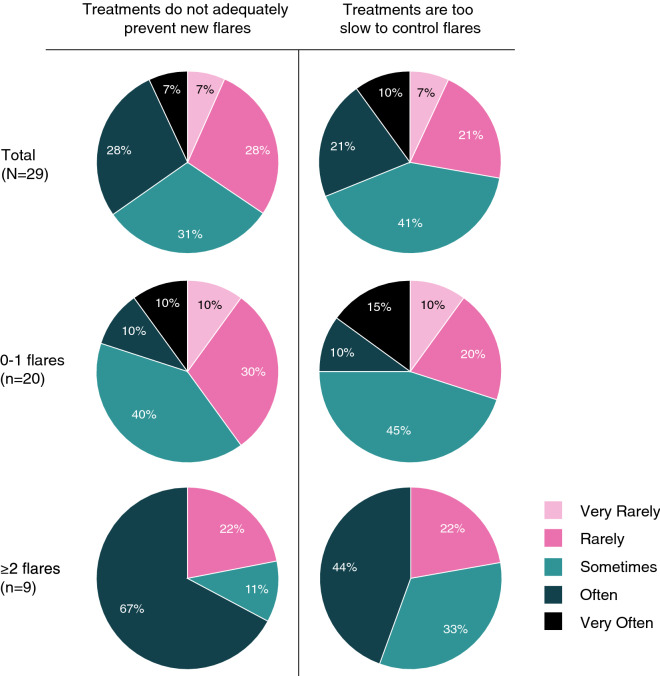
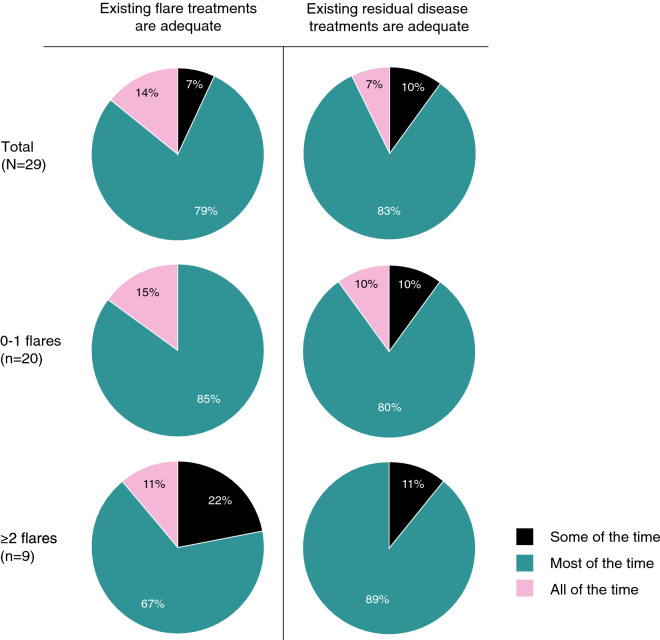
All dermatologists stated that pustules were necessary to diagnose a GPP flare. The most frequently reported triggering factors for GPP were steroid withdrawal (64%), infection (58%), and stress (50%). Most dermatologists indicated that available treatment options for GPP flares were adequate "most" (79%) or "all" (14%) of the time. Despite this reported adequacy, 38% of dermatologists reported that it was at least "somewhat common" for a flare to require hospitalization. Furthermore, 72% of dermatologists indicated that treatments were too slow to control flares, and 66% indicated that treatments did not adequately prevent new flares at least "sometimes".
This survey suggests that there are key features of GPP flares, and could initiate discussion around forming consensus guidelines for diagnosis and management. While the results suggest that moderately effective therapies may exist, the need for GPP-specific treatments remains.
泛发性脓疱型银屑病(GPP)是一种罕见、严重且可能危及生命的全身性慢性自身炎症性疾病,其特征为无菌性中性粒细胞脓疱。GPP的治疗标准因地区而异,关于病情发作及其治疗的信息和经验有限。我们的目的是通过更好地了解GPP的自然病史、研究皮肤科医生如何诊断GPP和GPP病情发作,并确定皮肤科医生目前开出的GPP治疗方案的范围和充分性,来确定GPP当前未满足的需求。
符合条件的皮肤科医生(N = 29)完成了一项包含28个问题的结构化调查,涵盖从GPP诊断标准到GPP症状及治疗等十个主题。
所有皮肤科医生均表示脓疱是诊断GPP病情发作的必要条件。GPP最常报告的触发因素是类固醇撤药(64%)、感染(58%)和压力(50%)。大多数皮肤科医生表示,GPP病情发作的现有治疗方案在“大多数”(79%)或“所有”(14%)时间内是足够的。尽管报告了这种充分性,但38%的皮肤科医生报告说病情发作需要住院治疗至少“有些常见”。此外,72%的皮肤科医生表示治疗控制病情发作的速度太慢,66%的医生表示治疗至少“有时”不能充分预防新的病情发作。
这项调查表明GPP病情发作有关键特征,并可引发围绕制定诊断和管理共识指南的讨论。虽然结果表明可能存在中等疗效的疗法,但对GPP特异性治疗的需求仍然存在。