School of Biomolecular Science and Engineering (BSE), Vidyasirimedhi Institute of Science and Technology (VISTEC), Rayong, Thailand; School of Chemistry, Institute of Science, The Suranaree University of Technology (SUT), Nakhon Ratchasima, Thailand.
School of Biomolecular Science and Engineering (BSE), Vidyasirimedhi Institute of Science and Technology (VISTEC), Rayong, Thailand.
J Biol Chem. 2021 Jan-Jun;296:100467. doi: 10.1016/j.jbc.2021.100467. Epub 2021 Feb 25.
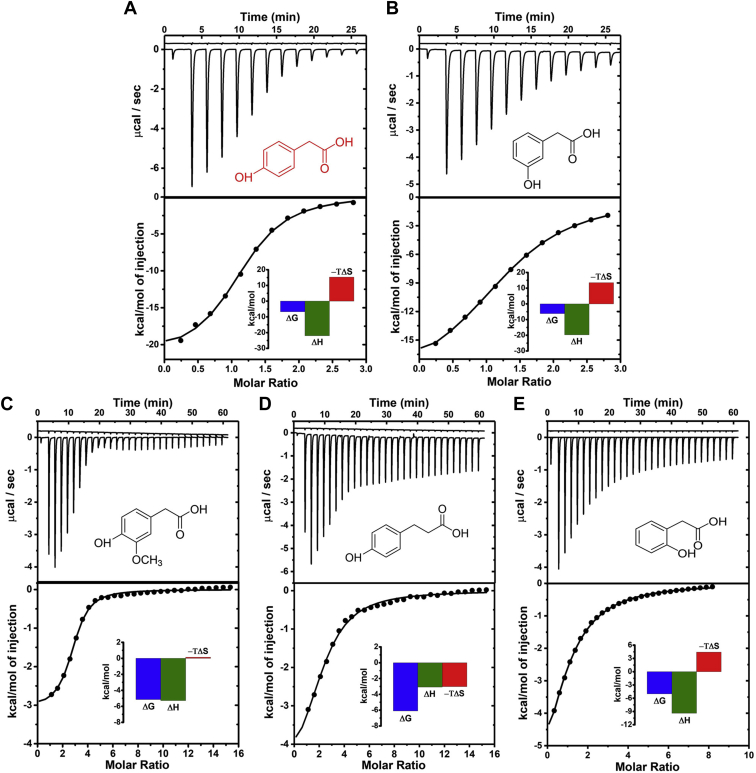
The C1 (reductase) subunit of 4-hydroxy-phenylacetate (4-HPA) 3-hydroxylase (HPAH) from the soil-based bacterium Acinetobacterbaumannii catalyzes NADH oxidation by molecular oxygen, with hydrogen peroxide as a by-product. 4-HPA is a potent allosteric modulator of C1, but also a known urinary biomarker for intestinal bacterial imbalance and for some cancers and brain defects. We thus envisioned that C1 could be used to facilitate 4-HPA detection. The proposed test protocol is simple and in situ and involves addition of NADH to C1 in solution, with or without 4-HPA, and direct acquisition of the HO current with an immersed Prussian Blue-coated screen-printed electrode (PB-SPE) assembly. We confirmed that cathodic HO amperometry at PB-SPEs is a reliable electrochemical assay for intrinsic and allosterically modulated redox enzyme activity. We further validated this approach for quantitative NADH electroanalysis and used it to evaluate the activation of NADH oxidation of C1 by 4-HPA and four other phenols. Using 4-HPA, the most potent effector, allosteric activation of C1 was related to effector concentration by a simple saturation function. The use of C1 for cathodic biosensor analysis of 4-HPA is the basis of the development of a simple and affordable clinical routine for assaying 4-HPA in the urine of patients with a related disease risk. Extension of this principle to work with other allosteric redox enzymes and their effectors is feasible.
土壤细菌鲍曼不动杆菌的 4-羟基苯乙酸(4-HPA)3-羟化酶(HPAH)的 C1(还原酶)亚基催化 NADH 被分子氧氧化,同时产生过氧化氢。4-HPA 是 C1 的有效变构调节剂,但也是肠道细菌失衡以及某些癌症和脑缺陷的已知尿生物标志物。因此,我们设想 C1 可以用于促进 4-HPA 的检测。所提出的测试方案简单且为原位实验,涉及在溶液中向 C1 中添加 NADH,无论是否存在 4-HPA,并直接使用浸入式普鲁士蓝涂层丝网印刷电极(PB-SPE)组件获取 HO 电流。我们证实,PB-SPE 上的阴极 HO 电流安培法是一种可靠的电化学测定法,用于测定固有和变构调节的氧化还原酶活性。我们进一步验证了这种方法用于定量 NADH 电分析,并将其用于评估 4-HPA 和其他四种酚类对 C1 的 NADH 氧化的激活作用。使用 4-HPA(最有效的效应物),C1 的变构激活与效应物浓度之间存在简单的饱和函数关系。C1 用于 4-HPA 在相关疾病风险患者尿液中的检测的阴极生物传感器分析是开发简单且负担得起的临床常规检测方法的基础。将该原理扩展到其他变构氧化还原酶及其效应物的工作是可行的。