Department of Neuromuscular Diseases, University College London Queen Square Institute of Neurology, Queen Square, London, WC1N 3BG, UK; The Francis Crick Institute, 1 Midland Road, London, NW1 1AT, UK.
Department of Neuromuscular Diseases, University College London Queen Square Institute of Neurology, Queen Square, London, WC1N 3BG, UK; The Francis Crick Institute, 1 Midland Road, London, NW1 1AT, UK.
Ageing Res Rev. 2021 May;67:101311. doi: 10.1016/j.arr.2021.101311. Epub 2021 Feb 24.
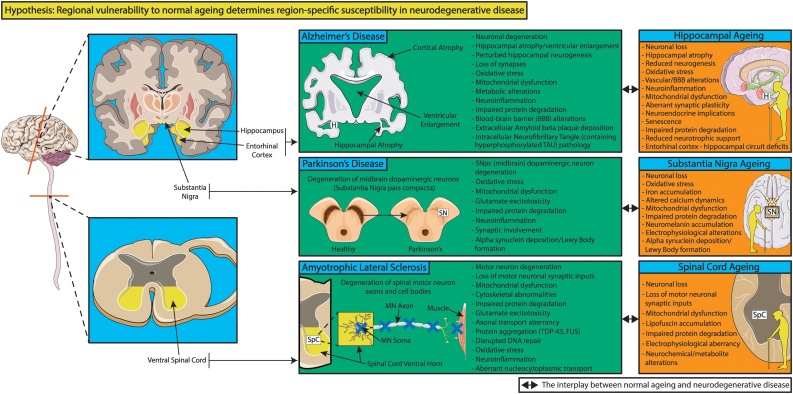
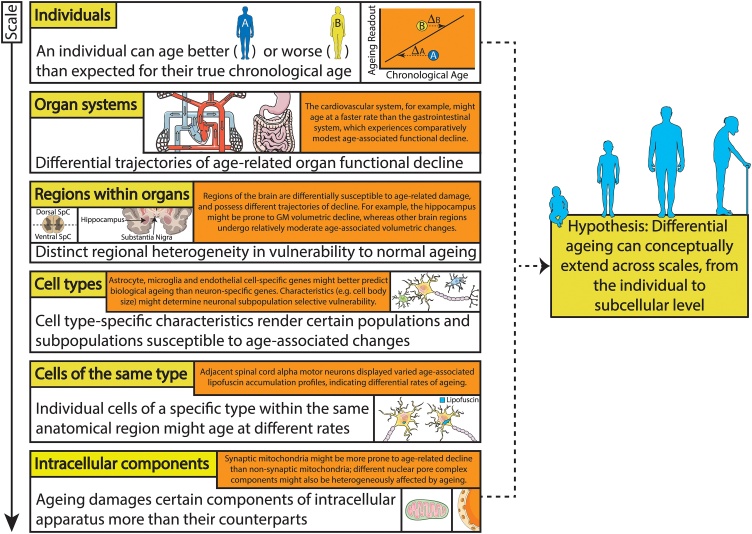
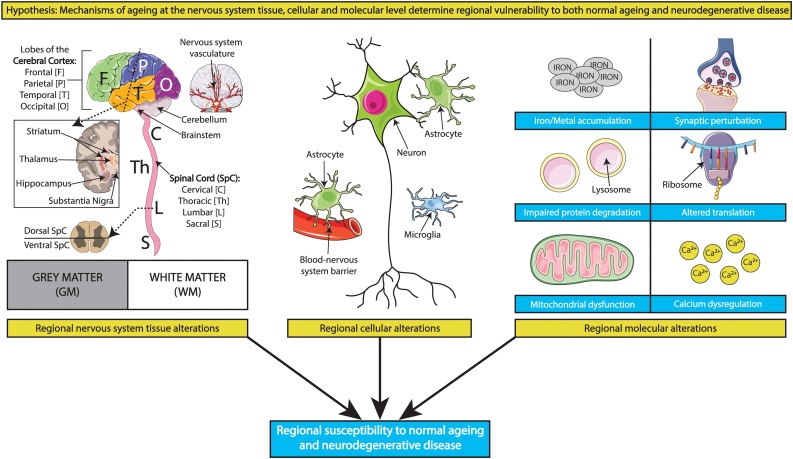
A number of age-associated neurodegenerative diseases, including Alzheimer's disease (AD), Parkinson's disease (PD) and amyotrophic lateral sclerosis (ALS), possess a shared characteristic of region-specific neurodegeneration. However, the mechanisms which determine why particular regions within the nervous system are selectively vulnerable to neurodegeneration, whilst others remain relatively unaffected throughout disease progression, remain elusive. Here, we review how regional susceptibility to the ubiquitous physiological phenomenon of normal ageing might underlie the vulnerability of these same regions to neurodegeneration, highlighting three regions archetypally associated with AD, PD and ALS (the hippocampus, substantia nigra pars compacta and ventral spinal cord, respectively), as especially prone to age-related alterations. Placing particular emphasis on these three regions, we comprehensively explore differential regional susceptibility to nervous system tissue, cellular and molecular level ageing to provide an integrated perspective on why age-related neurodegenerative diseases exhibit region-selective vulnerability. Combining these principles with increasingly recognised differences between chronological and biological ageing (termed differential or 'delta' ageing) might ultimately guide therapeutic approaches for these devastating neurodegenerative diseases, for which a paucity of disease modifying and/or life promoting treatments currently exist.
许多与年龄相关的神经退行性疾病,包括阿尔茨海默病(AD)、帕金森病(PD)和肌萎缩侧索硬化症(ALS),都具有区域特异性神经退行性变的共同特征。然而,决定为什么神经系统内的特定区域易受神经退行性变影响,而其他区域在疾病进展过程中相对不受影响的机制仍不清楚。在这里,我们回顾了普遍存在的正常衰老的生理现象如何导致这些相同区域对神经退行性变的易感性,强调了与 AD、PD 和 ALS 典型相关的三个区域(分别是海马体、黑质致密部和腹侧脊髓)特别容易受到与年龄相关的改变。特别强调这三个区域,我们全面探讨了神经系统组织、细胞和分子水平衰老的差异区域易感性,为为什么与年龄相关的神经退行性疾病表现出区域选择性易感性提供了综合观点。将这些原则与日益认识到的生物钟和生物学年龄之间的差异(称为差异或“δ”年龄)相结合,最终可能会为这些破坏性神经退行性疾病的治疗方法提供指导,目前这些疾病缺乏改变疾病和/或促进生命的治疗方法。