Department of Nutrition and Dietetics, College of Health Sciences, Mekelle University, Mekelle, Ethiopia.
Department of Statistics, College of Natural Sciences, Salale University, Fitche, Oromia, Ethiopia.
Nutr J. 2021 Feb 27;20(1):18. doi: 10.1186/s12937-021-00677-6.
Stunting or chronic undernutrition is a significant public health problem in Ethiopia. In 2019, 37% of Ethiopian children under-5 were stunted. Stunting results from a complex interaction of individual, household and social (environmental) factors. Improving the mother's overall care is the most important determinant in reducing the stunting levels in developing countries. We aimed to determine the most important maternal factors associated with stunting and quantify their effects.
This study used data from the nationally representative 2016 Ethiopian Demographic Health Survey (EDHS). Common maternal factors were first selected and analyzed using Pearson's chi-square of association followed by multiple logistic regression. To quantify the effect of a unit change of a predictor variable a model for the continuous maternal factors was developed. All analyses were carried out using IBM SPSS© Version 23.
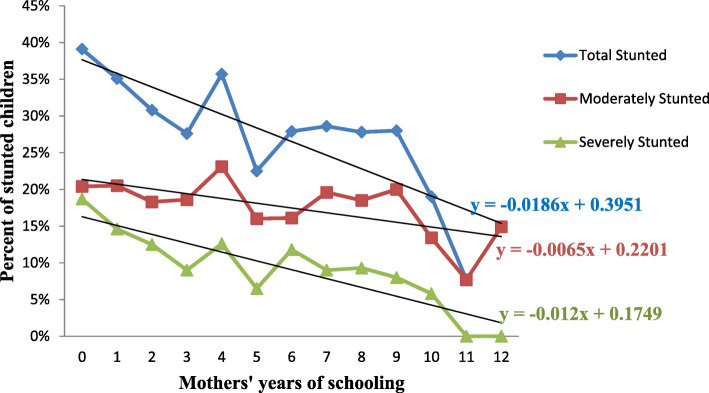
Higher maternal educational level, better maternal autonomy, average or above maternal height and weight, having at least 4 antenatal care (ANC) clinic visits, and delivering in a health facility were significantly associated with lower severe stunting levels. Unemployed mothers were 23% less likely (p = 0.003) to have a stunted child compared with employed mothers. Mothers delivering at home had 32% higher odds of stunting (p = 0.002). We found that short mothers (< 150 cm) were 2.5 more likely to have stunted children when compared with mothers above 160 cm. Every visit to the ANC clinic reduces stunting odds by 6.8% (p < 0.0001). The odds of stunting were reduced by 7% (p = 0.028) for every grade a girl spent in school. A unit increase in Body Mass Index (BMI) reduced the odds of stunting by 4% (p = 0.014) and every centimeter increase in maternal height reduced the odds of stunting by 0.5% (p = 0.01).
Maternal education, number of antenatal care visits, and place of delivery appear to be the most important predictors of child stunting in Ethiopia.. Therefore, educating and empowering women, improving access to family planning and ANC services, and addressing maternal malnutrition are important factors that should be included in policies aiming to reduce childhood stunting in Ethiopia.
发育迟缓或慢性营养不良是埃塞俄比亚的一个重大公共卫生问题。2019 年,埃塞俄比亚 5 岁以下儿童中有 37%发育迟缓。发育迟缓是个人、家庭和社会(环境)因素复杂相互作用的结果。改善母亲的整体护理是降低发展中国家发育迟缓水平的最重要决定因素。我们旨在确定与发育迟缓相关的最重要的产妇因素,并量化其影响。
本研究使用了全国代表性的 2016 年埃塞俄比亚人口与健康调查(EDHS)的数据。首先选择常见的产妇因素,并使用 Pearson 关联卡方分析,然后进行多因素逻辑回归分析。为了量化预测变量单位变化的影响,建立了一个连续产妇因素的模型。所有分析均使用 IBM SPSS© Version 23 进行。
较高的母亲教育水平、较好的母亲自主权、平均或以上的母亲身高和体重、至少进行 4 次产前保健(ANC)诊所就诊,以及在医疗机构分娩与较低的严重发育迟缓水平显著相关。与就业母亲相比,失业母亲的孩子发育迟缓的可能性低 23%(p=0.003)。在家分娩的母亲发育迟缓的可能性高 32%(p=0.002)。我们发现,与身高超过 160 厘米的母亲相比,身高不足 150 厘米的母亲生育发育迟缓儿童的可能性高 2.5 倍。每次去 ANC 诊所就诊,发育迟缓的几率就会降低 6.8%(p<0.0001)。女孩每上一个年级,发育迟缓的几率就会降低 7%(p=0.028)。体重指数(BMI)每增加一个单位,发育迟缓的几率就会降低 4%(p=0.014),母亲身高每增加 1 厘米,发育迟缓的几率就会降低 0.5%(p=0.01)。
母亲的教育程度、产前保健就诊次数和分娩地点似乎是埃塞俄比亚儿童发育迟缓的最重要预测因素。因此,教育和赋权妇女、改善计划生育和 ANC 服务的获取途径,以及解决产妇营养不良,是旨在减少埃塞俄比亚儿童发育迟缓的政策中应包含的重要因素。