• 文献检索
  • 文档翻译
  • 深度研究
  • 学术资讯
  • Suppr Zotero 插件Zotero 插件
  • 邀请有礼
  • 套餐&价格
  • 历史记录
应用&插件
Suppr Zotero 插件Zotero 插件浏览器插件Mac 客户端Windows 客户端微信小程序
定价
高级版会员购买积分包购买API积分包
服务
文献检索文档翻译深度研究API 文档MCP 服务
关于我们
关于 Suppr公司介绍联系我们用户协议隐私条款
关注我们

Suppr 超能文献

核心技术专利:CN118964589B侵权必究
粤ICP备2023148730 号-1Suppr @ 2026

文献检索

告别复杂PubMed语法,用中文像聊天一样搜索,搜遍4000万医学文献。AI智能推荐,让科研检索更轻松。

立即免费搜索

文件翻译

保留排版,准确专业,支持PDF/Word/PPT等文件格式,支持 12+语言互译。

免费翻译文档

深度研究

AI帮你快速写综述,25分钟生成高质量综述,智能提取关键信息,辅助科研写作。

立即免费体验

探索埃塞俄比亚儿童发育迟缓的空间差异及相关因素:空间和多水平分析

Exploring spatial variations and factors associated with childhood stunting in Ethiopia: spatial and multilevel analysis.

作者信息

Haile Demewoz, Azage Muluken, Mola Tegegn, Rainey Rochelle

机构信息

Department of Public Health, College of Medicine and Health Sciences, Bahir Dar University, P.O. Box 79, Bahir Dar, Ethiopia.

Department of Geography and Environmental Studies, Bahir Dar University, P.O. Box 79, Bahir Dar, Ethiopia.

出版信息

BMC Pediatr. 2016 Apr 15;16:49. doi: 10.1186/s12887-016-0587-9.

DOI:10.1186/s12887-016-0587-9
PMID:27084512
原文链接:https://pmc.ncbi.nlm.nih.gov/articles/PMC4833938/
Abstract

BACKGROUND

Stunting reflects a failure to receive adequate nutrition over a long period of time. Stunting is associated with adverse functional consequences including poor cognition, low educational performance, low adult wages, and poor reproductive outcomes. The objective of the study was to investigate spatial variations and factors associated with childhood stunting in Ethiopia.

METHODS

This study is a secondary data analysis of the 2011 Ethiopian Demographic and Health Survey (EDHS). A total of 9893 children aged 0-59 months were included in the analysis. The Getis-Ord spatial statistical tool was used to identify high and low hotspots areas of stunting. A multilevel multivariable logistic regression was used to identify factors associated with stunting.

RESULTS

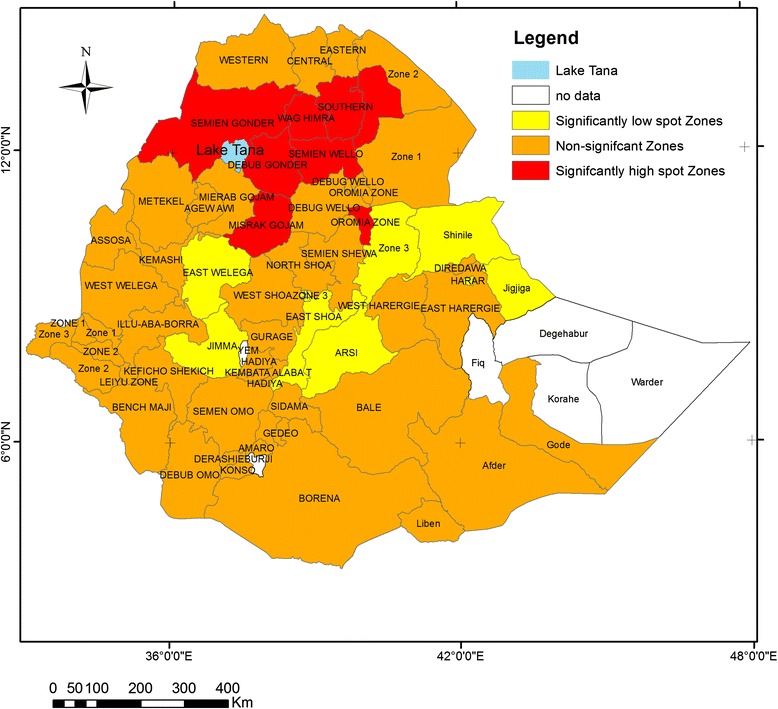
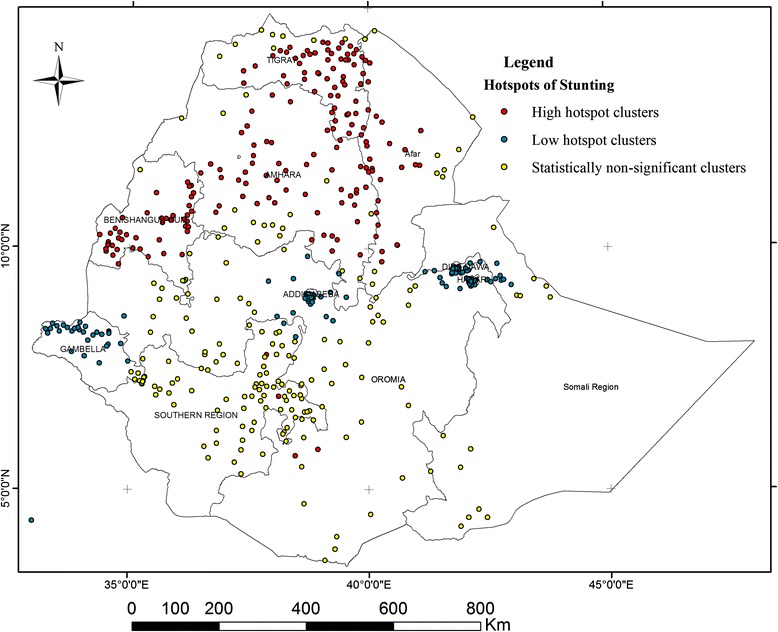
Statistically significant hotspots of stunting were found in northern parts of the country whereas low hotspots where there was less stunting than expected were found in the central, eastern, and western parts of the country. In the final model of multilevel logistic regression analysis, individual and community level factors accounted for 36.6 % of childhood stunting. Short birth interval [AOR = 1.68; 95%CI: (1.46-1.93)], being male [AOR = 1.20; 95%CI: (1.08-1.33)], and being from a male-headed household [AOR = 1.18; 95 % CI: (1.01-1.38)] were the factors that increased the odds of stunting at the individual level. Children in the age group between 24-35 months were more likely to be stunted than children whose age was less than one year [AOR = 6.61; 95 % CI: (5.17-8.44)]. The odds of stunting among children with severe anemia were higher than children with no anemia [AOR = 3.23; 95%CI: (2.35-4.43)]. Children with mothers who had completed higher education had lower odds of being stunted compared to children whose mothers had no formal education [AOR = 0.42; 95%CI: (0.18-0.94)]. The odds of being stunted were lower among children whose fathers completed higher education [AOR = 0.58; 95%CI: (0.38-0.89)] compared to children whose fathers had no formal education. Children whose mothers who had high a Body Mass Index (BMI) (≥25.0 kg/m(2)) were less likely to be stunted compared with children whose mothers had a normal BMI (18.5 kg/m(2)-24.9 kg/m(2))[AOR = 0.69; 95%CI: (0.52-0.90)]. Children from the poorest wealth quintile had higher odds of being stunted compared to children from the richest wealth quintiles [AOR = 1.43; 95 % CI: (1.08-1.88)]. Unavailability of improved latrine facilities and living in the northern parts of the country (Tigray, Affar, Amhara and Benishangul-Gumuzregions) were factors associated with higher odds of stunting from the community-level factors.

CONCLUSION

Stunting in children under five years old is not random in Ethiopia, with hotspots of higher stunting in the northern part of Ethiopia. Both individual and community-level factors were significant determinants of childhood stunting. The regions with high hotspots of child stunting should be targeted with additional resources, and the identified factors should be considered for nutritional interventions.
https://cdn.ncbi.nlm.nih.gov/pmc/blobs/6b64/4833938/7abcbfab2b23/12887_2016_587_Fig2_HTML.jpg
https://cdn.ncbi.nlm.nih.gov/pmc/blobs/6b64/4833938/33b58db1d12a/12887_2016_587_Fig1_HTML.jpg
https://cdn.ncbi.nlm.nih.gov/pmc/blobs/6b64/4833938/7abcbfab2b23/12887_2016_587_Fig2_HTML.jpg
https://cdn.ncbi.nlm.nih.gov/pmc/blobs/6b64/4833938/33b58db1d12a/12887_2016_587_Fig1_HTML.jpg
https://cdn.ncbi.nlm.nih.gov/pmc/blobs/6b64/4833938/7abcbfab2b23/12887_2016_587_Fig2_HTML.jpg
摘要

背景

发育迟缓反映了长期未能获得充足营养。发育迟缓与不良功能后果相关,包括认知能力差、教育表现不佳、成年工资低以及生殖结局不良。本研究的目的是调查埃塞俄比亚儿童发育迟缓的空间差异及相关因素。

方法

本研究是对2011年埃塞俄比亚人口与健康调查(EDHS)的二次数据分析。分析共纳入9893名0 - 59个月大的儿童。使用Getis-Ord空间统计工具来识别发育迟缓的高热点和低热点地区。采用多水平多变量逻辑回归来识别与发育迟缓相关的因素。

结果

在该国北部发现了具有统计学意义的发育迟缓热点地区,而在该国中部、东部和西部发现了发育迟缓低于预期的低热点地区。在多水平逻辑回归分析的最终模型中,个体和社区层面的因素占儿童发育迟缓的36.6%。短生育间隔[AOR = 1.68;95%CI:(1.46 - 1.93)]、男性[AOR = 1.20;95%CI:(1.08 - 1.33)]以及来自男性为户主的家庭[AOR = 1.18;95%CI:(1.01 - 1.38)]是在个体层面增加发育迟缓几率的因素。24 - 35个月年龄组的儿童比年龄小于1岁的儿童更易发育迟缓[AOR = 6.61;95%CI:(5.17 - 8.44)]。重度贫血儿童发育迟缓的几率高于无贫血儿童[AOR = 3.23;95%CI:(2.35 - 4.43)]。母亲完成高等教育的儿童发育迟缓的几率低于母亲未接受正规教育的儿童[AOR = 0.42;95%CI:(0.18 - 0.94)]。与父亲未接受正规教育的儿童相比,父亲完成高等教育的儿童发育迟缓的几率较低[AOR = 0.58;95%CI:(0.38 - 0.89)]。与母亲BMI正常(18.5kg/m² - 24.9kg/m²)的儿童相比,母亲BMI高(≥25.0kg/m²)的儿童发育迟缓的可能性较小[AOR = 0.69;95%CI:(0.52 - 0.9)]。与最富裕五分位组的儿童相比,最贫困五分位组的儿童发育迟缓的几率更高[AOR = 1.43;95%CI:(1.08 - 1.88)]。缺乏改良厕所设施以及居住在该国北部(提格雷、阿法尔、阿姆哈拉和本尚古勒 - 古穆兹地区)是社区层面与发育迟缓几率较高相关的因素。

结论

在埃塞俄比亚,五岁以下儿童的发育迟缓并非随机发生,埃塞俄比亚北部发育迟缓情况更为严重。个体和社区层面的因素都是儿童发育迟缓的重要决定因素。发育迟缓高热点地区应获得更多资源,并且在营养干预中应考虑已确定的相关因素。

相似文献

1
Exploring spatial variations and factors associated with childhood stunting in Ethiopia: spatial and multilevel analysis.探索埃塞俄比亚儿童发育迟缓的空间差异及相关因素:空间和多水平分析
BMC Pediatr. 2016 Apr 15;16:49. doi: 10.1186/s12887-016-0587-9.
2
Levels of stunting associated factors among under-five children in Ethiopia: A multi-level ordinal logistic regression analysis.埃塞俄比亚五岁以下儿童发育迟缓相关因素的水平:多水平有序逻辑回归分析。
PLoS One. 2024 Jan 2;19(1):e0296451. doi: 10.1371/journal.pone.0296451. eCollection 2024.
3
Geographical variation in hotspots of stunting among under-five children in Ethiopia: A geographically weighted regression and multilevel robust Poisson regression analysis.埃塞俄比亚五岁以下儿童发育迟缓热点的地理差异:地理加权回归和多层次稳健泊松回归分析。
PLoS One. 2024 May 14;19(5):e0303071. doi: 10.1371/journal.pone.0303071. eCollection 2024.
4
Severe stunting and its associated factors among children aged 6-59 months in Ethiopia; multilevel ordinal logistic regression model.埃塞俄比亚 6-59 月龄儿童严重发育迟缓及其相关因素;多水平有序逻辑回归模型。
Ital J Pediatr. 2021 Jul 26;47(1):161. doi: 10.1186/s13052-021-01110-8.
5
Coexistence of Anaemia and Stunting among Children Aged 6-59 Months in Ethiopia: Findings from the Nationally Representative Cross-Sectional Study.儿童期 6-59 个月贫血和发育迟缓共存:来自全国代表性横断面研究的结果。
Int J Environ Res Public Health. 2023 Jun 29;20(13):6251. doi: 10.3390/ijerph20136251.
6
Determinants of stunting among under-five children in Ethiopia: a multilevel mixed-effects analysis of 2016 Ethiopian demographic and health survey data.埃塞俄比亚五岁以下儿童发育迟缓的决定因素:对 2016 年埃塞俄比亚人口与健康调查数据的多层次混合效应分析。
BMC Pediatr. 2019 Jun 1;19(1):176. doi: 10.1186/s12887-019-1545-0.
7
Geographic weighted regression analysis of hot spots of anemia and its associated factors among children aged 6-59 months in Ethiopia: A geographic weighted regression analysis and multilevel robust Poisson regression analysis.地理加权回归分析埃塞俄比亚 6-59 月龄儿童贫血热点及其相关因素:地理加权回归分析和多层次稳健泊松回归分析。
PLoS One. 2021 Nov 4;16(11):e0259147. doi: 10.1371/journal.pone.0259147. eCollection 2021.
8
Spatial distribution and associated factors of severe malnutrition among under-five children in Ethiopia: further analysis of 2019 mini EDHS.埃塞俄比亚五岁以下儿童严重营养不良的空间分布及其相关因素:2019 年迷你 EDHS 的进一步分析。
BMC Public Health. 2023 Apr 28;23(1):791. doi: 10.1186/s12889-023-15639-2.
9
Spatial distribution of short birth interval and associated factors among reproductive age women in Ethiopia: spatial and multilevel analysis of 2019 Ethiopian mini demographic and health survey.埃塞俄比亚育龄妇女短生育间隔的空间分布及其影响因素:2019 年埃塞俄比亚迷你人口与健康调查的空间和多水平分析。
BMC Pregnancy Childbirth. 2023 Apr 22;23(1):275. doi: 10.1186/s12884-023-05610-9.
10
Spatial heterogeneity and factors influencing stunting and severe stunting among under-5 children in Ethiopia: spatial and multilevel analysis.埃塞俄比亚五岁以下儿童发育迟缓与重度发育迟缓的空间异质性及其影响因素:空间和多层次分析。
Sci Rep. 2020 Oct 2;10(1):16427. doi: 10.1038/s41598-020-73572-5.

引用本文的文献

1
Factors associated with childhood undernutrition in poor Ethiopian households: Implications for public health interventions.埃塞俄比亚贫困家庭中与儿童营养不良相关的因素:对公共卫生干预措施的启示
PLoS One. 2025 May 9;20(5):e0323332. doi: 10.1371/journal.pone.0323332. eCollection 2025.
2
Spatio-temporal variation of child stunting and associated risk factors in Rwanda.卢旺达儿童发育迟缓的时空变化及相关风险因素
BMC Public Health. 2025 Mar 29;25(1):1195. doi: 10.1186/s12889-025-22335-w.
3
Development of a diagnostic predictive model for determining child stunting in Malawi: a comparative analysis of variable selection approaches.

本文引用的文献

1
Climate change, crop production and child under nutrition in Ethiopia; a longitudinal panel study.埃塞俄比亚的气候变化、作物生产与儿童营养不良;一项纵向面板研究。
BMC Public Health. 2014 Aug 27;14:884. doi: 10.1186/1471-2458-14-884.
2
Determinants of stunting and overweight among young children and adolescents in sub-Saharan Africa.撒哈拉以南非洲地区幼儿和青少年发育迟缓与超重的决定因素。
Food Nutr Bull. 2014 Jun;35(2):167-78. doi: 10.1177/156482651403500203.
3
Association of maternal and child nutritional status in Brazil: a population based cross-sectional study.
开发马拉维儿童发育迟缓诊断预测模型:变量选择方法的比较分析。
BMC Med Res Methodol. 2024 Aug 8;24(1):175. doi: 10.1186/s12874-024-02283-6.
4
Epidemiology of stunting in children aged 6-59 months, an unresolved chronic nutritional problem in Ethiopia: A systematic review and meta-analysis.埃塞俄比亚6至59个月儿童发育迟缓的流行病学:一个尚未解决的慢性营养问题——系统评价与荟萃分析
SAGE Open Med. 2024 Jun 13;12:20503121241259862. doi: 10.1177/20503121241259862. eCollection 2024.
5
Determinants of aggregate anthropometric failure among children under-five years in Ethiopia: Application of multilevel mixed-effects negative binomial regression modeling.埃塞俄比亚五岁以下儿童总体人体测量失败的决定因素:多层次混合效应负二项回归模型的应用
PLOS Glob Public Health. 2024 Jun 4;4(6):e0003305. doi: 10.1371/journal.pgph.0003305. eCollection 2024.
6
Geographical variation in hotspots of stunting among under-five children in Ethiopia: A geographically weighted regression and multilevel robust Poisson regression analysis.埃塞俄比亚五岁以下儿童发育迟缓热点的地理差异:地理加权回归和多层次稳健泊松回归分析。
PLoS One. 2024 May 14;19(5):e0303071. doi: 10.1371/journal.pone.0303071. eCollection 2024.
7
Anthropometric failures and its predictors among under five children in Ethiopia: multilevel logistic regression model using 2019 Ethiopian demographic and health survey data.埃塞俄比亚五岁以下儿童的人体测量失败情况及其预测因素:使用2019年埃塞俄比亚人口与健康调查数据的多水平逻辑回归模型
BMC Public Health. 2024 Apr 24;24(1):1149. doi: 10.1186/s12889-024-18625-4.
8
Childhood stunting is highly clustered in Northern Province of Rwanda: A spatial analysis of a population-based study.儿童发育迟缓在卢旺达北部省高度聚集:一项基于人群研究的空间分析。
Heliyon. 2024 Jan 19;10(2):e24922. doi: 10.1016/j.heliyon.2024.e24922. eCollection 2024 Jan 30.
9
Levels of stunting associated factors among under-five children in Ethiopia: A multi-level ordinal logistic regression analysis.埃塞俄比亚五岁以下儿童发育迟缓相关因素的水平:多水平有序逻辑回归分析。
PLoS One. 2024 Jan 2;19(1):e0296451. doi: 10.1371/journal.pone.0296451. eCollection 2024.
10
Bayesian multilevel modelling of the association between socio-economic status and stunting among under-five-year children in Tanzania.贝叶斯多层次模型分析坦桑尼亚五岁以下儿童社会经济地位与发育迟缓之间的关系。
J Health Popul Nutr. 2023 Nov 29;42(1):135. doi: 10.1186/s41043-023-00474-3.
巴西母婴营养状况的关联:一项基于人群的横断面研究。
PLoS One. 2014 Jan 24;9(1):e87486. doi: 10.1371/journal.pone.0087486. eCollection 2014.
4
Understanding child stunting in India: a comprehensive analysis of socio-economic, nutritional and environmental determinants using additive quantile regression.了解印度儿童发育迟缓问题:运用加法分位数回归对社会经济、营养和环境决定因素进行综合分析。
PLoS One. 2013 Nov 4;8(11):e78692. doi: 10.1371/journal.pone.0078692. eCollection 2013.
5
Contextualising complementary feeding in a broader framework for stunting prevention.将补充喂养置于更广泛的发育迟缓预防框架中。
Matern Child Nutr. 2013 Sep;9 Suppl 2(Suppl 2):27-45. doi: 10.1111/mcn.12088.
6
Maternal and child undernutrition and overweight in low-income and middle-income countries.中低收入国家的母婴营养不足和超重问题。
Lancet. 2013 Aug 3;382(9890):427-451. doi: 10.1016/S0140-6736(13)60937-X. Epub 2013 Jun 6.
7
Determinants of reduced child stunting in Cambodia: analysis of pooled data from three demographic and health surveys.柬埔寨儿童发育迟缓减少的决定因素:三项人口与健康调查汇总数据的分析。
Bull World Health Organ. 2013 May 1;91(5):341-9. doi: 10.2471/BLT.12.113381. Epub 2013 Feb 19.
8
Household environmental conditions are associated with enteropathy and impaired growth in rural Bangladesh.家庭环境条件与孟加拉国农村地区的肠病和生长受损有关。
Am J Trop Med Hyg. 2013 Jul;89(1):130-137. doi: 10.4269/ajtmh.12-0629. Epub 2013 Apr 29.
9
Exploring variations in childhood stunting in Nigeria using league table, control chart and spatial analysis.利用排行榜、控制图和空间分析方法探索尼日利亚儿童发育迟缓的变化情况。
BMC Public Health. 2013 Apr 18;13:361. doi: 10.1186/1471-2458-13-361.
10
Trends and determinants of undernutrition among young Kenyan children: Kenya Demographic and Health Survey; 1993, 1998, 2003 and 2008-2009.肯尼亚年轻儿童营养不良的趋势和决定因素:肯尼亚人口与健康调查;1993 年、1998 年、2003 年和 2008-2009 年。
Public Health Nutr. 2012 Sep;15(9):1715-27. doi: 10.1017/S1368980012002856. Epub 2012 Jun 14.