Section of Adult Infectious Disease, Department of Infectious Disease, Faculty of Medicine, Imperial College London, London, UK; Department of Social Medicine, Hatyai Hospital, Songkhla, Thailand.
Section of Adult Infectious Disease, Department of Infectious Disease, Faculty of Medicine, Imperial College London, London, UK.
Lancet Infect Dis. 2021 Jul;21(7):1014-1026. doi: 10.1016/S1473-3099(20)30601-0. Epub 2021 Feb 25.
The ability to accurately predict early progression of dengue to severe disease is crucial for patient triage and clinical management. Previous systematic reviews and meta-analyses have found significant heterogeneity in predictors of severe disease due to large variation in these factors during the time course of the illness. We aimed to identify factors associated with progression to severe dengue disease that are detectable specifically in the febrile phase.
We did a systematic review and meta-analysis to identify predictors identifiable during the febrile phase associated with progression to severe disease defined according to WHO criteria. Eight medical databases were searched for studies published from Jan 1, 1997, to Jan 31, 2020. Original clinical studies in English assessing the association of factors detected during the febrile phase with progression to severe dengue were selected and assessed by three reviewers, with discrepancies resolved by consensus. Meta-analyses were done using random-effects models to estimate pooled effect sizes. Only predictors reported in at least four studies were included in the meta-analyses. Heterogeneity was assessed using the Cochrane Q and I statistics, and publication bias was assessed by Egger's test. We did subgroup analyses of studies with children and adults. The study is registered with PROSPERO, CRD42018093363.
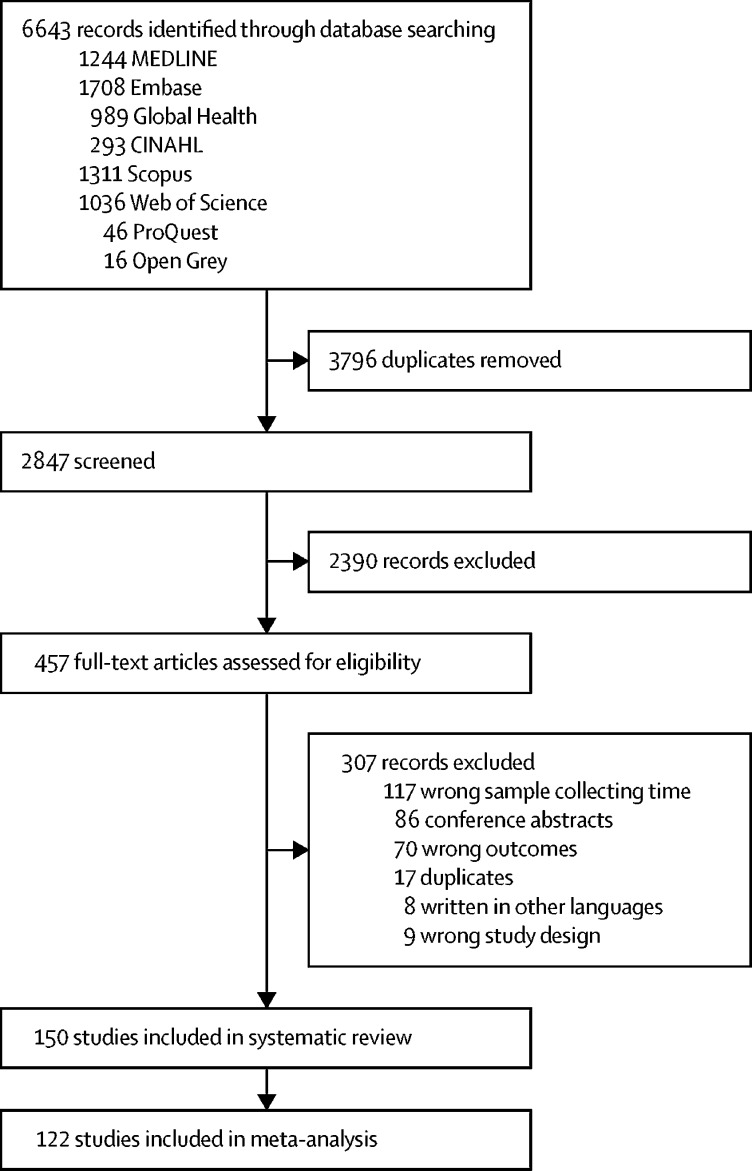
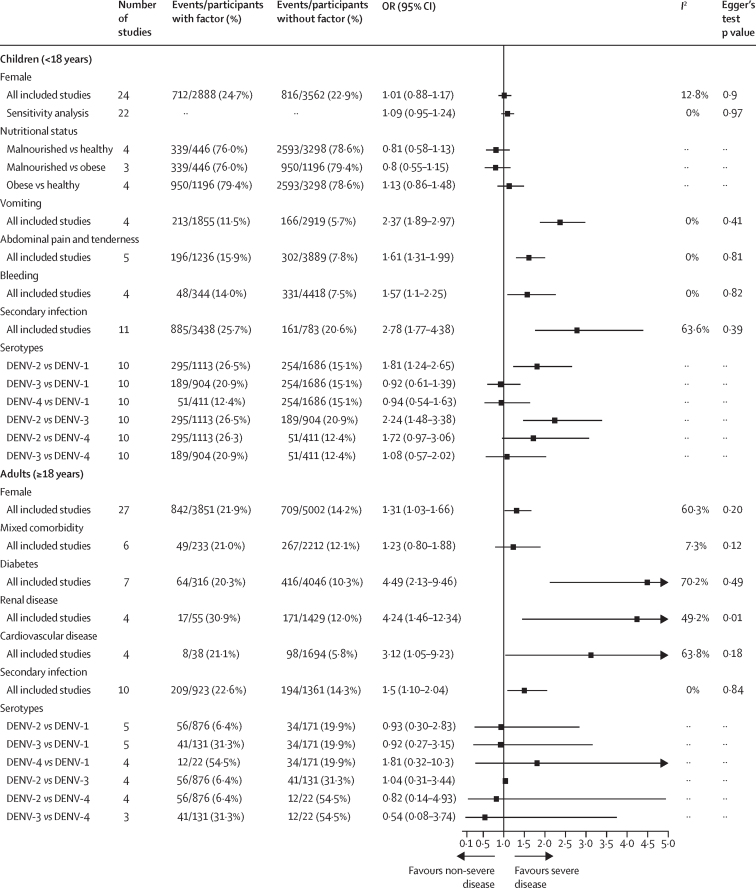
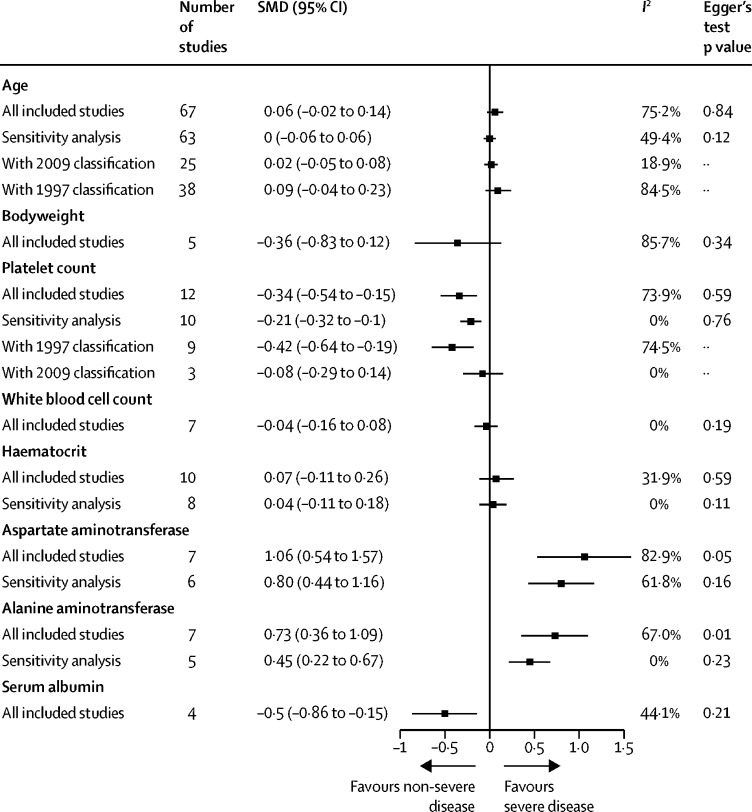
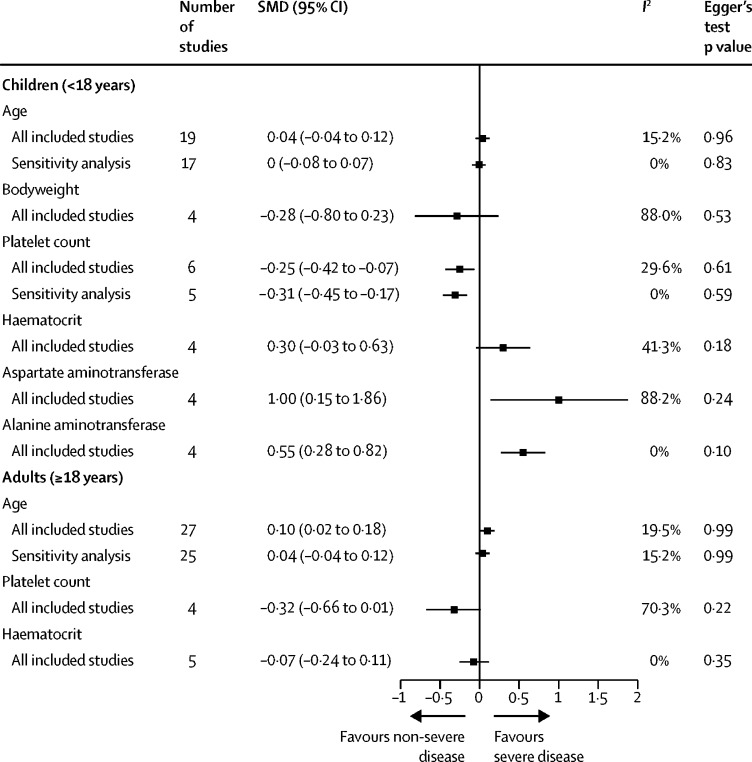
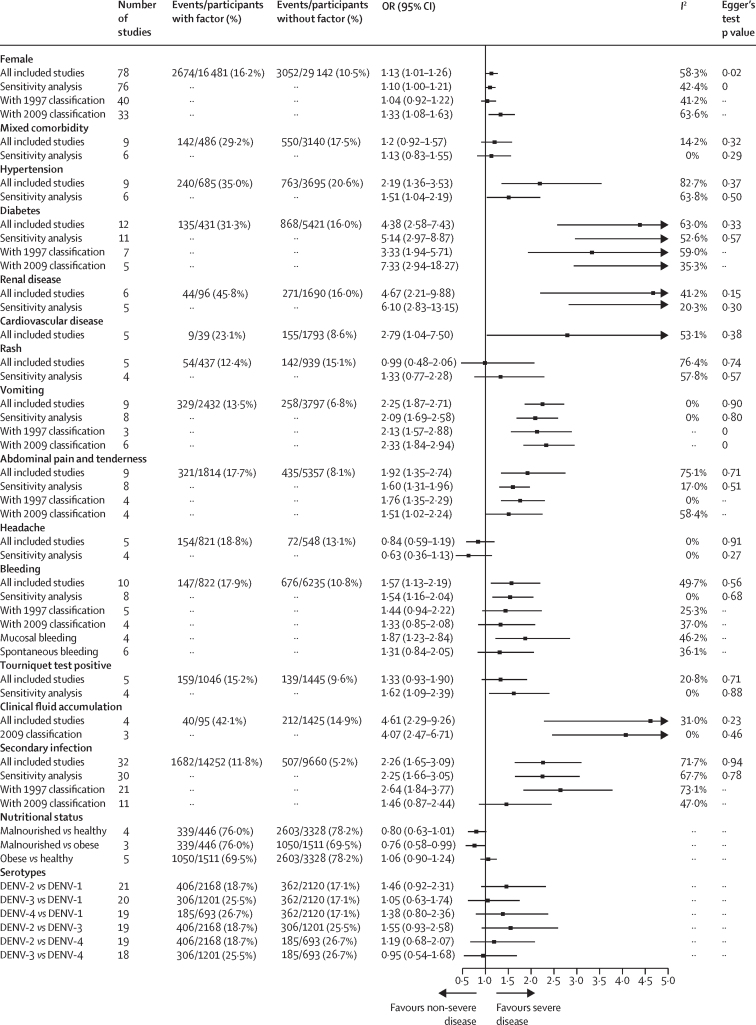
Of 6643 studies identified, 150 articles were included in the systematic review, and 122 articles comprising 25 potential predictors were included in the meta-analyses. Female patients had a higher risk of severe dengue than male patients in the main analysis (2674 [16·2%] of 16 481 vs 3052 [10·5%] of 29 142; odds ratio [OR] 1·13 [95% CI 1·01-1·26) but not in the subgroup analysis of studies with children. Pre-existing comorbidities associated with severe disease were diabetes (135 [31·3%] of 431 with vs 868 [16·0%] of 5421 without; crude OR 4·38 [2·58-7·43]), hypertension (240 [35·0%] of 685 vs 763 [20·6%] of 3695; 2·19 [1·36-3·53]), renal disease (44 [45·8%] of 96 vs 271 [16·0%] of 1690; 4·67 [2·21-9·88]), and cardiovascular disease (nine [23·1%] of 39 vs 155 [8·6%] of 1793; 2·79 [1·04-7·50]). Clinical features during the febrile phase associated with progression to severe disease were vomiting (329 [13·5%] of 2432 with vs 258 [6·8%] of 3797 without; 2·25 [1·87-2·71]), abdominal pain and tenderness (321 [17·7%] of 1814 vs 435 [8·1%] of 5357; 1·92 [1·35-2·74]), spontaneous or mucosal bleeding (147 [17·9%] of 822 vs 676 [10·8%] of 6235; 1·57 [1·13-2·19]), and the presence of clinical fluid accumulation (40 [42·1%] of 95 vs 212 [14·9%] of 1425; 4·61 [2·29-9·26]). During the first 4 days of illness, platelet count was lower (standardised mean difference -0·34 [95% CI -0·54 to -0·15]), serum albumin was lower (-0·5 [-0·86 to -0·15]), and aminotransferase concentrations were higher (aspartate aminotransferase [AST] 1·06 [0·54 to 1·57] and alanine aminotransferase [ALT] 0·73 [0·36 to 1·09]) among individuals who progressed to severe disease. Dengue virus serotype 2 was associated with severe disease in children. Secondary infections (vs primary infections) were also associated with severe disease (1682 [11·8%] of 14 252 with vs 507 [5·2%] of 9660 without; OR 2·26 [95% CI 1·65-3·09]). Although the included studies had a moderate to high risk of bias in terms of study confounding, the risk of bias was low to moderate in other domains. Heterogeneity of the pooled results varied from low to high on different factors.
This analysis supports monitoring of the warning signs described in the 2009 WHO guidelines on dengue. In addition, testing for infecting serotype and monitoring platelet count and serum albumin, AST, and ALT concentrations during the febrile phase of illness could improve the early prediction of severe dengue.
Wellcome Trust, National Institute for Health Research, Collaborative Project to Increase Production of Rural Doctors, and Royal Thai Government.
准确预测登革热向重症疾病的早期进展对于患者分诊和临床管理至关重要。先前的系统评价和荟萃分析发现,由于疾病过程中这些因素的变化很大,严重疾病的预测因素存在显著的异质性。我们旨在确定在发热期与进展为严重登革热相关的可检测因素,这些因素可特异性检测到发热期。
我们进行了一项系统评价和荟萃分析,以确定在发热期可检测到的与根据世界卫生组织标准进展为严重疾病相关的预测因素。从 1997 年 1 月 1 日至 2020 年 1 月 31 日,我们检索了 8 个医学数据库,以查找发表的研究。选择了评估发热期检测到的因素与登革热严重程度进展相关的英语原始临床研究,并由三位审稿人进行评估,如有分歧则通过共识解决。使用随机效应模型进行荟萃分析以估计合并效应大小。仅纳入至少有四项研究报告的预测因素进行荟萃分析。使用 Cochrane Q 和 I 统计量评估异质性,并使用 Egger 检验评估发表偏倚。我们对儿童和成人的研究进行了亚组分析。该研究已在 PROSPERO 注册,注册号为 CRD42018093363。
在 6643 项研究中,有 150 篇文章被纳入系统评价,122 篇文章(包含 25 个潜在预测因素)被纳入荟萃分析。与女性患者相比,男性患者患严重登革热的风险更高(2674 例[16.2%]的 16481 例与 3052 例[10.5%]的 29142 例;比值比[OR]1.13[95%CI 1.01-1.26),但在仅纳入儿童研究的亚组分析中并非如此。与严重疾病相关的预先存在的合并症包括糖尿病(431 例中有 135 例[31.3%]与 5421 例中无糖尿病者[16.0%]相比;粗 OR 4.38[2.58-7.43])、高血压(685 例中有 240 例[35.0%]与 3695 例中无高血压者[20.6%]相比;2.19[1.36-3.53])、肾脏疾病(96 例中有 44 例[45.8%]与 1690 例中无肾脏疾病者[16.0%]相比;4.67[2.21-9.88])和心血管疾病(39 例中有 9 例[23.1%]与 1793 例中无心血管疾病者[8.6%]相比;2.79[1.04-7.50])。发热期与进展为严重疾病相关的临床特征包括呕吐(2432 例中有 329 例[13.5%]与 3797 例中无呕吐者[6.8%]相比;2.25[1.87-2.71])、腹痛和压痛(1814 例中有 321 例[17.7%]与 5357 例中无腹痛和压痛者[8.1%]相比;1.92[1.35-2.74])、自发性或黏膜出血(822 例中有 147 例[17.9%]与 6235 例中无出血者[10.8%]相比;1.57[1.13-2.19])和临床液体积聚(95 例中有 40 例[42.1%]与 1425 例中无临床液体积聚者[14.9%]相比;4.61[2.29-9.26])。在疾病的前 4 天内,血小板计数较低(标准化均数差-0.34[95%CI-0.54 至-0.15]),血清白蛋白较低(-0.5[-0.86 至-0.15]),天门冬氨酸转氨酶(AST)和丙氨酸转氨酶(ALT)浓度较高(AST 为 1.06[0.54 至 1.57],ALT 为 0.73[0.36 至 1.09])。登革热病毒 2 型与儿童严重疾病有关。二次感染(与原发性感染相比)也与严重疾病有关(14252 例中有 1682 例[11.8%]与 9660 例中无二次感染者[5.2%]相比;OR 2.26[95%CI 1.65-3.09])。尽管纳入的研究在研究混杂方面存在中高度偏倚风险,但在其他领域的偏倚风险较低至中度。不同因素的汇总结果的异质性从低到高不等。
本分析支持监测 2009 年世界卫生组织登革热指南中描述的警告信号。此外,在发热期检测感染血清型并监测血小板计数和血清白蛋白、AST 和 ALT 浓度可以提高对严重登革热的早期预测。
惠康基金会、英国国家卫生与保健研究院、增加农村医生产量合作项目和泰国皇家政府。