Breast Clinic, Royal Perth Hospital, Perth, Western Australia, Australia.
Division of Surgery, Medical School, University of Western Australia, Crawley, Perth, Western Australia, Australia.
Br J Surg. 2021 Jan 27;108(1):40-48. doi: 10.1093/bjs/znaa008.
Previous studies have suggested improved efficiency and patient outcomes with 125I seed compared with hookwire localization (HWL) in breast-conserving surgery, but high-level evidence of superior surgical outcomes is lacking. The aim of this multicentre pragmatic RCT was to compare re-excision and positive margin rates after localization using 125I seed or hookwire in women with non-palpable breast cancer.
Between September 2013 and March 2018, women with non-palpable breast cancer eligible for breast-conserving surgery were assigned randomly to preoperative localization using 125I seeds or hookwires. Randomization was stratified by lesion type (pure ductal carcinoma in situ (DCIS) or other) and study site. Primary endpoints were rates of re-excision and margin positivity. Secondary endpoints were resection volumes and weights.
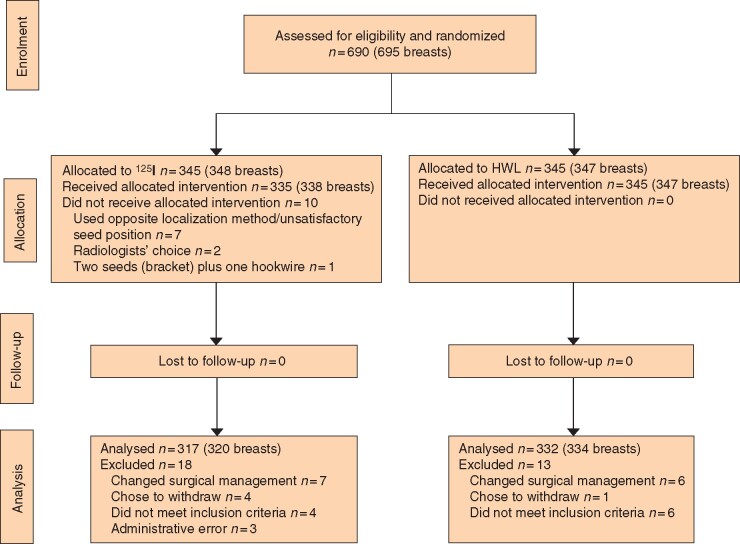
A total of 690 women were randomized at eight sites; 659 women remained after withdrawal (125I seed, 327; HWL, 332). Mean age was 60.3 years in the 125I seed group and 60.7 years in the HWL group, with no difference between the groups in preoperative lesion size (mean 13.2 mm). Lesions were pure DCIS in 25.9 per cent. The most common radiological lesion types were masses (46.9 per cent) and calcifications (28.2 per cent). The localization modality was ultrasonography in 65.5 per cent and mammography in 33.7 per cent. The re-excision rate after 125I seed localization was significantly lower than for HWL (13.9 versus 18.9 per cent respectively; P = 0.019). There were no significant differences in positive margin rates, or in specimen weights and volumes.
Re-excision rates after breast-conserving surgery were significantly lower after 125I seed localization compared with HWL. Registration number: ACTRN12613000655741 (http://www.ANZCTR.org.au/).
先前的研究表明,与钩丝定位(HWL)相比,125I 种子在保乳手术中具有更高的效率和患者结局,但缺乏手术结局更优的高级别证据。本多中心实用随机对照试验的目的是比较在非可触及乳腺癌患者中使用 125I 种子或钩丝定位后再次切除和阳性切缘的发生率。
2013 年 9 月至 2018 年 3 月,符合保乳手术条件的非可触及乳腺癌患者被随机分配至术前使用 125I 种子或钩丝定位。分层因素为病变类型(单纯导管原位癌(DCIS)或其他)和研究地点。主要终点是再次切除和切缘阳性的发生率。次要终点是切除体积和重量。
8 个地点共随机分配了 690 名女性;125I 种子组 327 名,HWL 组 332 名,共有 659 名女性在撤出后仍保留。125I 种子组的平均年龄为 60.3 岁,HWL 组为 60.7 岁,两组术前病变大小(平均 13.2mm)无差异。病变为单纯 DCIS 占 25.9%。最常见的影像学病变类型是肿块(46.9%)和钙化(28.2%)。定位方式 65.5%为超声,33.7%为乳腺 X 线摄影。125I 种子定位后再次切除率明显低于 HWL(分别为 13.9%和 18.9%;P=0.019)。阳性切缘率、标本重量和体积无显著差异。
与 HWL 相比,保乳手术后 125I 种子定位的再次切除率显著降低。注册号:ACTRN12613000655741(http://www.ANZCTR.org.au/)。