Koo Ja Ho, Kim Eun-Kyung, Moon Hee Jung, Yoon Jung Hyun, Park Vivian Youngjean, Kim Min Jung
Department of Radiology, Severance Hospital, Yonsei University College of Medicine, Seoul, Korea.
Ultrasonography. 2019 Oct;38(4):336-344. doi: 10.14366/usg.19004. Epub 2019 Apr 7.
The purpose of this study was to compare the visibility of breast tissue markers in cases of breast cancer on ultrasonography (US) after neoadjuvant chemotherapy (NAC) and to analyze whether the type of marker affected the choice of localization method after NAC.
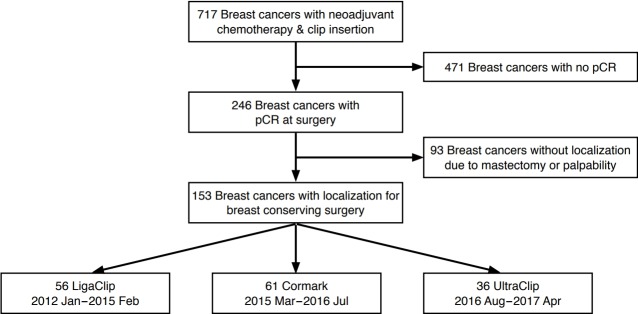
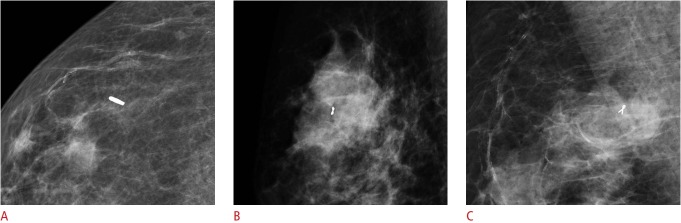
We included 153 tissue markers inserted within breast cancers that showed pathologically complete response (pCR) after NAC from January 2012 to April 2017. One of three types of markers (a surgical clip, Cormark, or UltraClip) was inserted. Medical records and imaging findings were retrospectively reviewed. We compared the visibility of the different types of tissue markers on US after NAC, and also compared the imaging modalities used in the preoperative localization. The chi-square test, Fisher exact test, and multiple logistic regression were used for analysis.
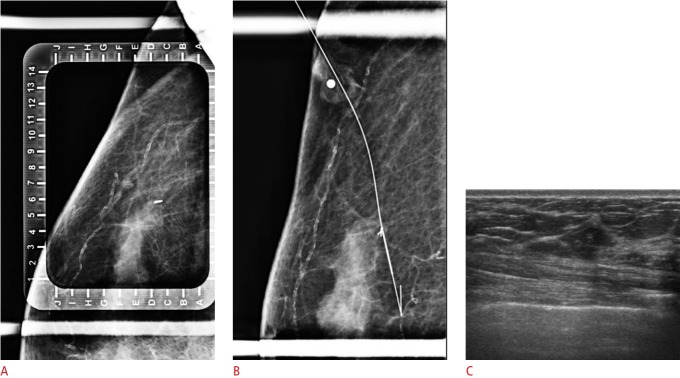
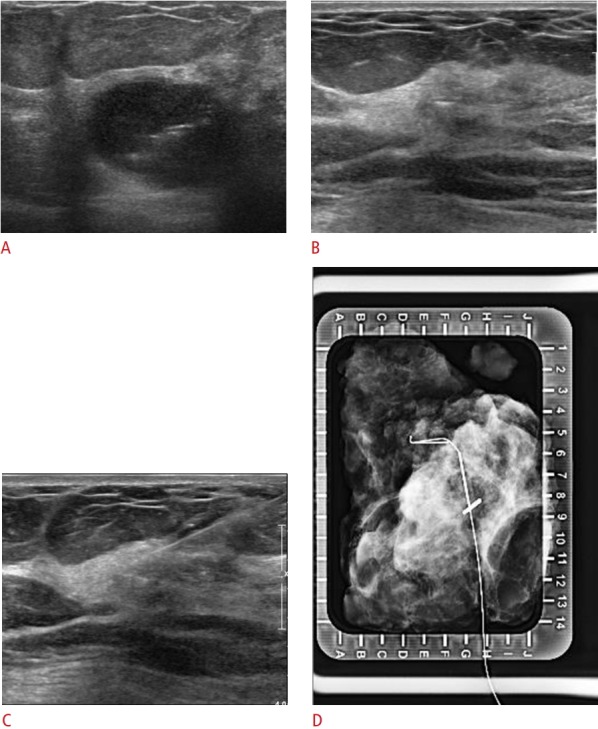
Of the 153 tissue markers, 56 were surgical clips, 61 Cormark, and 36 UltraClip. After NAC, residual lesions were not seen on US in 42 cases (27.5%). In multivariate analysis, the visibility of the surgical clips and Cormark markers was better than that of the UltraClip markers (odds ratio [OR], 5.467; 95% confidence interal [CI], 1.717 to 17.410; P=0.004 and OR, 3.045; 95% CI, 1.074 to 8.628; P=0.036, respectively). Among the 131 cases where localization targeting the marker was required, the proportion of US-guided localizations was significantly higher when a surgical clip was used than when an UltraClip marker was used (OR, 5.566; 95% CI, 1.610 to 19.246; P=0.007) in the multivariate analysis.
The type of breast tissue marker affected its visibility on US in cases with pCR after NAC, which in turn affected the localization methodology.
本研究旨在比较新辅助化疗(NAC)后乳腺癌病例中乳腺组织标记物在超声检查(US)中的可见性,并分析标记物类型是否会影响NAC后定位方法的选择。
我们纳入了2012年1月至2017年4月期间在NAC后病理显示完全缓解(pCR)的乳腺癌中插入的153个组织标记物。插入的标记物为三种类型之一(手术夹、Cormark或UltraClip)。对病历和影像学检查结果进行回顾性分析。我们比较了NAC后不同类型组织标记物在超声检查中的可见性,并比较了术前定位所使用的成像方式。采用卡方检验、Fisher精确检验和多元逻辑回归进行分析。
153个组织标记物中,56个为手术夹,61个为Cormark,36个为UltraClip。NAC后,42例(27.5%)超声检查未见残留病变。在多变量分析中,手术夹和Cormark标记物的可见性优于UltraClip标记物(优势比[OR]分别为5.467;95%置信区间[CI]为1.717至17.410;P = 0.004和OR为3.045;95%CI为1.074至8.628;P = 0.036)。在需要针对标记物进行定位的131例病例中,多变量分析显示,使用手术夹时超声引导定位的比例显著高于使用UltraClip标记物时(OR为5.566;95%CI为1.610至19.246;P = 0.007)。
乳腺组织标记物的类型会影响NAC后pCR病例中其在超声检查中的可见性,进而影响定位方法。