Mitochondrial Medicine Frontier Program, Division of Human Genetics, Department of Pediatrics, The Children's Hospital of Philadelphia, Philadelphia, PA, USA.
Aquatics Core Facility, The Children's Hospital of Philadelphia, Philadelphia, PA, USA.
Hum Mol Genet. 2021 May 12;30(7):536-551. doi: 10.1093/hmg/ddab059.
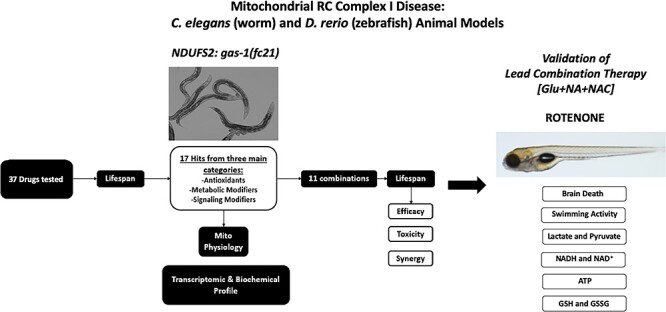
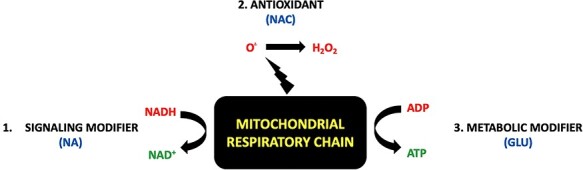
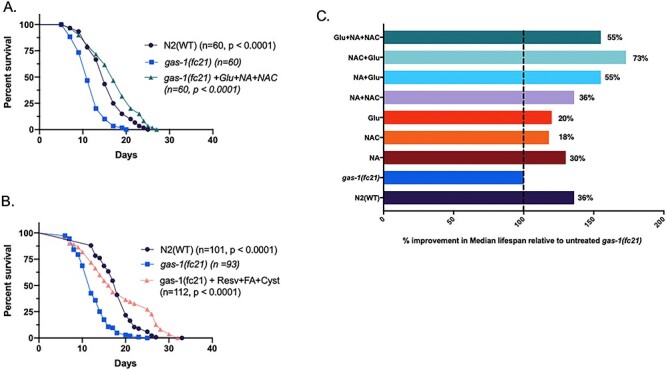
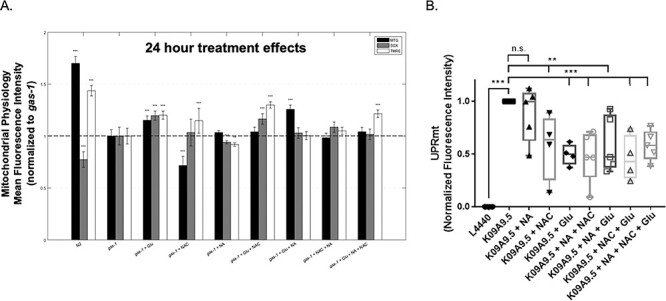
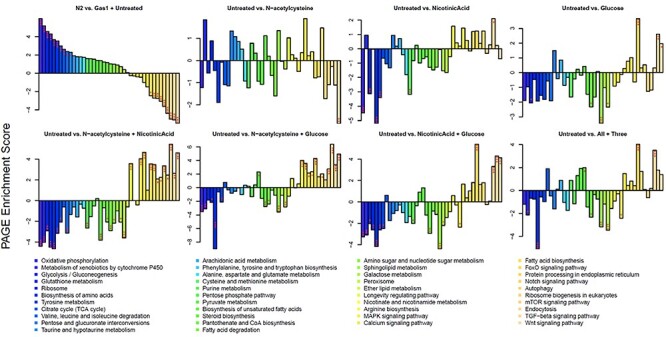
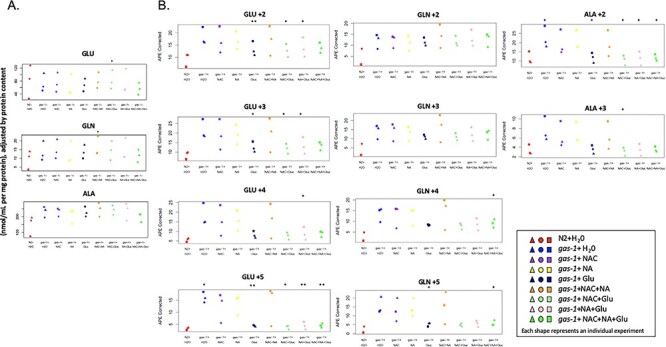
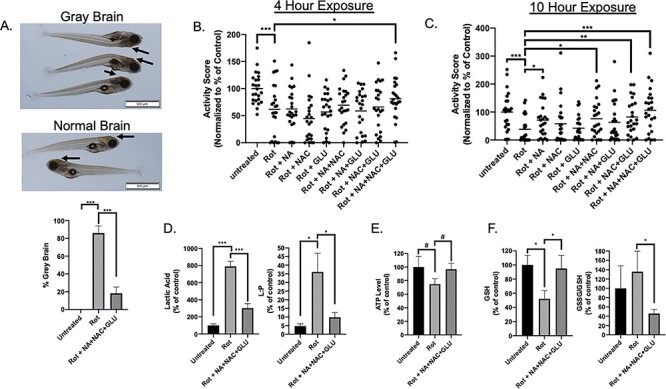
Mitochondrial respiratory chain disorders are empirically managed with variable antioxidant, cofactor and vitamin 'cocktails'. However, clinical trial validated and approved compounds, or doses, do not exist for any single or combinatorial mitochondrial disease therapy. Here, we sought to pre-clinically evaluate whether rationally designed mitochondrial medicine combinatorial regimens might synergistically improve survival, health and physiology in translational animal models of respiratory chain complex I disease. Having previously demonstrated that gas-1(fc21) complex I subunit ndufs2-/-C. elegans have short lifespan that can be significantly rescued with 17 different metabolic modifiers, signaling modifiers or antioxidants, here we evaluated 11 random combinations of these three treatment classes on gas-1(fc21) lifespan. Synergistic rescue occurred only with glucose, nicotinic acid and N-acetylcysteine (Glu + NA + NAC), yielding improved mitochondrial membrane potential that reflects integrated respiratory chain function, without exacerbating oxidative stress, and while reducing mitochondrial stress (UPRmt) and improving intermediary metabolic disruptions at the levels of the transcriptome, steady-state metabolites and intermediary metabolic flux. Equimolar Glu + NA + NAC dosing in a zebrafish vertebrate model of rotenone-based complex I inhibition synergistically rescued larval activity, brain death, lactate, ATP and glutathione levels. Overall, these data provide objective preclinical evidence in two evolutionary-divergent animal models of mitochondrial complex I disease to demonstrate that combinatorial Glu + NA + NAC therapy significantly improved animal resiliency, even in the face of stressors that cause severe metabolic deficiency, thereby preventing acute neurologic and biochemical decompensation. Clinical trials are warranted to evaluate the efficacy of this lead combinatorial therapy regimen to improve resiliency and health outcomes in human subjects with mitochondrial disease.
线粒体呼吸链障碍通过经验性使用各种抗氧化剂、辅助因子和维生素“鸡尾酒”来治疗。然而,目前还没有针对任何单一或组合的线粒体疾病治疗的经过临床试验验证和批准的化合物或剂量。在这里,我们试图在呼吸链复合物 I 疾病的转化动物模型中,对经过合理设计的线粒体药物组合方案是否能协同提高生存率、健康状况和生理机能进行临床前评估。我们之前已经证明,gas-1(fc21)复合物 I 亚基 ndufs2-/-秀丽隐杆线虫的寿命很短,用 17 种不同的代谢调节剂、信号调节剂或抗氧化剂可以显著挽救,在这里,我们评估了这三种治疗类别中的 11 种随机组合对 gas-1(fc21)寿命的影响。只有葡萄糖、烟酸和 N-乙酰半胱氨酸 (Glu+NA+NAC) 的协同挽救作用,才能改善线粒体膜电位,反映综合呼吸链功能,而不会加剧氧化应激,同时减少线粒体应激 (UPRmt),并改善转录组、稳态代谢物和中间代谢通量水平的中间代谢紊乱。在基于鱼藤酮的复合物 I 抑制的斑马鱼脊椎动物模型中,等摩尔的 Glu+NA+NAC 给药协同挽救了幼虫的活动能力、脑死亡、乳酸、ATP 和谷胱甘肽水平。总的来说,这些数据在两种进化上不同的线粒体复合物 I 疾病动物模型中提供了客观的临床前证据,证明组合 Glu+NA+NAC 治疗显著提高了动物的适应能力,即使在导致严重代谢缺陷的应激源面前,从而防止了急性神经和生化失代偿。需要进行临床试验来评估这种主要组合治疗方案在患有线粒体疾病的人类受试者中提高适应能力和健康结果的疗效。