Marshall Katherine L, Farah Mohamed H
Department of Neurology at Johns Hopkins School of Medicine, Baltimore, MD, USA.
Neural Regen Res. 2021 Oct;16(10):1901-1910. doi: 10.4103/1673-5374.308077.
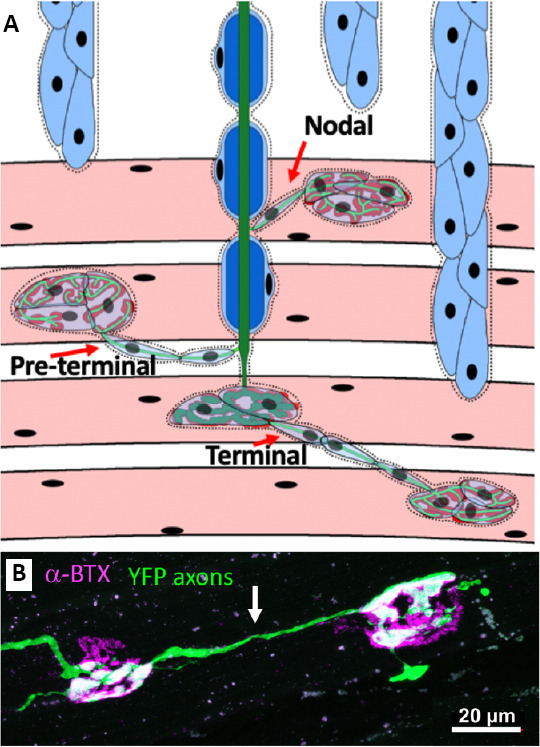
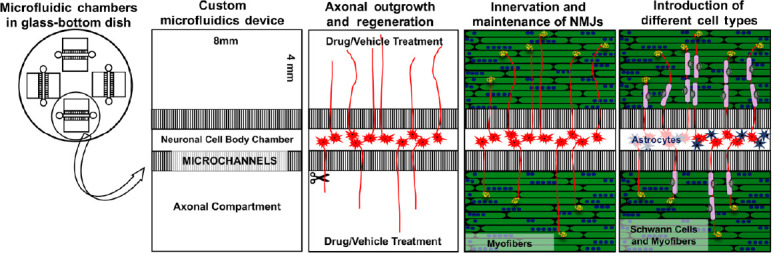
Nervous system disorders are prevalent health issues that will only continue to increase in frequency as the population ages. Dying-back axonopathy is a hallmark of many neurologic diseases and leads to axonal disconnection from their targets, which in turn leads to functional impairment. During the course of many of neurologic diseases, axons can regenerate or sprout in an attempt to reconnect with the target and restore synapse function. In amyotrophic lateral sclerosis (ALS), distal motor axons retract from neuromuscular junctions early in the disease-course before significant motor neuron death. There is evidence of compensatory motor axon sprouting and reinnervation of neuromuscular junctions in ALS that is usually quickly overtaken by the disease course. Potential drugs that enhance compensatory sprouting and encourage reinnervation may slow symptom progression and retain muscle function for a longer period of time in ALS and in other diseases that exhibit dying-back axonopathy. There remain many outstanding questions as to the impact of distinct disease-causing mutations on axonal outgrowth and regeneration, especially in regards to motor neurons derived from patient induced pluripotent stem cells. Compartmentalized microfluidic chambers are powerful tools for studying the distal axons of human induced pluripotent stem cells-derived motor neurons, and have recently been used to demonstrate striking regeneration defects in human motor neurons harboring ALS disease-causing mutations. Modeling the human neuromuscular circuit with human induced pluripotent stem cells-derived motor neurons will be critical for developing drugs that enhance axonal regeneration, sprouting, and reinnervation of neuromuscular junctions. In this review we will discuss compensatory axonal sprouting as a potential therapeutic target for ALS, and the use of compartmentalized microfluidic devices to find drugs that enhance regeneration and axonal sprouting of motor axons.
神经系统疾病是普遍存在的健康问题,且随着人口老龄化,其发病率只会持续上升。轴突逆行性病变是许多神经系统疾病的标志,会导致轴突与其靶标断开连接,进而导致功能障碍。在许多神经系统疾病的病程中,轴突可以再生或出芽,试图与靶标重新连接并恢复突触功能。在肌萎缩侧索硬化症(ALS)中,运动轴突远端在疾病进程早期就从神经肌肉接头处回缩,此时运动神经元尚未大量死亡。有证据表明,ALS中存在代偿性运动轴突发芽和神经肌肉接头重新支配现象,但通常很快就会被疾病进程所掩盖。能够增强代偿性发芽并促进重新支配的潜在药物,可能会减缓ALS以及其他表现出轴突逆行性病变的疾病的症状进展,并在更长时间内保留肌肉功能。关于不同致病突变对轴突生长和再生的影响,尤其是对于源自患者诱导多能干细胞的运动神经元,仍有许多悬而未决的问题。分隔式微流控腔室是研究源自人类诱导多能干细胞的运动神经元远端轴突的有力工具,最近已被用于证明携带ALS致病突变的人类运动神经元存在明显的再生缺陷。用源自人类诱导多能干细胞的运动神经元构建人类神经肌肉回路模型,对于开发增强轴突再生、出芽以及神经肌肉接头重新支配的药物至关重要。在这篇综述中,我们将讨论代偿性轴突发芽作为ALS潜在治疗靶点的情况,以及使用分隔式微流控装置来寻找增强运动轴突再生和出芽的药物。