Cao Xia, Liu Kevin, Liu Jun, Liu Yen-Wenn, Xu Li, Wang Hua, Zhu Yunhui, Wang Pengfei, Li Zhiwei, Wen Jie, Shen Chen, Li Meng, Nie Zuqing, Kong Xue-Jun
Second Affiliated Hospital of Kunming Medical University, Kunming, China.
Athinoula A. Martinos Center for Biomedical Imaging, Massachusetts General Hospital, Charlestown, MA, United States.
Front Neurosci. 2021 Feb 10;15:635925. doi: 10.3389/fnins.2021.635925. eCollection 2021.
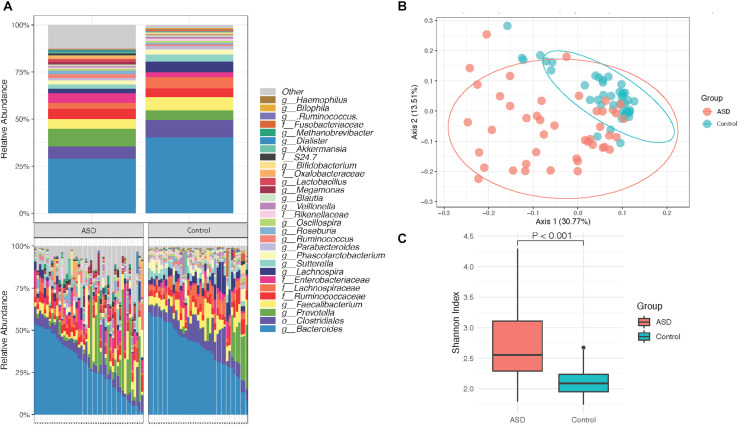
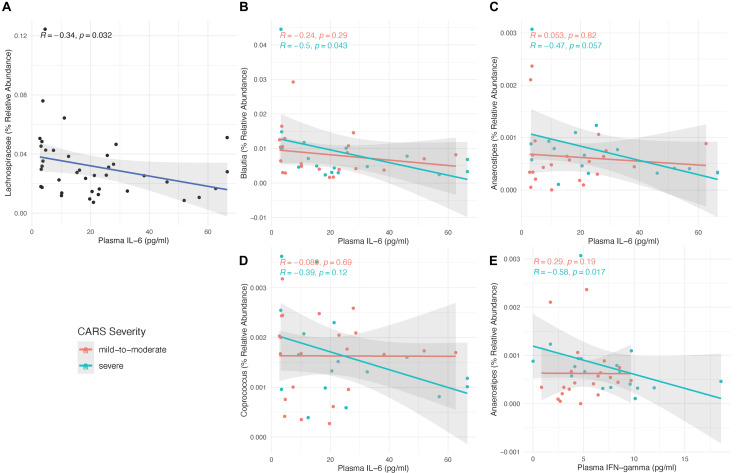
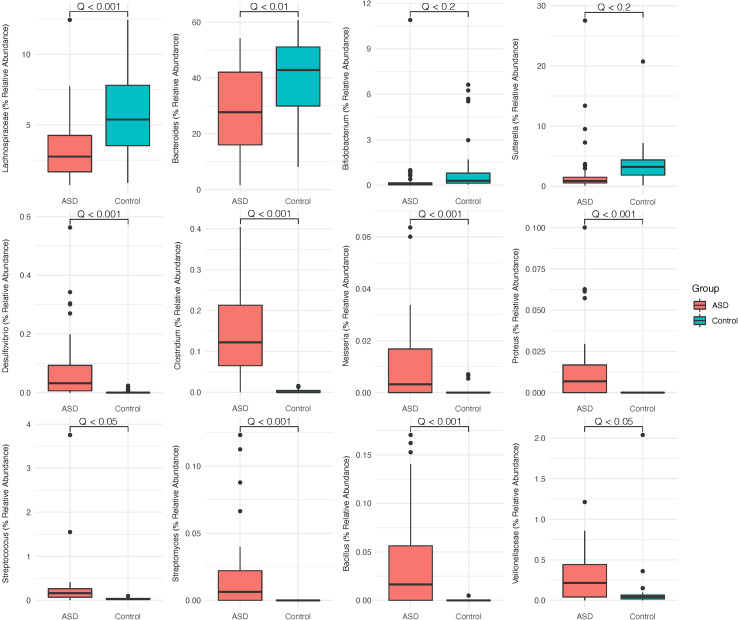
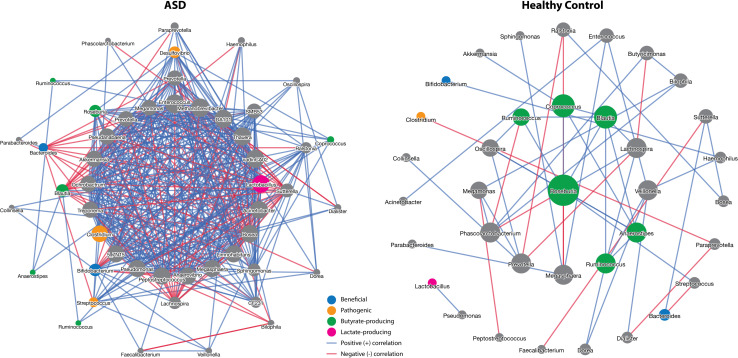
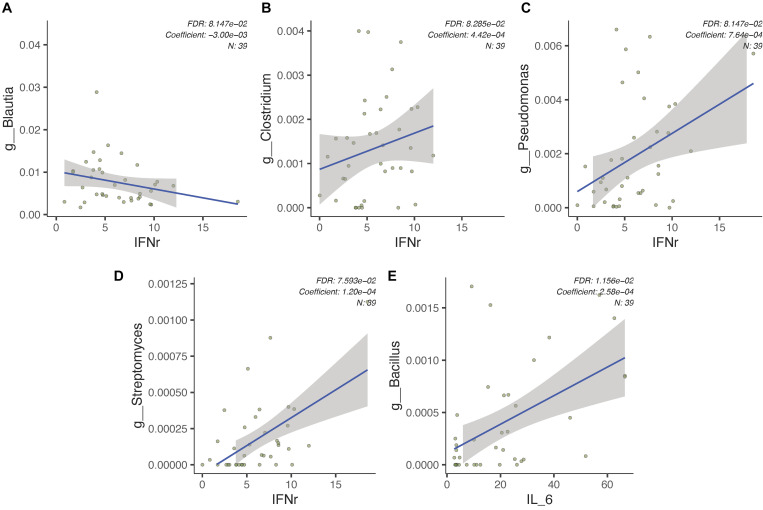
Inflammation and the gut-brain axis have been implicated in the pathogenesis of autism spectrum disorders (ASDs). To further understand the relationship between aberrant immune responses and dysbiotic features of the gut microbiome in ASD, we enrolled 45 ASD individuals and 41 healthy control subjects with ages ranging from 2 to 19 years. We found that ASD group subjects have significantly higher plasma levels of IL-2, IL-4, IL-5, IL-6, IL-10, TNF-α, TNF-β, and IFN-γ when compared to healthy controls (FDR-adjusted < 0.05). The plasma levels of pro-inflammatory cytokines IFN-γ and IL-6 are found to be further associated with several largely pathogenic gut microbiota uniquely detected in subjects with ASD. Furthermore, the ASD gut microbiome is characterized by reduced levels of several beneficial microbiota, including (FDR-adjusted < 0.01) and Lachnospiraceae (FDR-adjusted < 0.001). Analysis of Lachnospiraceae family and genus level taxa suggested that relative abundances of such taxa are negatively correlated with pro-inflammatory signaling cytokines IFN-γ and IL-6, particularly in subjects with severe ASD as defined by CARS ( < 0.05). Several largely pathogenic genera are determined to be associated with the pro-inflammatory cytokines IFN-γ and IL-6 (FDR-adjusted < 0.1). Additionally, IL-4 is significantly negatively correlated with CARS total score ( < 0.05). Based on such results, we propose that the association between the disturbances of specific cytokines and alterations in gut microbiota abundance observed in children and adolescents with ASD provides additional evidence on the induction of aberrant pro-inflammatory mechanisms in ASD and its early diagnosis.
炎症与肠-脑轴已被认为与自闭症谱系障碍(ASD)的发病机制有关。为了进一步了解ASD中异常免疫反应与肠道微生物群生态失调特征之间的关系,我们招募了45名年龄在2至19岁之间的ASD个体和41名健康对照受试者。我们发现,与健康对照组相比,ASD组受试者的血浆中白细胞介素-2(IL-2)、白细胞介素-4(IL-4)、白细胞介素-5(IL-5)、白细胞介素-6(IL-6)、白细胞介素-10(IL-10)、肿瘤坏死因子-α(TNF-α)、肿瘤坏死因子-β(TNF-β)和干扰素-γ(IFN-γ)水平显著更高(经错误发现率校正,P<0.05)。发现促炎细胞因子IFN-γ和IL-6的血浆水平与在ASD受试者中独特检测到的几种主要致病性肠道微生物群进一步相关。此外,ASD肠道微生物群的特征是几种有益微生物群水平降低,包括(经错误发现率校正,P<0.01)和毛螺菌科(经错误发现率校正,P<0.001)。对毛螺菌科科和属水平分类群的分析表明,这些分类群的相对丰度与促炎信号细胞因子IFN-γ和IL-6呈负相关,特别是在由儿童孤独症评定量表(CARS)定义的重度ASD受试者中(P<0.05)。确定几种主要致病性属与促炎细胞因子IFN-γ和IL-6相关(经错误发现率校正,P<0.1)。此外,IL-4与CARS总分显著负相关(P<0.05)。基于这些结果,我们提出,在患有ASD的儿童和青少年中观察到的特定细胞因子紊乱与肠道微生物群丰度改变之间的关联,为ASD中异常促炎机制的诱导及其早期诊断提供了额外证据。