Institute of Immunology, University of Muenster, Muenster, Germany.
Department of Dermatology, University of Muenster, Muenster, Germany.
Front Immunol. 2021 Feb 12;11:599947. doi: 10.3389/fimmu.2020.599947. eCollection 2020.
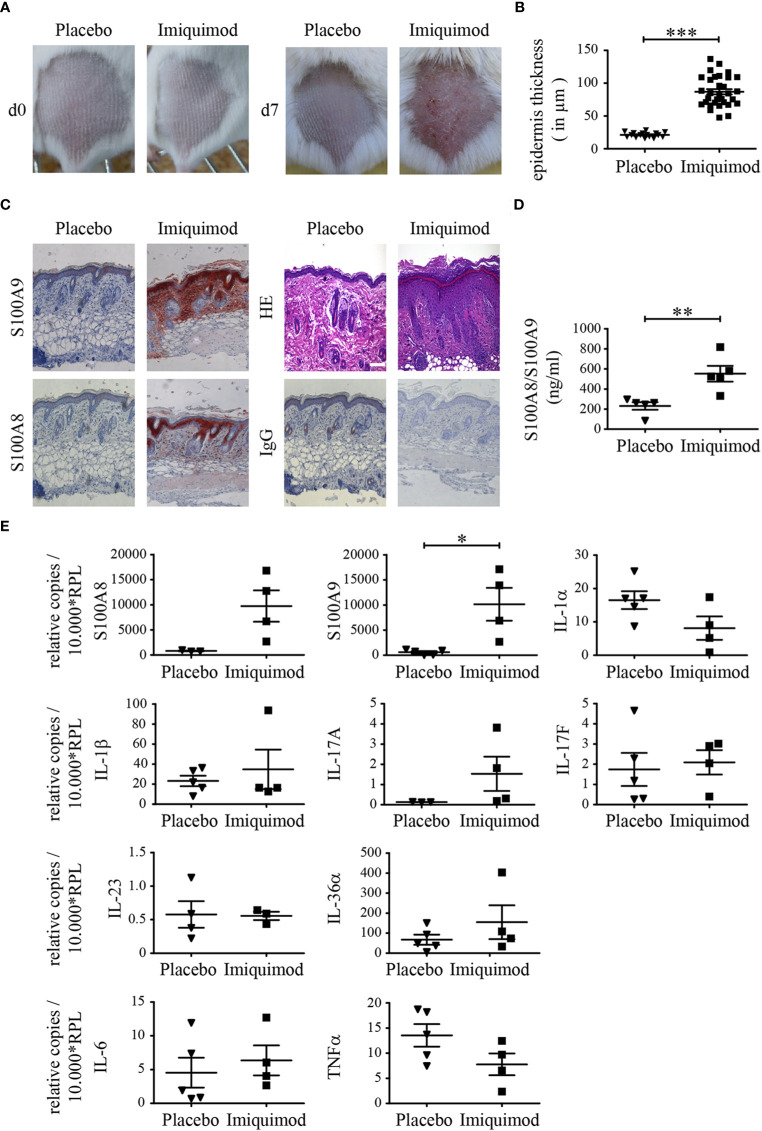
Psoriasis is one of the most common immune-mediated inflammatory skin diseases. Expression and secretion of two pro-inflammatory molecules of the S100-alarmin family, S100A8 and S100A9, in keratinocytes is a hallmark of psoriasis, which is also characterized by an altered differentiation of keratinocytes. Dimers of S100A8/S100A9 (calprotectin) bind to Toll-like receptor 4 and induce an inflammatory response in target cells. Targeted deletion of S100A9 reduced the inflammatory phenotype of psoriasis-like inflammation in mice. A role of S100-alarmins in differentiation and activation of keratinocytes was suggested but has been never shown in primary keratinocytes. We now confirm that induction of S100-alarmins in an imiquimod-induced murine model of psoriasis-like skin inflammation was associated with an increased expression of interleukin (IL)-1α, IL-6, IL-17A, or TNFα. This association was confirmed in transcriptome data obtained from controls, lesional and non-lesional skin of psoriasis patients, and a down-regulation of S100-alarmin expression after IL-17 directed therapy. However, analyzing primary S100A9 keratinocytes we found that expression of S100A8/S100A9 has no significant role for the maturation and inflammatory response pattern of keratinocytes. Moreover, keratinocytes are no target cells for the pro-inflammatory effects of S100A8/S100A9. However, different cytokines, especially IL-17A and F, highly abundant in psoriasis, strongly induced expression of S100-alarmins preferentially during early maturation stages of keratinocytes. Our data indicate that expression of S100A8 and S100A9 does not primarily influence maturation or activation of keratinocytes but rather represents the inflammatory response of these cells during psoriasis.
银屑病是最常见的免疫介导性炎症性皮肤病之一。角质形成细胞中 S100-警报素家族的两种促炎分子 S100A8 和 S100A9 的表达和分泌是银屑病的标志,其特征还在于角质形成细胞的分化改变。S100A8/S100A9(钙卫蛋白)二聚体与 Toll 样受体 4 结合,并在靶细胞中诱导炎症反应。S100A9 的靶向缺失减少了小鼠银屑病样炎症的炎症表型。提示 S100-警报素在角质形成细胞的分化和激活中起作用,但从未在原代角质形成细胞中得到证实。我们现在证实,在咪喹莫特诱导的银屑病样皮肤炎症小鼠模型中,S100-警报素的诱导与白细胞介素 (IL)-1α、IL-6、IL-17A 或 TNFα 的表达增加有关。在从对照、银屑病患者皮损和非皮损皮肤获得的转录组数据中以及在 IL-17 定向治疗后 S100-警报素表达下调时,均证实了这种关联。然而,分析原代 S100A9 角质形成细胞时,我们发现 S100A8/S100A9 的表达对角质形成细胞的成熟和炎症反应模式没有重要作用。此外,角质形成细胞不是 S100A8/S100A9 促炎作用的靶细胞。然而,不同的细胞因子,特别是在银屑病中高度丰富的 IL-17A 和 F,强烈诱导 S100-警报素的表达,尤其是在角质形成细胞的早期成熟阶段。我们的数据表明,S100A8 和 S100A9 的表达主要不影响角质形成细胞的成熟或激活,而是代表这些细胞在银屑病中的炎症反应。