Pan Jiawei, Sharif Rahat, Xu Xuewen, Chen Xuehao
School of Horticulture and Plant Protection, Yangzhou University, Yangzhou, China.
Joint International Research Laboratory of Agriculture and Agri-Product Safety, Yangzhou University, Yangzhou, China.
Front Plant Sci. 2021 Feb 10;11:627331. doi: 10.3389/fpls.2020.627331. eCollection 2020.
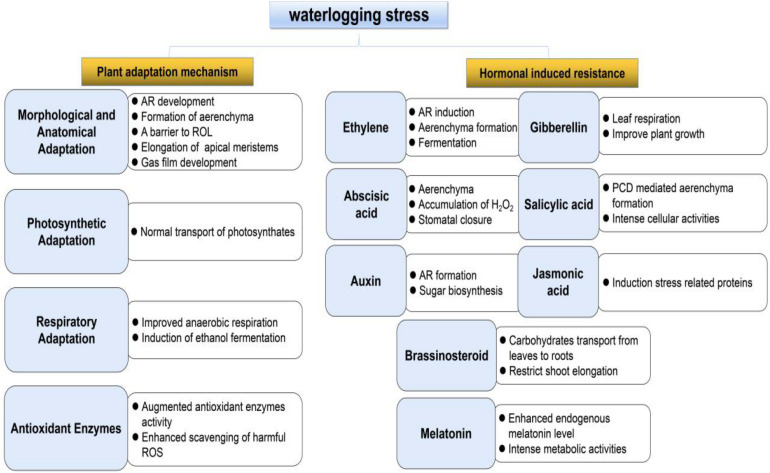
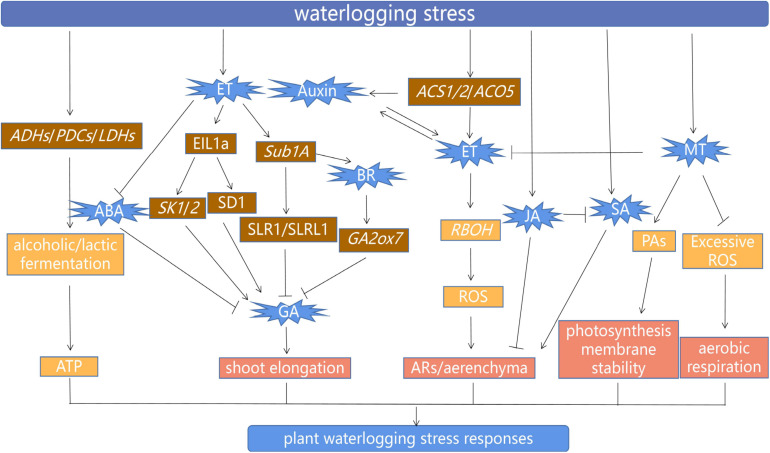
Waterlogging is one of the main abiotic stresses suffered by plants. Inhibition of aerobic respiration during waterlogging limits energy metabolism and restricts growth and a wide range of developmental processes, from seed germination to vegetative growth and further reproductive growth. Plants respond to waterlogging stress by regulating their morphological structure, energy metabolism, endogenous hormone biosynthesis, and signaling processes. In this updated review, we systematically summarize the changes in morphological structure, photosynthesis, respiration, reactive oxygen species damage, plant hormone synthesis, and signaling cascades after plants were subjected to waterlogging stress. Finally, we propose future challenges and research directions in this field.
涝害是植物遭受的主要非生物胁迫之一。涝害期间有氧呼吸的抑制限制了能量代谢,并从种子萌发到营养生长以及进一步的生殖生长等广泛的发育过程。植物通过调节其形态结构、能量代谢、内源激素生物合成和信号传导过程来应对涝害胁迫。在这篇更新的综述中,我们系统地总结了植物遭受涝害胁迫后在形态结构、光合作用、呼吸作用、活性氧损伤、植物激素合成和信号级联方面的变化。最后,我们提出了该领域未来的挑战和研究方向。