Dias Luciano S, Swaroop Vineeta T, de Angeli Luiz R A, Larson Jill E, Rojas Ana-Marie, Karakostas Tasos
Shirley Ryan Ability Laboratory, Chicago, Illinois, USA.
Ann and Robert H. Lurie Children's Hospital of Chicago, Chicago, Illinois, USA.
J Child Orthop. 2021 Feb 1;15(1):1-5. doi: 10.1302/1863-2548.15.200248.
In myelomeningocele, several classifications have been used. The present manuscript proposes a new functional classification to better assess the prognosis and management of these patients.
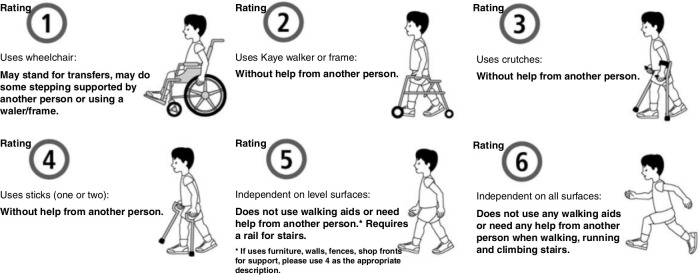
The manual muscle test is what defines the actual group in which the patient should be included. Furthermore, this new classification brings information about the bracing and external supports recommended to each functional level. We also recommend that the patient's Functional Mobility Scale should always be mentioned together with their functional level.
The four levels in this classification are MMFC1, MMFC2, MMFC3 and MMFC4. The MMFC1 group includes patients with significant muscle weakness. They need to use high braces crossing the hip joint with a walker to achieve some ambulation. The MMFC2 group includes patients who have functional hip flexors, knee extensors and knee flexors. However, the hip abductors are quite weak. These patients usually need to use a walker - or crutches - and Ankle-Foot Orthosis (AFOs). The MMFC3 group includes patients with functional hip flexors, knee extensors, knee flexors and hip abductors. However, the ankle plantar flexion function is absent. Most of them are able to walk independently, only using AFOs without any external support. The MMFC4 group includes patients who have preserved function in the entire lower limb musculature. These patients don't need any assistive devices to achieve an adequate ambulation pattern.
We hope that this new classification is a system that is simple to understand, serves as a gait prognosis guide and facilitates communication among healthcare professionals.
V.
在脊髓脊膜膨出症中,已使用了多种分类方法。本论文提出一种新的功能分类法,以更好地评估这些患者的预后和治疗。
徒手肌力测试确定患者应归入的实际组别。此外,这种新分类法提供了针对每个功能水平推荐的支具和外部支撑的相关信息。我们还建议,应始终将患者的功能活动量表与其功能水平一并提及。
该分类法的四个级别为MMFC1、MMFC2、MMFC3和MMFC4。MMFC1组包括肌肉严重无力的患者。他们需要使用跨过髋关节的高支具并借助助行器才能实现一定程度的行走。MMFC2组包括髋屈肌、膝伸肌和膝屈肌功能正常的患者。然而,髋外展肌相当薄弱。这些患者通常需要使用助行器或拐杖以及踝足矫形器(AFO)。MMFC3组包括髋屈肌、膝伸肌、膝屈肌和髋外展肌功能正常的患者。然而,踝关节跖屈功能缺失。他们中的大多数人能够独立行走,仅使用AFO且无需任何外部支撑。MMFC4组包括整个下肢肌肉组织功能均得以保留的患者。这些患者无需任何辅助器械就能实现适当的行走模式。
我们希望这种新分类法是一个易于理解的系统,可作为步态预后指南,并促进医疗保健专业人员之间的沟通。
V级。