• 文献检索
  • 文档翻译
  • 深度研究
  • 学术资讯
  • Suppr Zotero 插件Zotero 插件
  • 邀请有礼
  • 套餐&价格
  • 历史记录
应用&插件
Suppr Zotero 插件Zotero 插件浏览器插件Mac 客户端Windows 客户端微信小程序
定价
高级版会员购买积分包购买API积分包
服务
文献检索文档翻译深度研究API 文档MCP 服务
关于我们
关于 Suppr公司介绍联系我们用户协议隐私条款
关注我们

Suppr 超能文献

核心技术专利:CN118964589B侵权必究
粤ICP备2023148730 号-1Suppr @ 2026

文献检索

告别复杂PubMed语法,用中文像聊天一样搜索,搜遍4000万医学文献。AI智能推荐,让科研检索更轻松。

立即免费搜索

文件翻译

保留排版,准确专业,支持PDF/Word/PPT等文件格式,支持 12+语言互译。

免费翻译文档

深度研究

AI帮你快速写综述,25分钟生成高质量综述,智能提取关键信息,辅助科研写作。

立即免费体验

在训练量匹配的条件下,训练频率对受过训练的男性肌肉力量的影响。

Effects of training frequency on muscular strength for trained men under volume matched conditions.

作者信息

Johnsen Emil, van den Tillaar Roland

机构信息

Department of Sport Sciences and Physical Education, Nord University, Levanger, Norway.

出版信息

PeerJ. 2021 Feb 18;9:e10781. doi: 10.7717/peerj.10781. eCollection 2021.

DOI:10.7717/peerj.10781
PMID:33643706
原文链接:https://pmc.ncbi.nlm.nih.gov/articles/PMC7897409/
Abstract

BACKGROUND

In resistance training, the role of training frequency to increase maximal strength is often debated. However, the limited data available does not allow for clear training frequency "optimization" recommendations. The purpose of this study was to investigate the effects of training frequency on maximal muscular strength and rate of perceived exertion (RPE). The total weekly training volume was equally distributed between two and four sessions per muscle group.

METHODS

Twenty-one experienced resistance-trained male subjects (height: 1.85 ± 0.06 m, body mass: 85.3 ± 12.3 kg, age: 27.6 ± 7.6 years) were tested prior to and after an 8-week training period in one-repetition maximum (1RM) barbell back squat and bench press. Subjects were randomly assigned to a SPLIT group ( = 10), in which there were two training sessions of squats and lower-body exercises and two training sessions of bench press and upper-body exercises, or a FULLBODY group ( = 11), in which four sessions with squats, bench press and supplementary exercises were conducted every session. In each session, the subjects rated their RPE after barbell back squat, bench press, and the full session.

RESULTS

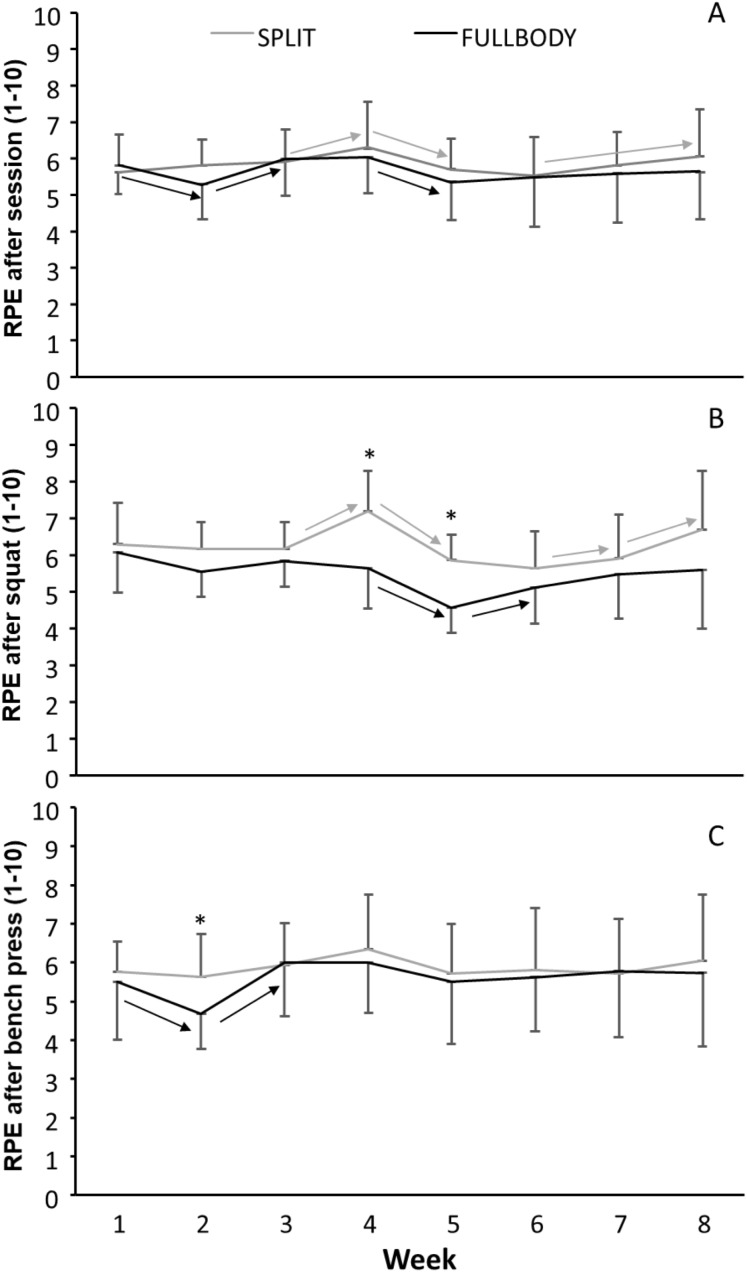
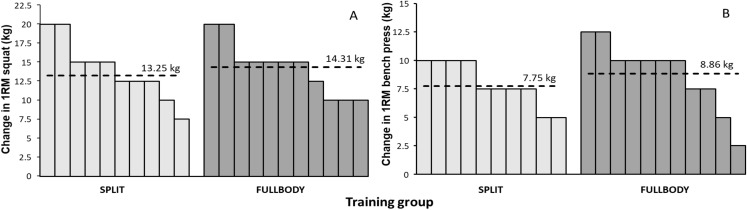
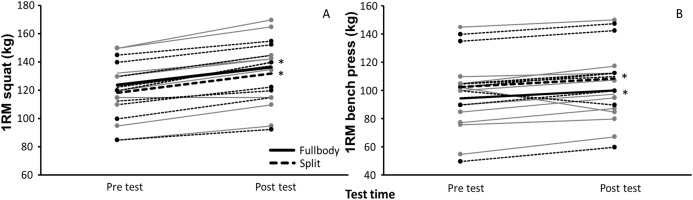
Both groups significantly increased 1RM strength in barbell back squat (SPLIT group: +13.25 kg; FULLBODY group: +14.31 kg) and bench press (SPLIT group: +7.75 kg; FULLBODY group: +8.86 kg) but training frequency did not affect this increase for squat ( = 0.640) or bench press ( = 0.431). Both groups showed a significant effect for time on RPE on all three measurements. The analyses showed only an interaction effect between groups on time for the RPE after the squat exercise ( = 0.002).

CONCLUSION

We conclude that there are no additional benefits of increasing the training frequency from two to four sessions under volume-equated conditions, but it could be favorable to spread the total training volume into several training bouts through the week to avoid potential increases in RPE, especially after the squat exercise.

摘要

背景

在阻力训练中,训练频率对增加最大力量的作用常常存在争议。然而,现有的有限数据无法给出明确的训练频率“优化”建议。本研究的目的是调查训练频率对最大肌肉力量和主观用力程度(RPE)的影响。每周的总训练量在每个肌肉群的两到四个训练 session 之间平均分配。

方法

21 名有经验的进行阻力训练的男性受试者(身高:1.85±0.06 米,体重:85.3±12.3 千克,年龄:27.6±7.6 岁)在为期 8 周的训练期前后接受了杠铃深蹲和卧推的一次重复最大重量(1RM)测试。受试者被随机分配到 SPLIT 组(n = 10),该组进行两次深蹲和下肢训练 session 以及两次卧推和上肢训练 session,或者 FULLBODY 组(n = 11),该组每次训练进行四次包含深蹲、卧推和辅助练习的 session。在每次训练中,受试者在杠铃深蹲、卧推和整个训练 session 后对他们的 RPE 进行评分。

结果

两组的杠铃深蹲 1RM 力量(SPLIT 组:增加 13.25 千克;FULLBODY 组:增加 14.31 千克)和卧推 1RM 力量(SPLIT 组:增加 7.75 千克;FULLBODY 组:增加 8.86 千克)均显著增加,但训练频率对深蹲(p = 0.640)或卧推(p = 0.431)的这种增加没有影响。两组在所有三项测量中 RPE 随时间均有显著变化。分析表明,仅在深蹲练习后的 RPE 方面,组间在时间上存在交互作用(p = 0.002)。

结论

我们得出结论,在训练量相等的条件下,将训练频率从两次增加到四次没有额外益处,但将总训练量分散到一周的多个训练 bout 中可能有利于避免 RPE 的潜在增加,尤其是在深蹲练习之后。
https://cdn.ncbi.nlm.nih.gov/pmc/blobs/06d3/7897409/50671d200338/peerj-09-10781-g003.jpg
https://cdn.ncbi.nlm.nih.gov/pmc/blobs/06d3/7897409/9e51f442ea87/peerj-09-10781-g001.jpg
https://cdn.ncbi.nlm.nih.gov/pmc/blobs/06d3/7897409/9e931d359bb6/peerj-09-10781-g002.jpg
https://cdn.ncbi.nlm.nih.gov/pmc/blobs/06d3/7897409/50671d200338/peerj-09-10781-g003.jpg
https://cdn.ncbi.nlm.nih.gov/pmc/blobs/06d3/7897409/9e51f442ea87/peerj-09-10781-g001.jpg
https://cdn.ncbi.nlm.nih.gov/pmc/blobs/06d3/7897409/9e931d359bb6/peerj-09-10781-g002.jpg
https://cdn.ncbi.nlm.nih.gov/pmc/blobs/06d3/7897409/50671d200338/peerj-09-10781-g003.jpg

相似文献

1
Effects of training frequency on muscular strength for trained men under volume matched conditions.在训练量匹配的条件下,训练频率对受过训练的男性肌肉力量的影响。
PeerJ. 2021 Feb 18;9:e10781. doi: 10.7717/peerj.10781. eCollection 2021.
2
Caffeine ingestion acutely enhances muscular strength and power but not muscular endurance in resistance-trained men.摄入咖啡因能急性增强抗阻训练男性的肌肉力量和爆发力,但不会增强肌肉耐力。
Eur J Sport Sci. 2017 Sep;17(8):1029-1036. doi: 10.1080/17461391.2017.1330362. Epub 2017 May 24.
3
High-Frequency Resistance Training Is Not More Effective Than Low-Frequency Resistance Training in Increasing Muscle Mass and Strength in Well-Trained Men.高频阻力训练并不比低频阻力训练更能有效增加训练有素男性的肌肉质量和力量。
J Strength Cond Res. 2019 Jul;33 Suppl 1:S130-S139. doi: 10.1519/JSC.0000000000002559.
4
RPE and Velocity Relationships for the Back Squat, Bench Press, and Deadlift in Powerlifters.力量举运动员深蹲、卧推和硬拉时的RPE与速度关系
J Strength Cond Res. 2017 Feb;31(2):292-297. doi: 10.1519/JSC.0000000000001517.
5
Factors Related to Average Concentric Velocity of Four Barbell Exercises at Various Loads.与不同负荷下四种杠铃练习的平均向心速度相关的因素。
J Strength Cond Res. 2019 Mar;33(3):597-605. doi: 10.1519/JSC.0000000000003043.
6
Effects of unilateral, bilateral, and combined unilateral+bilateral complex resistance training on bench press and squat strength in adolescent boxers.单侧、双侧以及单侧+双侧联合复合阻力训练对青少年拳击手卧推和深蹲力量的影响。
Front Physiol. 2024 Mar 4;15:1321519. doi: 10.3389/fphys.2024.1321519. eCollection 2024.
7
Self-Rated Accuracy of Rating of Perceived Exertion-Based Load Prescription in Powerlifters.力量举运动员中基于主观用力感觉的负荷处方评级的自评准确性
J Strength Cond Res. 2017 Oct;31(10):2938-2943. doi: 10.1519/JSC.0000000000002097.
8
The influence of direct supervision of resistance training on strength performance.抗阻训练直接监督对力量表现的影响。
Med Sci Sports Exerc. 2000 Jun;32(6):1175-84. doi: 10.1097/00005768-200006000-00023.
9
Twice-daily sessions result in a greater muscle strength and a similar muscle hypertrophy compared to once-daily session in resistance-trained men.与每天进行一次训练的抗阻训练男性相比,每天进行两次训练可带来更大的肌肉力量和相似的肌肉肥大效果。
J Sports Med Phys Fitness. 2022 Mar;62(3):324-336. doi: 10.23736/S0022-4707.21.12118-8. Epub 2021 Feb 26.
10
High Resistance-Training Volume Enhances Muscle Thickness in Resistance-Trained Men.高强度抗阻训练量可增加抗阻训练男性的肌肉厚度。
J Strength Cond Res. 2022 Jan 1;36(1):22-30. doi: 10.1519/JSC.0000000000003413.

引用本文的文献

1
Quantifying the Generality of Strength Adaptation: A Meta-Analysis.量化力量适应的普遍性:一项荟萃分析。
Sports Med. 2023 Mar;53(3):637-648. doi: 10.1007/s40279-022-01790-0. Epub 2022 Nov 18.
2
Effect of different training frequencies on maximal strength performance and muscle hypertrophy in trained individuals-a within-subject design.不同训练频率对训练个体最大力量表现和肌肉肥大的影响:一项自身对照设计研究。
PLoS One. 2022 Oct 13;17(10):e0276154. doi: 10.1371/journal.pone.0276154. eCollection 2022.
3
Equal-Volume Strength Training With Different Training Frequencies Induces Similar Muscle Hypertrophy and Strength Improvement in Trained Participants.

本文引用的文献

1
Similar Muscular Adaptations in Resistance Training Performed Two Versus Three Days Per Week.每周进行两天与三天抗阻训练时相似的肌肉适应性变化
J Hum Kinet. 2019 Aug 21;68:135-143. doi: 10.2478/hukin-2019-0062. eCollection 2019 Aug.
2
Calculating Set-Volume for the Limb Muscles with the Performance of Multi-Joint Exercises: Implications for Resistance Training Prescription.通过多关节运动表现计算肢体肌肉的设定体积:对阻力训练处方的启示
Sports (Basel). 2019 Jul 22;7(7):177. doi: 10.3390/sports7070177.
3
How many times per week should a muscle be trained to maximize muscle hypertrophy? A systematic review and meta-analysis of studies examining the effects of resistance training frequency.
不同训练频率的等容量力量训练在训练参与者中诱导出相似的肌肉肥大和力量提升。
Front Physiol. 2022 Jan 5;12:789403. doi: 10.3389/fphys.2021.789403. eCollection 2021.
每周应该训练多少次肌肉才能最大限度地促进肌肉肥大?一项系统回顾和荟萃分析研究了抗阻训练频率的影响。
J Sports Sci. 2019 Jun;37(11):1286-1295. doi: 10.1080/02640414.2018.1555906. Epub 2018 Dec 17.
4
Resistance Training Frequencies of 3 and 6 Times Per Week Produce Similar Muscular Adaptations in Resistance-Trained Men.每周进行 3 次和 6 次的抗阻训练产生相似的肌肉适应性。
J Strength Cond Res. 2019 Jul;33 Suppl 1:S122-S129. doi: 10.1519/JSC.0000000000002909.
5
Dose-Response Relationship of Weekly Resistance-Training Volume and Frequency on Muscular Adaptations in Trained Men.每周抗阻训练量和频率与训练男性肌肉适应性的剂量-反应关系。
Int J Sports Physiol Perform. 2019 Mar 1;14(3):360-368. doi: 10.1123/ijspp.2018-0427. Epub 2019 Feb 6.
6
Weekly Training Frequency Effects on Strength Gain: A Meta-Analysis.每周训练频率对力量增长的影响:一项荟萃分析。
Sports Med Open. 2018 Aug 3;4(1):36. doi: 10.1186/s40798-018-0149-9.
7
Time Course of Recovery From Resistance Exercise With Different Set Configurations.不同组次设置下抗阻运动恢复时间进程。
J Strength Cond Res. 2020 Oct;34(10):2867-2876. doi: 10.1519/JSC.0000000000002756.
8
Effects of equal-volume resistance training with different training frequencies in muscle size and strength in trained men.不同训练频率的等容阻力训练对训练有素男性肌肉大小和力量的影响。
PeerJ. 2018 Jun 22;6:e5020. doi: 10.7717/peerj.5020. eCollection 2018.
9
Effect of Resistance Training Frequency on Neuromuscular Performance and Muscle Morphology After 8 Weeks in Trained Men.抗阻训练频率对训练男性 8 周后神经肌肉性能和肌肉形态的影响。
J Strength Cond Res. 2019 Aug;33(8):2104-2116. doi: 10.1519/JSC.0000000000002563.
10
High-Frequency Resistance Training Is Not More Effective Than Low-Frequency Resistance Training in Increasing Muscle Mass and Strength in Well-Trained Men.高频阻力训练并不比低频阻力训练更能有效增加训练有素男性的肌肉质量和力量。
J Strength Cond Res. 2019 Jul;33 Suppl 1:S130-S139. doi: 10.1519/JSC.0000000000002559.