Huo Zihe, Lomora Mihai, Kym Urs, Palivan Cornelia, Holland-Cunz Stefan G, Gros Stephanie J
Department of Pediatric Surgery, University Children's Hospital Basel, Basel, Switzerland.
Department of Clinical Research, University of Basel, Basel, Switzerland.
Front Cell Dev Biol. 2021 Feb 11;9:605272. doi: 10.3389/fcell.2021.605272. eCollection 2021.
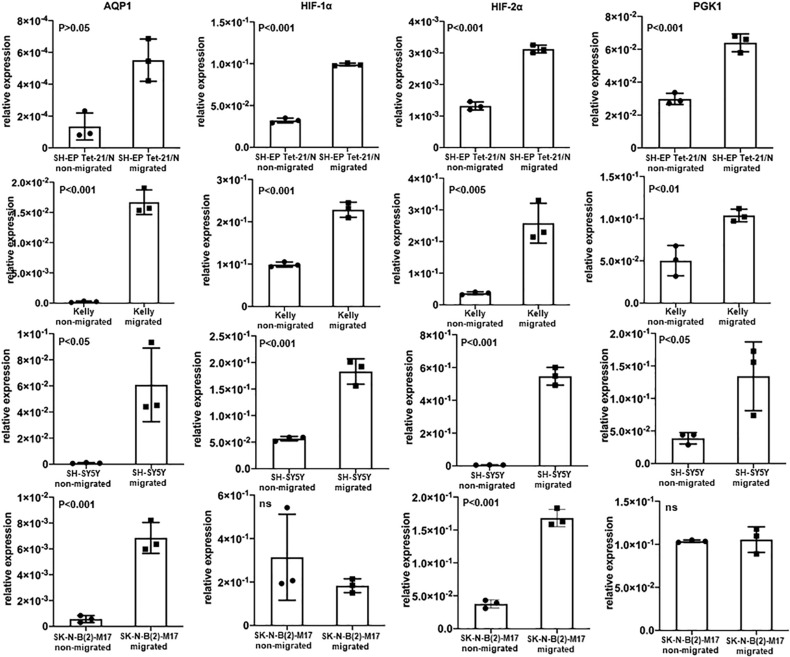
The water channel aquaporin 1 (AQP1) has been implicated in tumor progression and metastasis. It is hypothesized that AQP1 expression can facilitate the transmembrane water transport leading to changes in cell structure that promote migration. Its impact in neuroblastoma has not been addressed so far. The objectives of this study have been to determine whether AQP1 expression in neuroblastoma is dependent on hypoxia, to demonstrate whether AQP1 is functionally relevant for migration, and to further define AQP1-dependent properties of the migrating cells. This was determined by investigating the reaction of neuroblastoma cell lines, particularly SH-SY5Y, Kelly, SH-EP Tet-21/N and SK-N-BE(2)-M17 to hypoxia, quantitating the AQP1-related water permeability by stopped-flow spectroscopy, and studying the migration-related properties of the cells in a modified transwell assay. We find that AQP1 expression in neuroblastoma cells is up-regulated by hypoxic conditions, and that increased AQP1 expression enabled the cells to form a phenotype which is associated with migratory properties and increased cell agility. This suggests that the hypoxic tumor microenvironment is the trigger for some tumor cells to transition to a migratory phenotype. We demonstrate that migrating tumor cell express elevated AQP1 levels and a hypoxic biochemical phenotype. Our experiments strongly suggest that elevated AQP1 might be a key driver in transitioning stable tumor cells to migrating tumor cells in a hypoxic microenvironment.
水通道蛋白1(AQP1)与肿瘤进展和转移有关。据推测,AQP1的表达可促进跨膜水转运,导致细胞结构发生变化,从而促进迁移。到目前为止,其在神经母细胞瘤中的作用尚未得到研究。本研究的目的是确定神经母细胞瘤中AQP1的表达是否依赖于缺氧,证明AQP1在功能上是否与迁移相关,并进一步确定迁移细胞中依赖于AQP1的特性。这是通过研究神经母细胞瘤细胞系,特别是SH-SY5Y、Kelly、SH-EP Tet-21/N和SK-N-BE(2)-M17对缺氧的反应,通过停流光谱法定量与AQP1相关的水渗透性,并在改良的Transwell试验中研究细胞的迁移相关特性来确定的。我们发现,缺氧条件可上调神经母细胞瘤细胞中AQP1的表达,并且AQP1表达的增加使细胞能够形成与迁移特性和增加的细胞灵活性相关的表型。这表明缺氧的肿瘤微环境是一些肿瘤细胞转变为迁移表型的触发因素。我们证明,迁移的肿瘤细胞表达升高的AQP1水平和缺氧生化表型。我们的实验强烈表明,升高的AQP1可能是在缺氧微环境中将稳定的肿瘤细胞转变为迁移的肿瘤细胞的关键驱动因素。