Yu Wenjuan, Huang Jingjing, He Sidi, Zhang Lei, Shen Yifeng, Li Huafang
Psychiatry, Shanghai Mental Health Center, Shanghai Jiao Tong University School of Medicine, Shanghai, China.
Shanghai Clinical Research Center for Mental Health, Shanghai, China.
Gen Psychiatr. 2021 Feb 8;34(1):e100289. doi: 10.1136/gpsych-2020-100289. eCollection 2021.
Atypical antipsychotics as first-line drugs have been used in patients with schizophrenia in China and abroad. However, its safety still needs to be evaluated in a large population, especially in Chinese patients.
The main objective of this study is to evaluate the safety and related factors of long-term atypical antipsychotic use in patients with schizophrenia in China. The secondary objective includes the long-term efficacy of atypical antipsychotics in these patients, as well as pharmacoeconomic evaluation, population pharmacokinetic studies and pharmacogenomics studies.
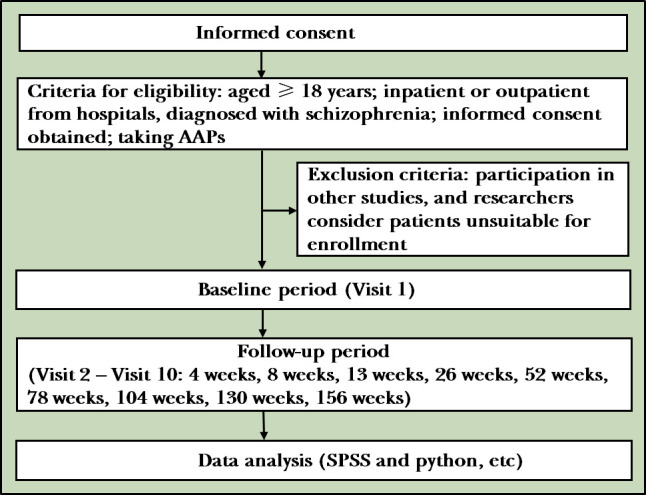
This study has an observational design. The atypical antipsychotics include quetiapine, olanzapine, risperidone, aripiprazole, ziprasidone, paliperidone, amisulpride, perospirone and clozapine. Visits occur at 0, 4, 8, 13, 26, 52, 78, 104, 130 and 156 weeks. The efficacy evaluations include symptoms, social function, recurrence rate and hospitalisation. The safety measures include physical examination, vital signs, abdominal circumference, laboratory tests (such as blood cell analysis, blood biochemical tests and serum prolactin/thyroxine levels), 12-lead ECG, extrapyramidal syndrome assessment, sexual function evaluation, medication and other adverse events. The secondary measures include the Positive and Negative Syndrome Scale, Clinical Global Impression-Severity of Illness Scale, Calgary Depression Scale for Schizophrenia, Personal and Social Performance Scale, relapse rate, drug consolidation, medical-related expenses, income, drug plasma concentration and genetic information.
This is a large sample, non-interventional and long-term prospective clinical study designed to truly reflect the specific details of clinical practice, fully respect patients' needs, and understand patients' treatment intentions and actual treatment details.
This research method details the aims, methods, study design, strengths and limitations of the study.
非典型抗精神病药物作为一线用药已在国内外用于精神分裂症患者。然而,其安全性仍需在大量人群中进行评估,尤其是中国患者。
本研究的主要目的是评估中国精神分裂症患者长期使用非典型抗精神病药物的安全性及相关因素。次要目的包括非典型抗精神病药物在这些患者中的长期疗效,以及药物经济学评估、群体药代动力学研究和药物基因组学研究。
本研究采用观察性设计。非典型抗精神病药物包括喹硫平、奥氮平、利培酮、阿立哌唑、齐拉西酮、帕利哌酮、氨磺必利、哌罗匹隆和氯氮平。访视时间点为第0、4、8、13、26、52、78、104、130和156周。疗效评估包括症状、社会功能、复发率和住院情况。安全性指标包括体格检查、生命体征、腹围、实验室检查(如血细胞分析、血液生化检查和血清催乳素/甲状腺素水平)、12导联心电图、锥体外系综合征评估、性功能评估、用药及其他不良事件。次要指标包括阳性和阴性症状量表、临床总体印象-疾病严重程度量表、精神分裂症卡尔加里抑郁量表、个人和社会功能量表、复发率、药物巩固情况、医疗相关费用、收入、药物血浆浓度和基因信息。
这是一项大样本、非干预性的长期前瞻性临床研究,旨在真实反映临床实践的具体细节,充分尊重患者需求,了解患者的治疗意愿和实际治疗细节。
本研究方法详细阐述了研究的目的、方法、研究设计、优势和局限性。