He Sidi, Yu Wen Juan, Wang Xiaoliang, Zhang Lei, Zhao Nan, Li Guanjun, Shen Yi Feng, Li Huafang
Shanghai Mental Health Center, Shanghai Jiao Tong University School of Medicine, Shanghai, China.
Shanghai Pudong New Area Mental Health Center, Shanghai, China.
Gen Psychiatr. 2020 Jul 6;33(4):e100206. doi: 10.1136/gpsych-2020-100206. eCollection 2020.
Hyperprolactinemia is a common adverse reaction in patients with schizophrenia who take antipsychotic drugs; it often leads to treatment non-compliance in patients and has an adverse effect on their prognosis.
This study aimed to explore the risk factors of elevated prolactin (PRL) caused by risperidone (RIS) and olanzapine (OLZ) and the relationship between PRL and fasting plasma glucose and lipids.
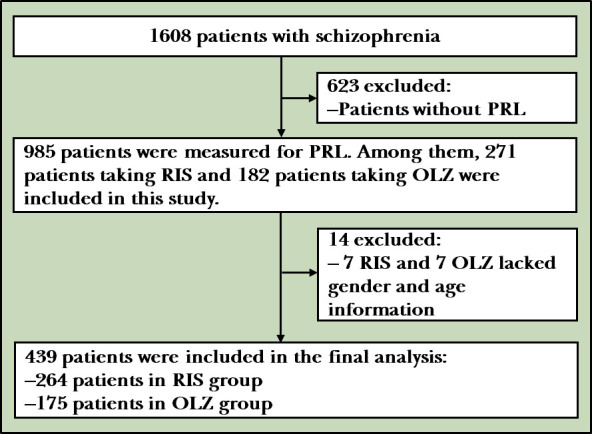
Patients with schizophrenia were divided into two groups: 264 patients who were taking RIS and 175 patients who were taking OLZ. These two groups were further divided according to serum PRL levels: an elevated PRL group (>30 ng/mL) and a normal PRL group (PRL ≤30 ng/mL). The demographics, medication dosage, fasting plasma glucose, total cholesterol and triglycerides were compared in the two groups. Logistic regression analysis was performed to explore the risk factors of elevated PRL levels.
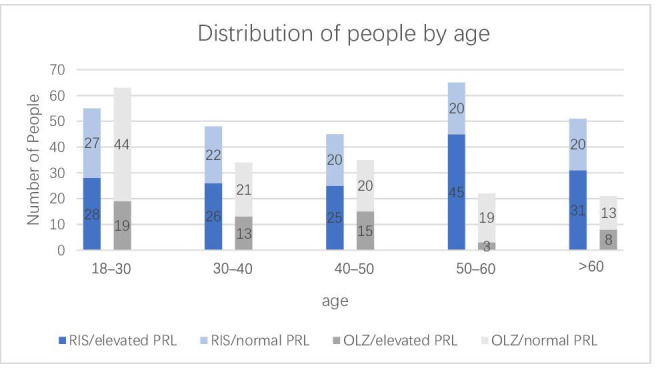
Compared with the OLZ group, the RIS group had a greater number of patients with elevated PRL (155/264 vs 58/175). Either the RIS or the OLZ group, the proportion of elevated PRL was greater in female patients (RIS: χ=6.76, p=0.009; OLZ: χ=12.98, p<0.001) and with higher doses of the related drugs (RIS: =-3.73, p<0.001; OLZ: =-2.31, p=0.021). In patients taking RIS, the elevated PRL subgroup took the drug for a longer period (=-2.76, p=0.006) and had lower triglyceride levels (=2.76, p=0.006). In patients taking OLZ, the elevated PRL subgroup had lower fasting plasma glucose levels (=2.29, p=0.022). Logistic regression analysis showed that gender, dose and fasting glucose levels were significantly associated with elevated PRL levels (RIS: p=0.001, OLZ: p<0.001; RIS: p<0.001; OLZ: p=0.003; RIS: p=0.020, OLZ: p=0.001, respectively).
Compared with OLZ, RIS had a greater effect on PRL in patients with schizophrenia, and in patients with schizophrenia taking RIS or OLZ, gender and dose were significantly correlated with the PRL value. Moreover, the plasma glucose level of the group with elevated PRL was lower than that of the group with normal PRL. The results also showed that high serum PRL may be associated with a favourable glucose metabolic profile in patients with schizophrenia taking RIS or OLZ. Further studies are warranted to confirm this association.
NCT02640911.
高催乳素血症是服用抗精神病药物的精神分裂症患者常见的不良反应;它常导致患者治疗依从性差,并对其预后产生不良影响。
本研究旨在探讨利培酮(RIS)和奥氮平(OLZ)引起催乳素(PRL)升高的危险因素以及PRL与空腹血糖和血脂之间的关系。
将精神分裂症患者分为两组:264例服用RIS的患者和175例服用OLZ的患者。这两组再根据血清PRL水平进一步分为:PRL升高组(>30 ng/mL)和PRL正常组(PRL≤30 ng/mL)。比较两组的人口统计学特征、药物剂量、空腹血糖、总胆固醇和甘油三酯。进行逻辑回归分析以探讨PRL水平升高的危险因素。
与OLZ组相比,RIS组PRL升高的患者数量更多(155/264 vs 58/175)。在RIS组或OLZ组中,女性患者PRL升高的比例更大(RIS:χ=6.76,p=0.009;OLZ:χ=12.98,p<0.001),且相关药物剂量更高(RIS:=-3.73,p<0.001;OLZ:=-2.31,p=0.021)。在服用RIS的患者中,PRL升高亚组服用该药的时间更长(=-2.76,p=0.006)且甘油三酯水平更低(=2.76,p=0.006)。在服用OLZ的患者中,PRL升高亚组的空腹血糖水平更低(=2.29,p=0.022)。逻辑回归分析表明,性别、剂量和空腹血糖水平与PRL水平升高显著相关(RIS:p=0.001,OLZ:p<0.001;RIS:p<0.001;OLZ:p=0.003;RIS:p=0.020,OLZ:p=0.001)。
与OLZ相比,RIS对精神分裂症患者的PRL影响更大,在服用RIS或OLZ的精神分裂症患者中,性别和剂量与PRL值显著相关。此外,PRL升高组的血浆葡萄糖水平低于PRL正常组。结果还表明,高血清PRL可能与服用RIS或OLZ的精神分裂症患者良好的糖代谢状况相关。需要进一步研究来证实这种关联。
NCT02640911。