Tissue Injury Branch, National Institute of Nursing Research (NIH), Bethesda, MD, USA.
Neurogenetics Branch, National Institute of Neurological Disorders and Stroke (NIH), Bethesda, MD, USA.
J Neuromuscul Dis. 2021;8(4):657-668. doi: 10.3233/JND-200549.
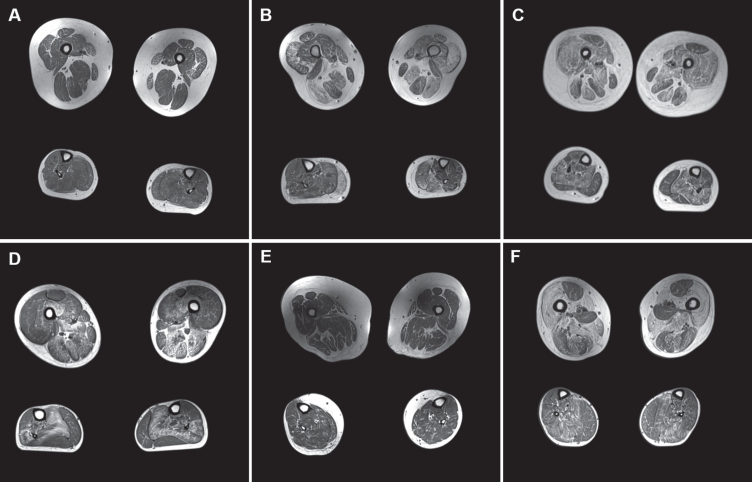
Ryanodine receptor 1-related myopathy (RYR1-RM) can present with a selective pattern and gradient of intramuscular fatty infiltration (IMFI) on magnetic resonance imaging (MRI).
To demonstrate an automated protocol for quantification of IMFI in the lower extremity muscles of individuals with RYR1-RM using T1-weighted MRI and to examine the relationships of IMFI with motor function and clinical severity.
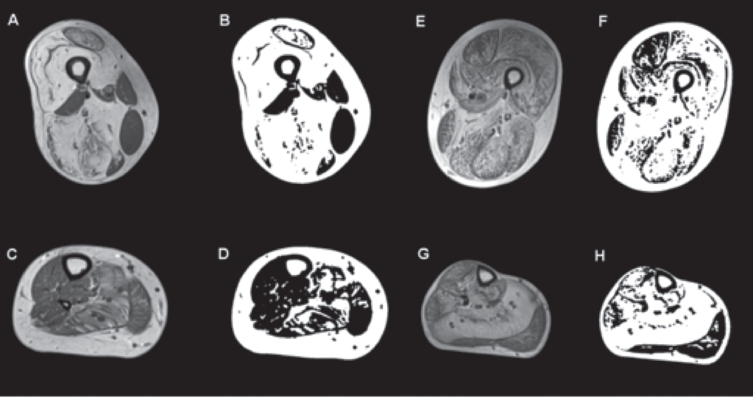
Axial images of the lower extremity muscles were acquired by T1-weighted fast spin-echo and short tau inversion recovery (STIR) sequences. A modified ImageJ-based program was used for quantification. IMFI data was analyzed by mode of inheritance, motor function, and clinical severity.
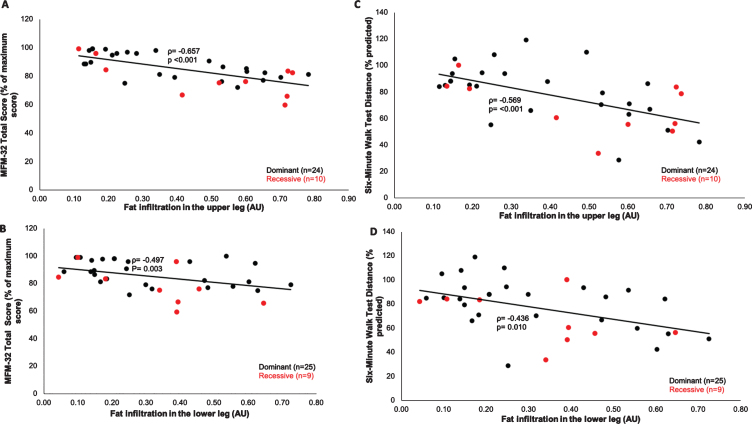
Upper and lower leg IMFI from 36 genetically confirmed and ambulatory RYR1-RM affected individuals (26 dominant and 10 recessive) were analyzed using Grey-scale quantification. There was no statistically significant difference in IMFI between dominant and recessive cases in upper or lower legs. IMFI in both upper and lower legs was inversely correlated with participant performance on the motor function measure (MFM-32) total score (upper leg: p < 0.001; lower leg: p = 0.003) and the six-minute walk test (6MWT) distance (upper leg: p < 0.001; lower leg: p = 0.010). There was no significant difference in mean IMFI between participants with mild versus severe clinical phenotypes (p = 0.257).
A modified ImageJ-based algorithm was able to select and quantify fatty infiltration in a cohort of heterogeneously affected individuals with RYR1-RM. IMFI was not predictive of mode of inheritance but showed strong correlation with motor function and capacity tests including MFM-32 and 6MWT, respectively.
Ryanodine 受体 1 相关肌病(RYR1-RM)在磁共振成像(MRI)上可表现出选择性的肌肉内脂肪浸润(IMFI)模式和梯度。
展示一种使用 T1 加权 MRI 对 RYR1-RM 个体下肢肌肉进行 IMFI 定量的自动化方案,并研究 IMFI 与运动功能和临床严重程度的关系。
使用 T1 加权快速自旋回波和短 tau 反转恢复(STIR)序列采集下肢肌肉的轴向图像。使用基于改良的 ImageJ 的程序进行定量。根据遗传方式、运动功能和临床严重程度分析 IMFI 数据。
对 36 名经基因证实且能走动的 RYR1-RM 受累个体(26 名显性遗传和 10 名隐性遗传)的上肢和下肢 IMFI 进行了 Grey-scale 量化分析。在上肢或下肢,显性和隐性病例的 IMFI 之间无统计学差异。上肢和下肢的 IMFI 均与运动功能量表(MFM-32)总分(上肢:p<0.001;下肢:p=0.003)和 6 分钟步行试验(6MWT)距离(上肢:p<0.001;下肢:p=0.010)呈负相关。在临床表型轻度与重度之间,IMFI 的平均值无显著差异(p=0.257)。
改良的基于 ImageJ 的算法能够在一组异质性 RYR1-RM 受累个体中选择和量化脂肪浸润。IMFI 与遗传方式无关,但与运动功能和包括 MFM-32 和 6MWT 在内的容量测试具有很强的相关性。