National Institute for Public Health and the Environment, Centre for Infectious Disease Control, Antonie van Leeuwenhoeklaan 9, Bilthoven 3720 BA, Netherlands.
University of Oxford, Department of Paediatrics, Oxford Vaccine Group, Oxford OX3 7LE, United Kingdom.
EBioMedicine. 2021 Mar;65:103247. doi: 10.1016/j.ebiom.2021.103247. Epub 2021 Feb 26.
Pertussis can lead to serious disease and even death in infants. Older adults are more vulnerable to complications as well. In high-income countries, acellular pertussis vaccines are used for priming vaccination. In the administration of booster vaccinations to different age groups and target populations there is a substantial between-country variation. We investigated the effect of age on the response to acellular pertussis booster vaccination in three European countries.
This phase IV longitudinal intervention study performed in Finland, the Netherlands and the United Kingdom between October 2017 and January 2019 compared the vaccine responses between healthy participants of four age groups: children (7-10y), adolescents (11-15y), young adults (20-34y), and older adults (60-70y). All participants received a three-component acellular pertussis vaccine. Serum IgG and IgA antibody concentrations to pertussis antigens at day 0, 28, and 1 year were measured with a multiplex immunoassay, using pertussis toxin concentrations at day 28 as primary outcome. This trial is registered with ClinicalTrialsRegister.eu (2016-003,678-42).
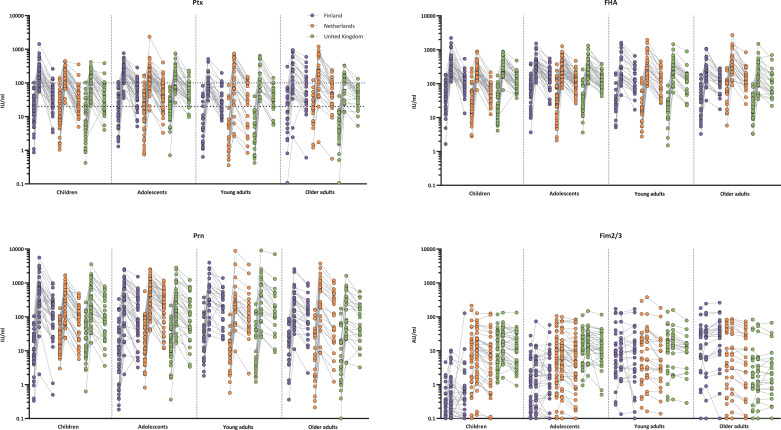
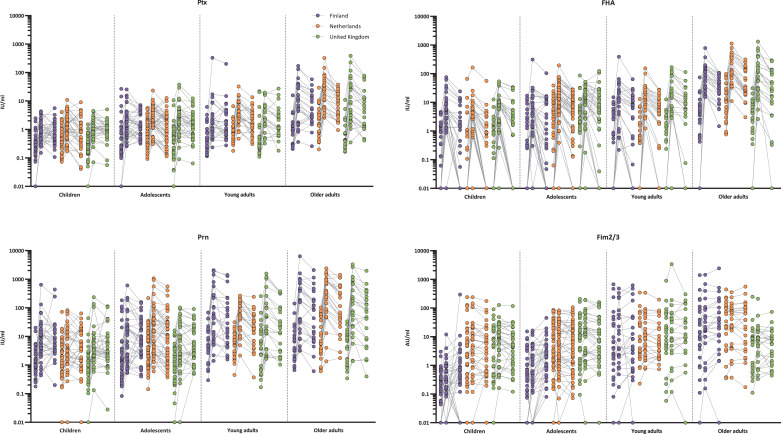
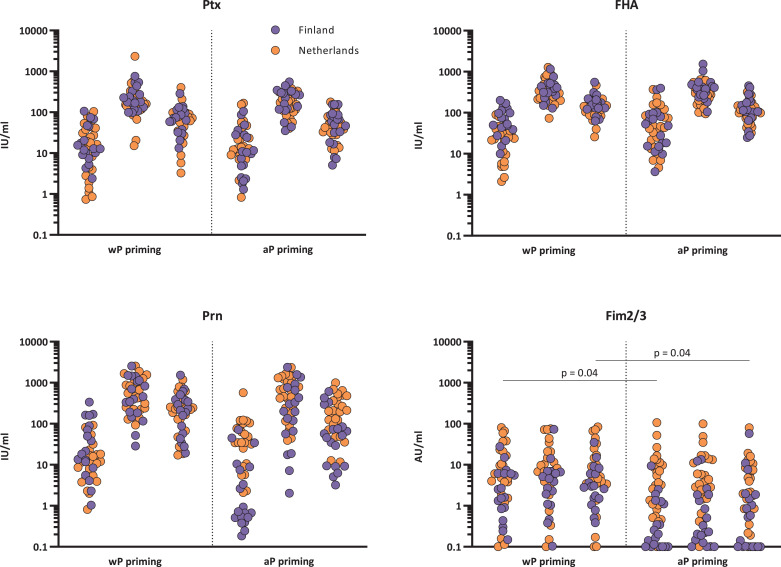
Children (n = 109), adolescents (n = 121), young adults (n = 74), and older adults (n = 75) showed high IgG antibody concentrations to pertussis toxin at day 28 with GMCs of 147 (95% CI 120-181), 161 (95% CI 132-196), 103 (95% CI 80-133), and 121 IU/ml (95% CI 94-155), respectively. A significant increase in GMCs for vaccine antigens in all age groups by 28 days was found which had decreased by 1 year. Differences in patterns of IgG GMCs at 28 days and 1 year post-vaccination did not have a consistent relationship to age. In contrast, IgA antibodies for all antigens increased with age at all timepoints.
Acellular pertussis booster vaccination induces significant serum IgG responses to pertussis antigens across the age range which are not uniformly less in older adults. Acellular boosters could be considered for older adults to reduce the health and economic burden of pertussis.
百日咳可导致婴儿罹患严重疾病甚至死亡,老年人也更容易出现并发症。在高收入国家,使用无细胞百日咳疫苗进行基础免疫接种。在为不同年龄组和目标人群接种加强针时,各国之间存在很大的差异。我们研究了年龄对 3 个欧洲国家无细胞百日咳加强针接种反应的影响。
这项于 2017 年 10 月至 2019 年 1 月在芬兰、荷兰和英国进行的 4 期纵向干预研究比较了 4 个年龄组(7-10 岁、11-15 岁、20-34 岁和 60-70 岁)健康参与者之间的疫苗反应。所有参与者均接种了三组分无细胞百日咳疫苗。使用微阵列免疫分析法于第 0、28 和 1 天测量血清 IgG 和 IgA 抗体对百日咳抗原的浓度,以第 28 天的百日咳毒素浓度作为主要结果。本试验在 ClinicalTrialsRegister.eu 注册(2016-003,678-42)。
儿童(n=109)、青少年(n=121)、青年成年人(n=74)和老年人(n=75)在第 28 天对百日咳毒素的 IgG 抗体浓度较高,几何平均浓度(GMC)分别为 147(95%CI 120-181)、161(95%CI 132-196)、103(95%CI 80-133)和 121 IU/ml(95%CI 94-155)。所有年龄组在 28 天内疫苗抗原的 GMC 均显著增加,1 年后则有所下降。接种疫苗后 28 天和 1 年时 IgG GMC 模式的差异与年龄无一致关系。相比之下,所有抗原的 IgA 抗体随年龄增加而增加,在所有时间点均如此。
无细胞百日咳加强针接种可诱导全年龄段对百日咳抗原产生显著的血清 IgG 反应,老年人的反应并不一致较低。可考虑为老年人接种无细胞疫苗,以降低百日咳的健康和经济负担。