Jang Jae Hoon, Moon Nam Hoon, Rhee Seung Joon, Jung Seok Jin, Ahn Tae Young
Department of Orthopedic Surgery, Bio-medical Research Institute, Trauma Center, Pusan National University Hospital, 179 Gudeok-Ro Seo-Gu, Busan, 49241, Republic of Korea.
Department of Orthopedic Surgery, Bio-medical Research Institute, Pusan National University Hospital, 179 Gudeok-Ro Seo-Gu, Busan, 49241, Republic of Korea.
BMC Musculoskelet Disord. 2021 Mar 1;22(1):222. doi: 10.1186/s12891-021-04082-2.
Transverse acetabular fractures, although classified as elementary, have worse outcomes than other types of acetabular fractures. Prognostic factors for this fracture type are not clearly established. This study aimed to assess the surgical outcomes of transverse acetabular fractures and subtypes thereof and to investigate the prognostic factors.
Between 2014 and 2019, 39 patients (39 hips) had transverse fractures or subtypes thereof. We reviewed the surgical outcomes and evaluated patient factors, injury factors, and surgical factors in relation to osteoarthritis (OA) and conversion to total hip arthroplasty (THA). Additionally, we analyzed the cutoff values for postoperative residual gaps and steps.
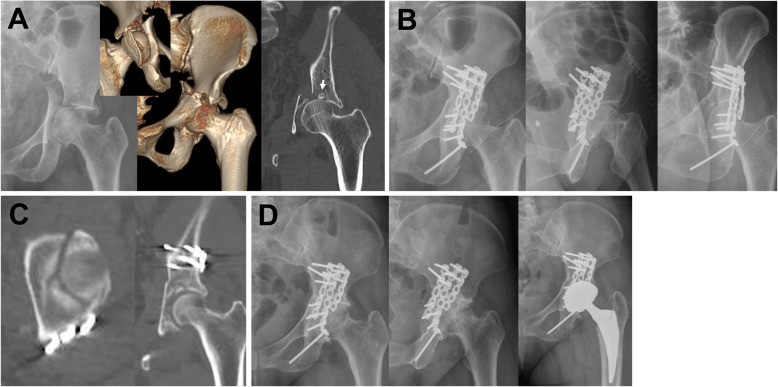
Twenty-three male patients and sixteen female with a mean age of 41.7 years (range, 18-78 years) were included. There were 29 satisfactory reductions (74.4%). Eleven hips (28.2%) developed OA, and five (12.8%) of them underwent THA. Dome impaction (odds ratio [OR], 41.173; 95% confidence interval [CI], 1.804-939.814; p = 0.020) and residual gaps (OR, 4.251; 95% CI, 1.248-14.479; p = 0.021) were correlated with poor outcomes. Residual gaps (≥3 mm) and residual steps (≥1 mm) were significantly associated with OA.
Relatively poor reduction was found for transverse acetabular fractures and subtypes thereof. However, the rates of OA and conversion to THA were not high. Dome impaction and wide residual gaps were identified as risk factors for poor outcomes. The development of OA significantly increased if residual gap and step were more than 3 mm and 1 mm, respectively.
髋臼横行骨折虽被归类为基本骨折类型,但其预后比其他类型的髋臼骨折更差。该骨折类型的预后因素尚未明确确立。本研究旨在评估髋臼横行骨折及其亚型的手术疗效,并探究预后因素。
2014年至2019年间,39例患者(39髋)发生髋臼横行骨折或其亚型骨折。我们回顾了手术疗效,并评估了与骨关节炎(OA)和转为全髋关节置换术(THA)相关的患者因素、损伤因素和手术因素。此外,我们分析了术后残余间隙和台阶的临界值。
纳入23例男性患者和16例女性患者,平均年龄41.7岁(范围18 - 78岁)。29例复位满意(74.4%)。11髋(28.2%)发生OA,其中5髋(12.8%)接受了THA。穹顶撞击(比值比[OR],41.173;95%置信区间[CI],1.804 - 939.814;p = 0.020)和残余间隙(OR,4.251;95% CI,1.248 - 14.479;p = 0.021)与不良预后相关。残余间隙(≥3 mm)和残余台阶(≥1 mm)与OA显著相关。
髋臼横行骨折及其亚型的复位相对较差。然而,OA发生率和转为THA的比例并不高。穹顶撞击和较宽的残余间隙被确定为不良预后的危险因素。如果残余间隙和台阶分别大于3 mm和1 mm,OA的发生率会显著增加。