Department of Paediatrics, Faculty of Medicine, University of Kelaniya, Thalagolla Road, Ragama, 11010, Sri Lanka.
Department of Medicine, Faculty of Medicine, University of Kelaniya, Ragama, Sri Lanka.
Orphanet J Rare Dis. 2021 Mar 1;16(1):114. doi: 10.1186/s13023-021-01757-w.
Hydroxyurea is one of the earliest drugs that showed promise in the management of haemoglobinopathies that include β-thalassaemia and sickle cell disease. Despite this, many aspects of hydroxyurea are either unknown or understudied; specifically, its usefulness in β-thalassaemia major and haemoglobin E β-thalassaemia is unclear. However, during COVID-19 pandemic, it has become a valuable adjunct to transfusion therapy in patients with β-haemoglobinopathies. In this review, we aim to explore the available in vitro and in vivo mechanistic data and the clinical utility of hydroxyurea in β-haemoglobinopathies with a special emphasis on its usefulness during the COVID-19 pandemic.
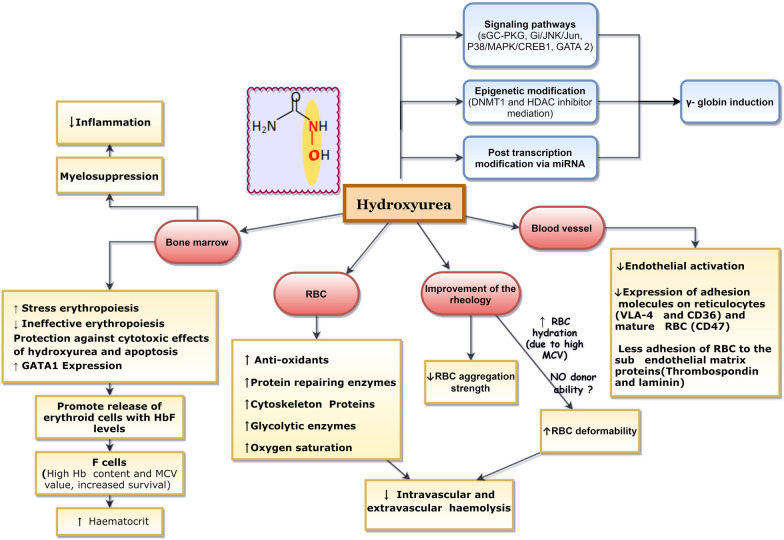
Hydroxyurea is an S-phase-specific drug that reversibly inhibits ribonucleoside diphosphate reductase enzyme which catalyses an essential step in the DNA biosynthesis. In human erythroid cells, it induces the expression of γ-globin, a fetal globin gene that is suppressed after birth. Through several molecular pathways described in this review, hydroxyurea exerts many favourable effects on the haemoglobin content, red blood cell indices, ineffective erythropoiesis, and blood rheology in patients with β-haemoglobinopathies. Currently, it is recommended for sickle cell disease and non-transfusion dependent β-thalassaemia. A number of clinical trials are ongoing to evaluate its usefulness in transfusion dependent β-thalassaemia. During the COVID-19 pandemic, it was widely used as an adjunct to transfusion therapy due to limitations in the availability of blood and logistical disturbances. Thus, it has become clear that hydroxyurea could play a remarkable role in reducing transfusion requirements of patients with haemoglobinopathies, especially when donor blood is a limited resource.
Hydroxyurea is a well-tolerated oral drug which has been in use for many decades. Through its actions of reversible inhibition of ribonucleoside diphosphate reductase enzyme and fetal haemoglobin induction, it exerts many favourable effects on patients with β-haemoglobinopathies. It is currently approved for the treatment of sickle cell disease and non-transfusion dependent β-thalassaemia. Also, there are various observations to suggest that hydroxyurea is an important adjunct in the treatment of transfusion dependent β-thalassaemia which should be confirmed by randomised clinical trials.
羟脲是最早在包括β-地中海贫血和镰状细胞病在内的血红蛋白病治疗中显示出前景的药物之一。尽管如此,羟脲的许多方面要么是未知的,要么是研究不足的;特别是它在重型β-地中海贫血和血红蛋白 E β-地中海贫血中的用途尚不清楚。然而,在 COVID-19 大流行期间,它已成为β-血红蛋白病患者输血治疗的一种有价值的辅助药物。在本综述中,我们旨在探讨羟脲在β-血红蛋白病中的现有体外和体内机制数据及其临床应用,特别强调其在 COVID-19 大流行期间的用途。
羟脲是一种 S 期特异性药物,可逆地抑制核糖核苷酸二磷酸还原酶,该酶催化 DNA 生物合成中的一个关键步骤。在人类红细胞中,它诱导γ-珠蛋白的表达,γ-珠蛋白是一种出生后被抑制的胎儿珠蛋白基因。通过本综述中描述的几种分子途径,羟脲对β-血红蛋白病患者的血红蛋白含量、红细胞指数、无效红细胞生成和血液流变学产生许多有利影响。目前,它被推荐用于镰状细胞病和非输血依赖型β-地中海贫血。目前正在进行多项临床试验,以评估其在输血依赖型β-地中海贫血中的用途。在 COVID-19 大流行期间,由于血液供应有限和物流干扰,它被广泛用作输血治疗的辅助药物。因此,羟脲可以显著降低血红蛋白病患者的输血需求,尤其是当供体血液是有限资源时,这一点已经变得很清楚。
羟脲是一种耐受良好的口服药物,已使用了数十年。通过其对核糖核苷酸二磷酸还原酶的可逆抑制和胎儿血红蛋白的诱导作用,它对β-血红蛋白病患者产生了许多有利影响。它目前被批准用于治疗镰状细胞病和非输血依赖型β-地中海贫血。此外,有各种观察结果表明,羟脲是输血依赖型β-地中海贫血治疗的重要辅助药物,这需要通过随机临床试验来证实。