Department of Radiation Oncology, Nanfang Hospital, Southern Medical University, Guangzhou, Guangdong, China.
Chronic Airways Diseases Laboratory, Department of Respiratory and Critical Care Medicine, Nanfang Hospital, Southern Medical University, Guangzhou, Guangdong, China.
J Exp Clin Cancer Res. 2021 Mar 1;40(1):87. doi: 10.1186/s13046-021-01878-x.
Irradiation has emerged as a valid tool for nasopharyngeal carcinoma (NPC) in situ treatment; however, NPC derived from tissues treated with irradiation is a main cause cancer-related death. The purpose of this study is to uncover the underlying mechanism regarding tumor growth after irradiation and provided potential therapeutic strategy.
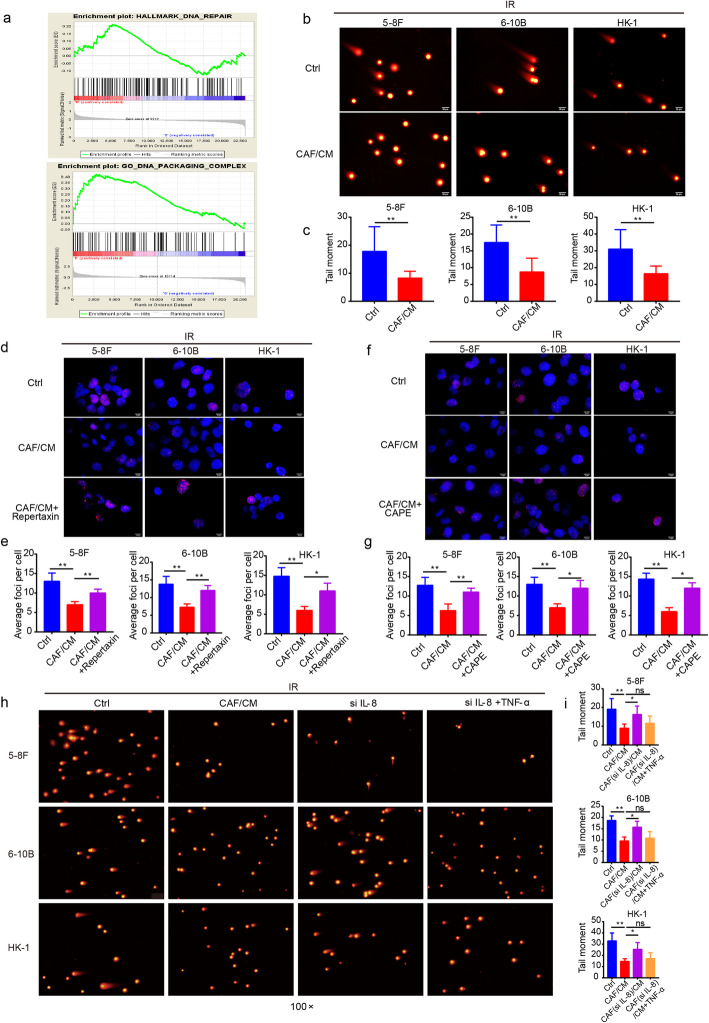
Fibroblasts were extracted from fresh NPC tissue and normal nasopharyngeal mucosa. Immunohistochemistry was conducted to measure the expression of α-SMA and FAP. Cytokines were detected by protein array chip and identified by real-time PCR. CCK-8 assay was used to detect cell proliferation. Radiation-resistant (IRR) 5-8F cell line was established and colony assay was performed to evaluate tumor cell growth after irradiation. Signaling pathways were acquired via gene set enrichment analysis (GSEA). Comet assay and γ-H2AX foci assay were used to measure DNA damage level. Protein expression was detected by western blot assay. In vivo experiment was performed subcutaneously.
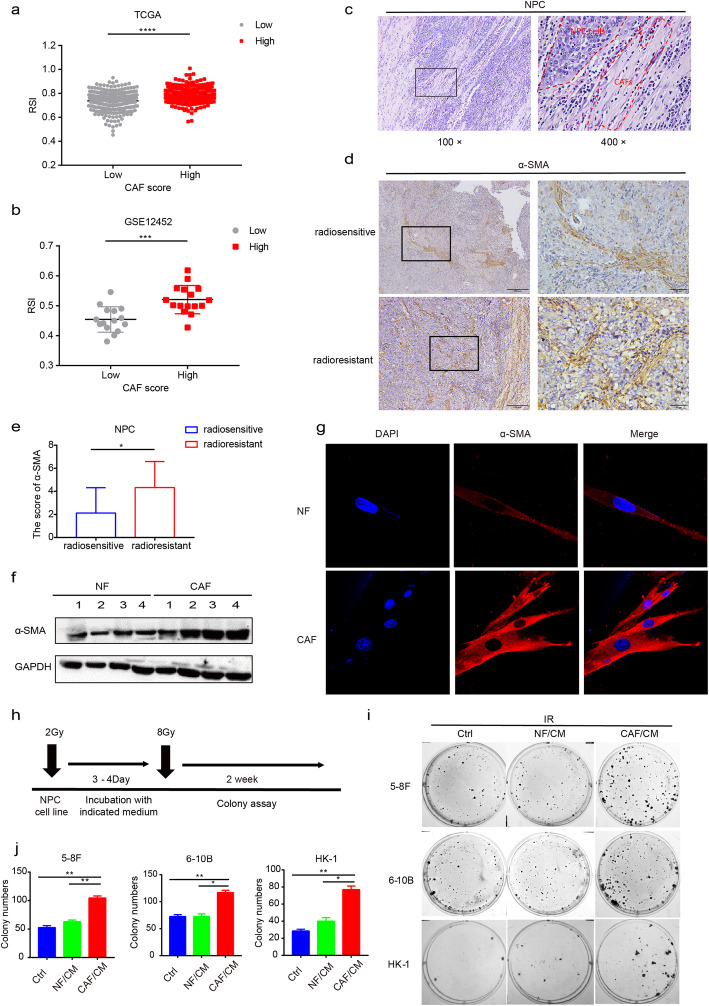
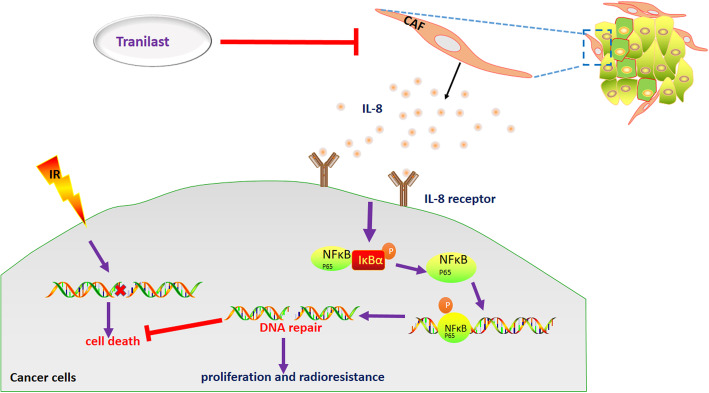
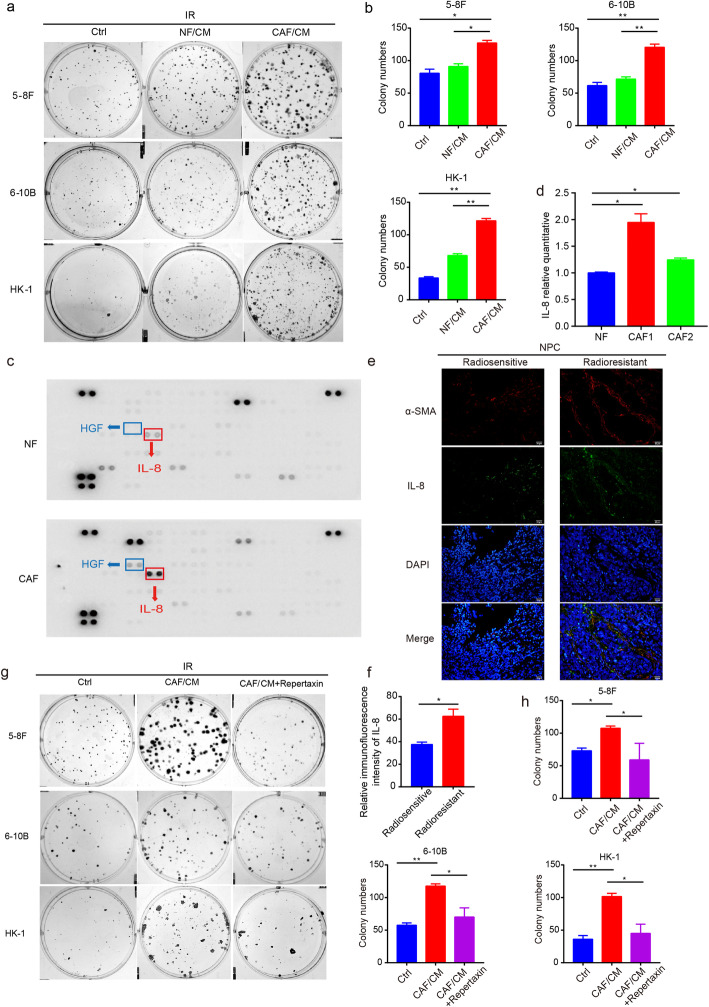
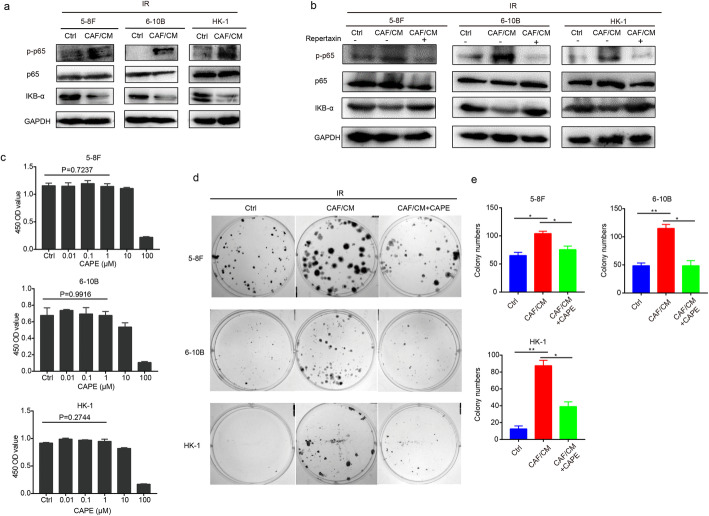
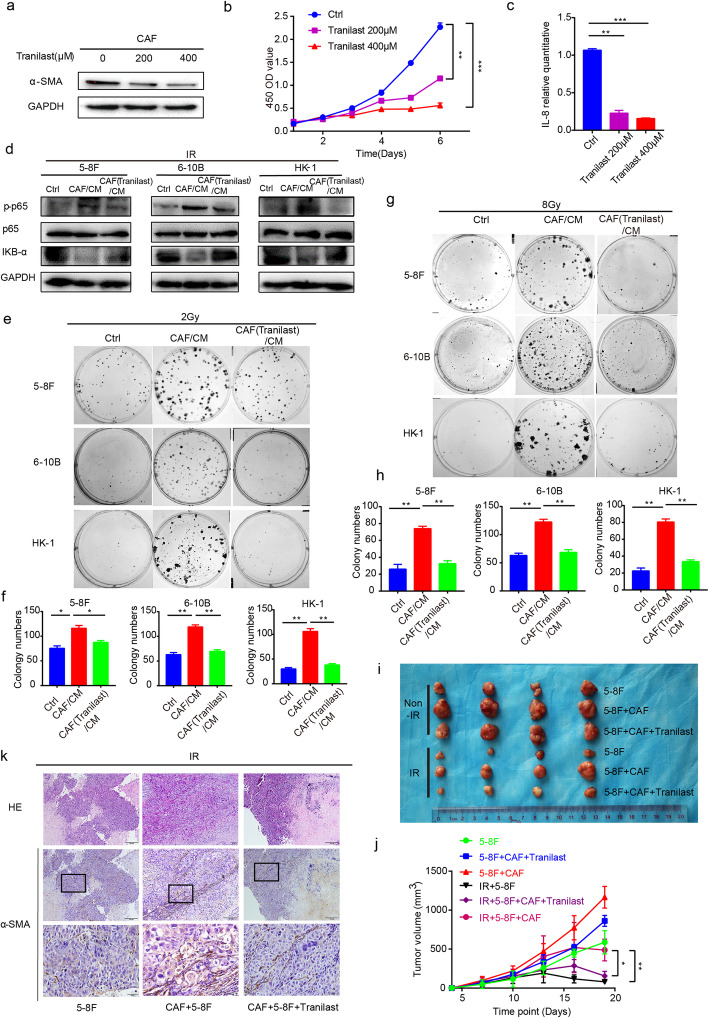
We found that radiation-resistant NPC tissues were constantly infiltrated with a greater number of cancer-associated fibroblasts (CAFs) compared to radiosensitive NPC tissues. Further research revealed that CAFs induced the formation of radioresistance and promoted NPC cell survival following irradiation via the IL-8/NF-κB pathway to reduce irradiation-induced DNA damage. Treatment with Tranilast, a CAF inhibitor, restricted the survival of CAF-induced NPC cells and attenuated the of radioresistance properties.
Together, these data demonstrate that CAFs can promote the survival of irradiated NPC cells via the NF-κB pathway and induce radioresistance that can be interrupted by Tranilast, suggesting the potential value of Tranilast in sensitizing NPC cells to irradiation.
放射治疗已成为治疗鼻咽癌(NPC)原位的有效手段;然而,NPC 来源于接受放射治疗的组织,是癌症相关死亡的主要原因。本研究旨在揭示放射治疗后肿瘤生长的潜在机制,并提供潜在的治疗策略。
从新鲜 NPC 组织和正常鼻咽黏膜中提取成纤维细胞。通过免疫组织化学法测量α-SMA 和 FAP 的表达。通过蛋白质芯片检测细胞因子,并通过实时 PCR 进行鉴定。CCK-8 检测细胞增殖。建立耐辐射(IRR)5-8F 细胞系,进行集落形成实验评估照射后肿瘤细胞生长情况。通过基因集富集分析(GSEA)获得信号通路。彗星实验和γ-H2AX 焦点实验用于测量 DNA 损伤水平。通过 Western blot 检测蛋白表达。进行皮下体内实验。
我们发现,与放射敏感 NPC 组织相比,耐辐射 NPC 组织中不断浸润着更多的癌相关成纤维细胞(CAFs)。进一步的研究表明,CAFs 通过 IL-8/NF-κB 通路诱导放射抵抗的形成,并促进照射后 NPC 细胞的存活,从而减少照射诱导的 DNA 损伤。使用 CAF 抑制剂曲尼司特治疗可限制 CAF 诱导的 NPC 细胞的存活,并减弱其放射抵抗特性。
综上所述,这些数据表明 CAFs 可通过 NF-κB 通路促进照射后 NPC 细胞的存活,并诱导放射抵抗,曲尼司特可阻断该过程,提示曲尼司特在增强 NPC 细胞对放疗的敏感性方面具有潜在价值。