• 文献检索
  • 文档翻译
  • 深度研究
  • 学术资讯
  • Suppr Zotero 插件Zotero 插件
  • 邀请有礼
  • 套餐&价格
  • 历史记录
应用&插件
Suppr Zotero 插件Zotero 插件浏览器插件Mac 客户端Windows 客户端微信小程序
定价
高级版会员购买积分包购买API积分包
服务
文献检索文档翻译深度研究API 文档MCP 服务
关于我们
关于 Suppr公司介绍联系我们用户协议隐私条款
关注我们

Suppr 超能文献

核心技术专利:CN118964589B侵权必究
粤ICP备2023148730 号-1Suppr @ 2026

文献检索

告别复杂PubMed语法,用中文像聊天一样搜索,搜遍4000万医学文献。AI智能推荐,让科研检索更轻松。

立即免费搜索

文件翻译

保留排版,准确专业,支持PDF/Word/PPT等文件格式,支持 12+语言互译。

免费翻译文档

深度研究

AI帮你快速写综述,25分钟生成高质量综述,智能提取关键信息,辅助科研写作。

立即免费体验

评估开放性骨折术前水性抗菌皮肤溶液的实用性随机试验(水性预处理):一项整群随机交叉研究的可行性

Pragmatic randomized trial evaluating pre-operative aqueous antiseptic skin solution in open fractures (Aqueous-PREP): the feasibility of a cluster randomized crossover study.

作者信息

Sprague Sheila, Guyatt Paige, Bzovsky Sofia, Nguyen Uyen, Bhandari Mohit, Thabane Lehana, Petrisor Brad, Johal Herman S, Leonard Jordan, Dodds Shannon, Mossuto Franca, O'Toole Robert V, Howe Andrea, Demyanovich Haley K, Camara Megan, O'Hara Nathan N, Slobogean Gerard P

机构信息

Division of Orthopedic Surgery, Department of Surgery, McMaster University, Hamilton, Ontario, Canada.

Department of Health Research Methods, Evidence, and Impact, McMaster University, Hamilton, Ontario, Canada.

出版信息

Pilot Feasibility Stud. 2021 Mar 1;7(1):61. doi: 10.1186/s40814-021-00800-8.

DOI:10.1186/s40814-021-00800-8
PMID:33648577
原文链接:https://pmc.ncbi.nlm.nih.gov/articles/PMC7919062/
Abstract

BACKGROUND

Preoperative antiseptic skin solutions are used prior to most surgical procedures; however, there is no definitive research comparing infection-related outcomes following use of the various solutions available to orthopedic trauma surgeons. The objective of this pilot study was to test the feasibility of a cluster randomized crossover trial that assesses the comparative effectiveness of a 10% povidone-iodine solution versus a 4% chlorhexidine gluconate solution for the management of open fractures.

METHODS

Two orthopedic trauma centers participated in this pilot study. Each of these clinical sites was randomized to a starting solution (povidone-iodine solution or chlorhexidine gluconate) then subsequently crossed over to the other treatment after 2 months. During the 4-month enrollment phase, we assessed compliance, enrollment rates, participant follow-up, and accurate documentation of the primary clinical outcome. Feasibility outcomes included (1) the implementation of the interventions during a run-in period; (2) enrollment of participants during two 2-month enrollment phases; (3) application of the trial interventions as per the cluster randomization crossover scheme; (4) participant follow-up; and (5) accurate documentation of the primary outcome (surgical site infection). Feasibility outcomes were summarized using descriptive statistics reported as means (standard deviation) or medians (first quartile, third quartile) for continuous variables depending on their distribution and counts (percentage) for categorical variables. Corresponding 95% confidence intervals (CIs) were also reported.

RESULTS

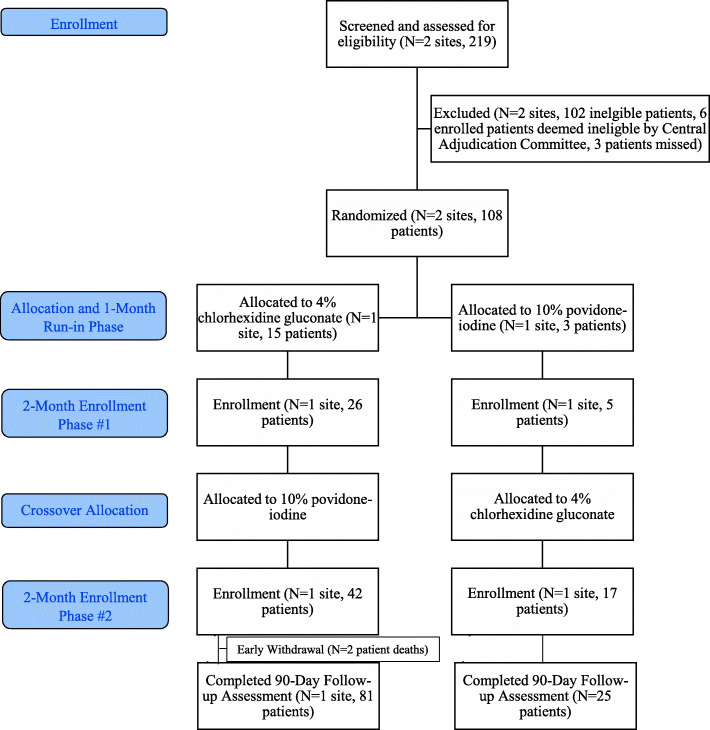
All five of the criteria for feasibility were met. During the run-in phase, all 18 of the eligible patients identified at the two clinical sites received the correct cluster-assigned treatment. A total of 135 patients were enrolled across both sites during the 4-month recruitment phase, which equates to 92% (95% CI 85.9 to 96.4%) of eligible patients being enrolled. Compliance with the assigned treatment in the pilot study was 98% (95% CI 93.5 to 99.8%). Ninety-eight percent (95% CI 93.5 to 99.8%) of participants completed the 90-day post-surgery follow-up and the primary outcome (SSI) was accurately documented for 100% (95% CI 96.6 to 100.0%) of the participants.

CONCLUSIONS

These results confirm the feasibility of a definitive study comparing antiseptic solutions using a cluster randomized crossover trial design. Building upon the infrastructure established during the pilot phase, a definitive study has been successfully initiated.

TRIAL REGISTRATION

ClincialTrials.gov , number NCT03385304 . Registered December 28, 2017.

摘要

背景

大多数外科手术前都会使用术前抗菌皮肤溶液;然而,对于骨科创伤外科医生可获得的各种溶液使用后与感染相关的结果,尚无明确的研究进行比较。这项初步研究的目的是测试一项整群随机交叉试验的可行性,该试验评估10%聚维酮碘溶液与4%葡萄糖酸氯己定溶液在开放性骨折治疗中的相对有效性。

方法

两个骨科创伤中心参与了这项初步研究。每个临床地点被随机分配一种起始溶液(聚维酮碘溶液或葡萄糖酸氯己定溶液),然后在2个月后交叉使用另一种治疗方法。在4个月的入组阶段,我们评估了依从性、入组率、参与者随访情况以及主要临床结果的准确记录。可行性结果包括:(1)在试运行期内实施干预措施;(2)在两个2个月的入组阶段招募参与者;(3)按照整群随机交叉方案应用试验干预措施;(4)参与者随访;(5)准确记录主要结果(手术部位感染)。可行性结果使用描述性统计进行总结,连续变量根据其分布情况报告为均值(标准差)或中位数(第一四分位数、第三四分位数),分类变量报告为计数(百分比)。还报告了相应的95%置信区间(CI)。

结果

所有五项可行性标准均得到满足。在试运行阶段,两个临床地点确定的所有18名符合条件的患者均接受了正确分配的整群治疗。在4个月的招募阶段,两个地点共招募了135名患者,这相当于92%(95%CI 85.9%至96.4%)的符合条件患者被纳入研究。初步研究中对分配治疗的依从性为98%(95%CI 93.5%至99.8%)。98%(95%CI 93.5%至99.8%)的参与者完成了术后90天的随访,100%(95%CI 96.6%至100.0%)的参与者的主要结果(手术部位感染)得到了准确记录。

结论

这些结果证实了使用整群随机交叉试验设计比较抗菌溶液的确定性研究的可行性。在初步阶段建立的基础设施基础上,一项确定性研究已成功启动。

试验注册

ClinicalTrials.gov,编号NCT03385304。2017年12月28日注册。
https://cdn.ncbi.nlm.nih.gov/pmc/blobs/3c90/7919062/a0cfb0550a4c/40814_2021_800_Fig1_HTML.jpg

相似文献

1
Pragmatic randomized trial evaluating pre-operative aqueous antiseptic skin solution in open fractures (Aqueous-PREP): the feasibility of a cluster randomized crossover study.评估开放性骨折术前水性抗菌皮肤溶液的实用性随机试验(水性预处理):一项整群随机交叉研究的可行性
Pilot Feasibility Stud. 2021 Mar 1;7(1):61. doi: 10.1186/s40814-021-00800-8.
2
Effectiveness of Iodophor vs Chlorhexidine Solutions for Surgical Site Infections and Unplanned Reoperations for Patients Who Underwent Fracture Repair: The PREP-IT Master Protocol.碘制剂与洗必泰溶液用于骨折修复患者的手术部位感染和非计划再手术的效果:PREP-IT 主方案。
JAMA Netw Open. 2020 Apr 1;3(4):e202215. doi: 10.1001/jamanetworkopen.2020.2215.
3
Aqueous skin antisepsis before surgical fixation of open fractures (Aqueous-PREP): a multiple-period, cluster-randomised, crossover trial.水性皮肤消毒剂在开放性骨折手术固定前的应用(Aqueous-PREP):一项多周期、整群随机、交叉试验。
Lancet. 2022 Oct 15;400(10360):1334-1344. doi: 10.1016/S0140-6736(22)01652-X.
4
A pragmatic randomized trial evaluating pre-operative aqueous antiseptic skin solutions in open fractures (Aqueous-PREP): statistical analysis plan.一项评价开放性骨折患者术前使用水性抗菌皮肤溶液的实用随机临床试验(Aqueous-PREP):统计分析计划。
Trials. 2022 Sep 12;23(1):772. doi: 10.1186/s13063-022-06541-0.
5
Cluster identification, selection, and description in cluster randomized crossover trials: the PREP-IT trials.在整群随机交叉试验中对群组的识别、选择和描述:PREP-IT 试验。
Trials. 2020 Aug 12;21(1):712. doi: 10.1186/s13063-020-04611-9.
6
A randomized open-label controlled trial of chlorhexidine-alcohol vs povidone-iodine for cesarean antisepsis: the CAPICA trial.氯己定-酒精与聚维酮碘用于剖宫产术皮肤消毒的随机开放标签对照试验:CAPICA试验
Am J Obstet Gynecol. 2017 Oct;217(4):463.e1-463.e8. doi: 10.1016/j.ajog.2017.05.060. Epub 2017 Jun 7.
7
Skin preparation for preventing infection following caesarean section.剖宫产术后预防感染的皮肤准备
Cochrane Database Syst Rev. 2014 Sep 17(9):CD007462. doi: 10.1002/14651858.CD007462.pub3.
8
Safety and efficacy of 2% chlorhexidine gluconate aqueous versus 2% chlorhexidine gluconate in 70% isopropyl alcohol for skin disinfection prior to percutaneous central venous catheter insertion in preterm neonates: the ARCTIC randomised-controlled feasibility trial protocol.2%葡萄糖酸氯己定水溶液与 2%葡萄糖酸氯己定在 70%异丙醇用于早产儿经皮中心静脉置管前皮肤消毒的安全性和有效性:ARCTIC 随机对照可行性试验方案。
BMJ Open. 2019 Feb 19;9(2):e028022. doi: 10.1136/bmjopen-2018-028022.
9
Large variations in the practice patterns of surgical antiseptic preparation solutions in patients with open and closed extremity fractures: a cross-sectional survey.开放性和闭合性四肢骨折患者外科抗菌准备溶液的实践模式存在较大差异:一项横断面调查。
Antimicrob Resist Infect Control. 2018 Nov 29;7:148. doi: 10.1186/s13756-018-0440-z. eCollection 2018.
10
Aqueous olanexidine versus aqueous povidone-iodine for surgical skin antisepsis on the incidence of surgical site infections after clean-contaminated surgery: a multicentre, prospective, blinded-endpoint, randomised controlled trial.洗必泰葡萄糖酸洗必泰与聚维酮碘用于清洁污染手术术后手术部位感染发生率:一项多中心、前瞻性、盲终点、随机对照试验。
Lancet Infect Dis. 2020 Nov;20(11):1281-1289. doi: 10.1016/S1473-3099(20)30225-5. Epub 2020 Jun 15.

引用本文的文献

1
Cognitive Behavioural Therapy to Optimize Post-Operative Recovery (COPE): a randomized controlled feasibility trial in extremity fracture patients.认知行为疗法优化术后恢复(COPE):一项针对四肢骨折患者的随机对照可行性试验
Pilot Feasibility Stud. 2025 Jan 11;11(1):3. doi: 10.1186/s40814-024-01592-3.

本文引用的文献

1
The Comparative Efficacy of Chlorhexidine Gluconate and Povidone-iodine Antiseptics for the Prevention of Infection in Clean Surgery: A Systematic Review and Network Meta-analysis.氯己定葡萄糖酸盐和聚维酮碘消毒剂预防清洁手术感染的比较疗效:系统评价和网络荟萃分析。
Ann Surg. 2021 Dec 1;274(6):e481-e488. doi: 10.1097/SLA.0000000000004076.
2
Effectiveness of Iodophor vs Chlorhexidine Solutions for Surgical Site Infections and Unplanned Reoperations for Patients Who Underwent Fracture Repair: The PREP-IT Master Protocol.碘制剂与洗必泰溶液用于骨折修复患者的手术部位感染和非计划再手术的效果:PREP-IT 主方案。
JAMA Netw Open. 2020 Apr 1;3(4):e202215. doi: 10.1001/jamanetworkopen.2020.2215.
3
CONSORT 2010 statement: extension to randomised pilot and feasibility trials.
《CONSORT 2010声明:随机试点和可行性试验的扩展》
BMJ. 2016 Oct 24;355:i5239. doi: 10.1136/bmj.i5239.
4
A Randomized Trial Comparing Skin Antiseptic Agents at Cesarean Delivery.剖宫产术中皮肤消毒剂比较的随机试验
N Engl J Med. 2016 Feb 18;374(7):647-55. doi: 10.1056/NEJMoa1511048. Epub 2016 Feb 4.
5
Appropriate statistical methods were infrequently used in cluster-randomized crossover trials.在整群随机交叉试验中,适当的统计方法很少被使用。
J Clin Epidemiol. 2016 Jun;74:40-50. doi: 10.1016/j.jclinepi.2015.11.013. Epub 2015 Nov 26.
6
Consort 2010 statement: extension to cluster randomised trials.《CONSORT 2010声明:群组随机试验扩展版》
BMJ. 2012 Sep 4;345:e5661. doi: 10.1136/bmj.e5661.
7
Importance of alcohol in skin preparation protocols.酒精在皮肤准备方案中的重要性。
Infect Control Hosp Epidemiol. 2010 Sep;31(9):977. doi: 10.1086/655843.
8
Chlorhexidine-Alcohol versus Povidone-Iodine for Surgical-Site Antisepsis.氯己定-酒精与聚维酮碘用于手术部位消毒。
N Engl J Med. 2010 Jan 7;362(1):18-26. doi: 10.1056/NEJMoa0810988.
9
Effects of preoperative skin preparation on postoperative wound infection rates: a prospective study of 3 skin preparation protocols.术前皮肤准备对术后伤口感染率的影响:三种皮肤准备方案的前瞻性研究
Infect Control Hosp Epidemiol. 2009 Oct;30(10):964-71. doi: 10.1086/605926.
10
Antiseptics and disinfectants: activity, action, and resistance.防腐剂与消毒剂:活性、作用及抗性
Clin Microbiol Rev. 1999 Jan;12(1):147-79. doi: 10.1128/CMR.12.1.147.