Tuuli Methodius G, Liu Jingxia, Stout Molly J, Martin Shannon, Cahill Alison G, Odibo Anthony O, Colditz Graham A, Macones George A
From the Department of Obstetrics and Gynecology (M.G.T., M.J.S., S.M., A.G.C., G.A.M.) and the Division of Public Health Sciences (J.L., G.A.C.), Washington University School of Medicine in St. Louis, St. Louis; and the Department of Obstetrics and Gynecology, University of South Florida, Tampa (A.O.O.).
N Engl J Med. 2016 Feb 18;374(7):647-55. doi: 10.1056/NEJMoa1511048. Epub 2016 Feb 4.
Preoperative skin antisepsis has the potential to decrease the risk of surgical-site infection. However, evidence is limited to guide the choice of antiseptic agent at cesarean delivery, which is the most common major surgical procedure among women in the United States.
In this single-center, randomized, controlled trial, we evaluated whether the use of chlorhexidine-alcohol for preoperative skin antisepsis was superior to the use of iodine-alcohol for the prevention of surgical-site infection after cesarean delivery. We randomly assigned patients undergoing cesarean delivery to skin preparation with either chlorhexidine-alcohol or iodine-alcohol. The primary outcome was superficial or deep surgical-site infection within 30 days after cesarean delivery, on the basis of definitions from the Centers for Disease Control and Prevention.
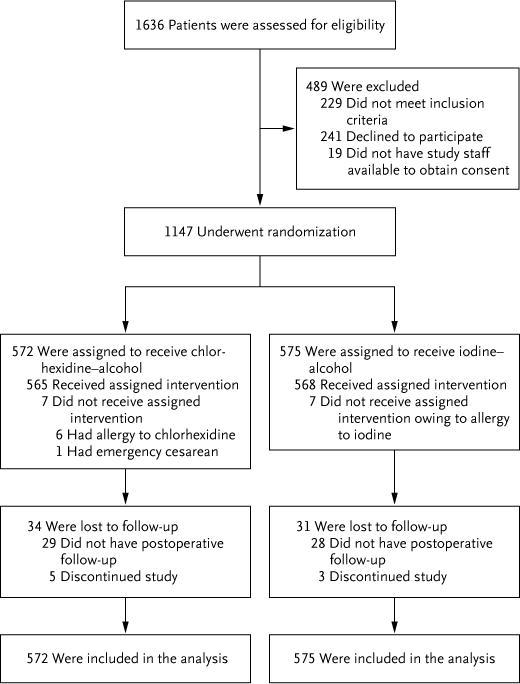
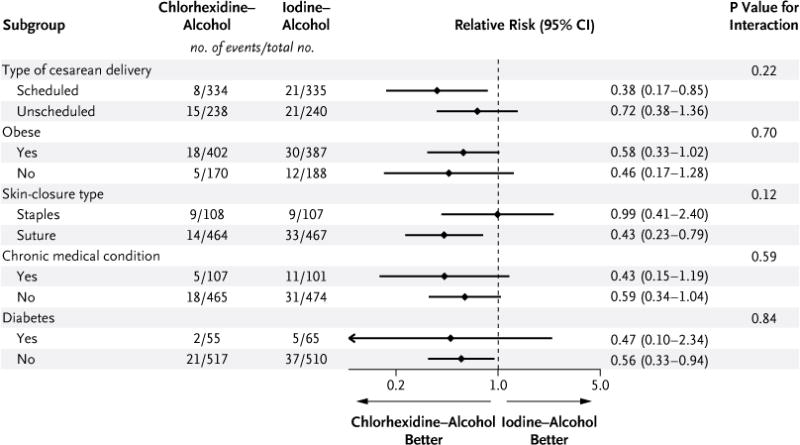
From September 2011 through June 2015, a total of 1147 patients were enrolled; 572 patients were assigned to chlorhexidine-alcohol and 575 to iodine-alcohol. In an intention-to-treat analysis, surgical-site infection was diagnosed in 23 patients (4.0%) in the chlorhexidine-alcohol group and in 42 (7.3%) in the iodine-alcohol group (relative risk, 0.55; 95% confidence interval, 0.34 to 0.90; P=0.02). The rate of superficial surgical-site infection was 3.0% in the chlorhexidine-alcohol group and 4.9% in the iodine-alcohol group (P=0.10); the rate of deep infection was 1.0% and 2.4%, respectively (P=0.07). The frequency of adverse skin reactions was similar in the two groups.
The use of chlorhexidine-alcohol for preoperative skin antisepsis resulted in a significantly lower risk of surgical-site infection after cesarean delivery than did the use of iodine-alcohol. (Funded by the National Institutes of Health and Washington University School of Medicine in St. Louis; ClinicalTrials.gov number, NCT01472549.).
术前皮肤消毒有可能降低手术部位感染的风险。然而,在美国,剖宫产是女性中最常见的大型外科手术,关于剖宫产时消毒剂选择的证据有限。
在这项单中心、随机、对照试验中,我们评估了使用氯己定 - 酒精进行术前皮肤消毒在预防剖宫产术后手术部位感染方面是否优于使用碘 - 酒精。我们将接受剖宫产的患者随机分为用氯己定 - 酒精或碘 - 酒精进行皮肤准备的两组。主要结局是根据疾病控制与预防中心的定义,剖宫产术后30天内的表浅或深部手术部位感染。
从2011年9月至2015年6月,共纳入1147例患者;572例患者被分配至氯己定 - 酒精组,575例被分配至碘 - 酒精组。在意向性分析中,氯己定 - 酒精组有23例患者(4.0%)被诊断为手术部位感染,碘 - 酒精组有42例(7.3%)(相对风险,0.55;95%置信区间,0.34至0.90;P = 0.02)。氯己定 - 酒精组表浅手术部位感染率为3.0%,碘 - 酒精组为4.9%(P = 0.10);深部感染率分别为1.0%和2.4%(P = 0.07)。两组不良皮肤反应的发生率相似。
与使用碘 - 酒精相比,使用氯己定 - 酒精进行术前皮肤消毒可使剖宫产术后手术部位感染的风险显著降低。(由美国国立卫生研究院和圣路易斯华盛顿大学医学院资助;ClinicalTrials.gov编号,NCT01472549。)