Hu Cheng, Zhao Jianfa, Gao Qiang, Yan Hongtao, Rong Hongtao, Huang Jianwei, Liu Jing, Cai Yongqing, Li Cong, Chen Hao, Zhao Lin, Liu Guodong, Jin Changqing, Xu Zuyan, Xiang Tao, Zhou X J
National Lab for Superconductivity, Beijing National Laboratory for Condensed Matter Physics, Institute of Physics, Chinese Academy of Sciences, Beijing, China.
University of Chinese Academy of Sciences, Beijing, China.
Nat Commun. 2021 Mar 1;12(1):1356. doi: 10.1038/s41467-021-21605-6.
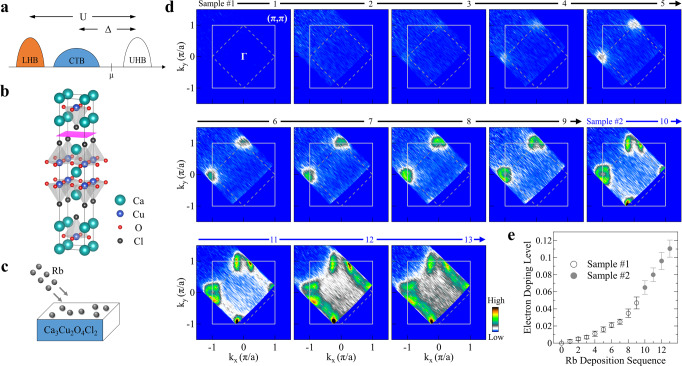
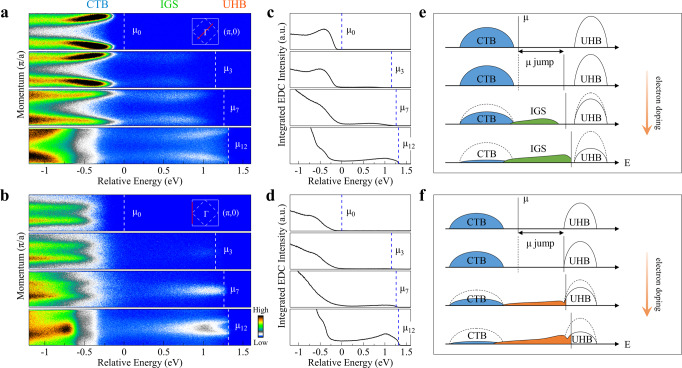
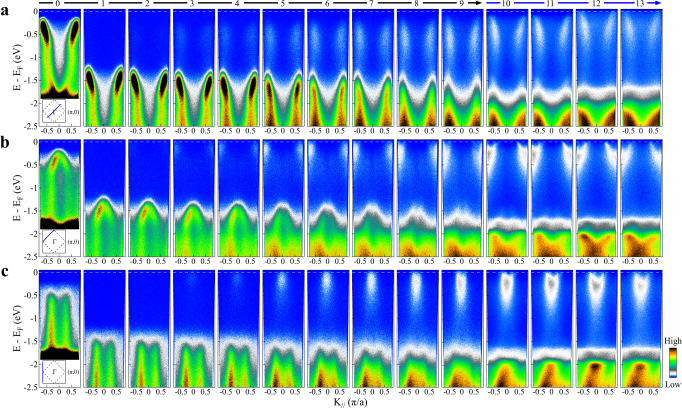
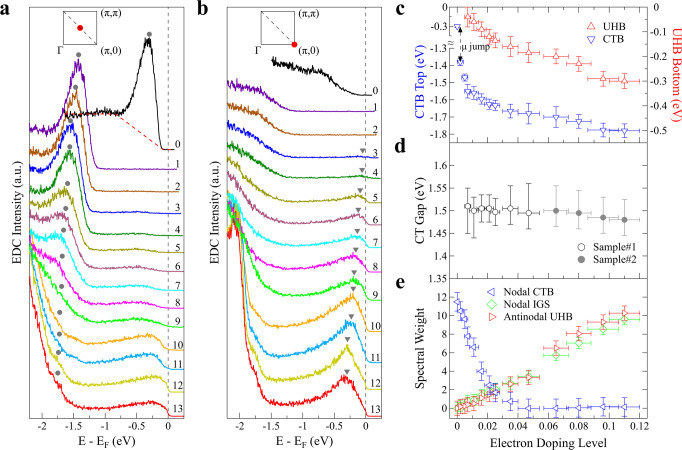
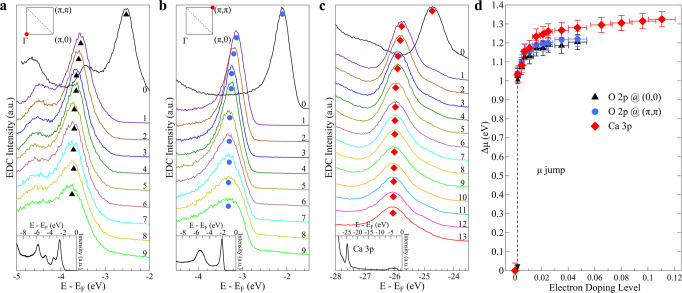
High temperature superconductivity in cuprates arises from doping a parent Mott insulator by electrons or holes. A central issue is how the Mott gap evolves and the low-energy states emerge with doping. Here we report angle-resolved photoemission spectroscopy measurements on a cuprate parent compound by sequential in situ electron doping. The chemical potential jumps to the bottom of the upper Hubbard band upon a slight electron doping, making it possible to directly visualize the charge transfer band and the full Mott gap region. With increasing doping, the Mott gap rapidly collapses due to the spectral weight transfer from the charge transfer band to the gapped region and the induced low-energy states emerge in a wide energy range inside the Mott gap. These results provide key information on the electronic evolution in doping a Mott insulator and establish a basis for developing microscopic theories for cuprate superconductivity.
铜酸盐中的高温超导性源于通过电子或空穴对母体莫特绝缘体进行掺杂。一个核心问题是莫特能隙如何演化以及随着掺杂低能态如何出现。在此,我们报告了通过连续原位电子掺杂对一种铜酸盐母体化合物进行的角分辨光电子能谱测量。在轻微电子掺杂时,化学势跃迁至上部哈伯德带的底部,从而能够直接观察到电荷转移带和整个莫特能隙区域。随着掺杂增加,由于光谱权重从电荷转移带转移到能隙区域,莫特能隙迅速崩塌,并且在莫特能隙内的宽能量范围内出现了诱导的低能态。这些结果提供了关于掺杂莫特绝缘体时电子演化的关键信息,并为发展铜酸盐超导性的微观理论奠定了基础。