Department of Pathology, Central Laboratory of The Third Affiliated Hospital of Guangzhou Medical University, Guangzhou, Guangdong 510150, P.R. China.
Department of Gynecology and Obstetrics, Guangzhou Institute of Obstetrics and Gynecology, Key Laboratory for Major Obstetric Diseases of Guangdong Province, The Third Affiliated Hospital of Guangzhou Medical University, Guangzhou, Guangdong 510150, P.R. China.
Mol Med Rep. 2021 May;23(5). doi: 10.3892/mmr.2021.11943. Epub 2021 Mar 2.
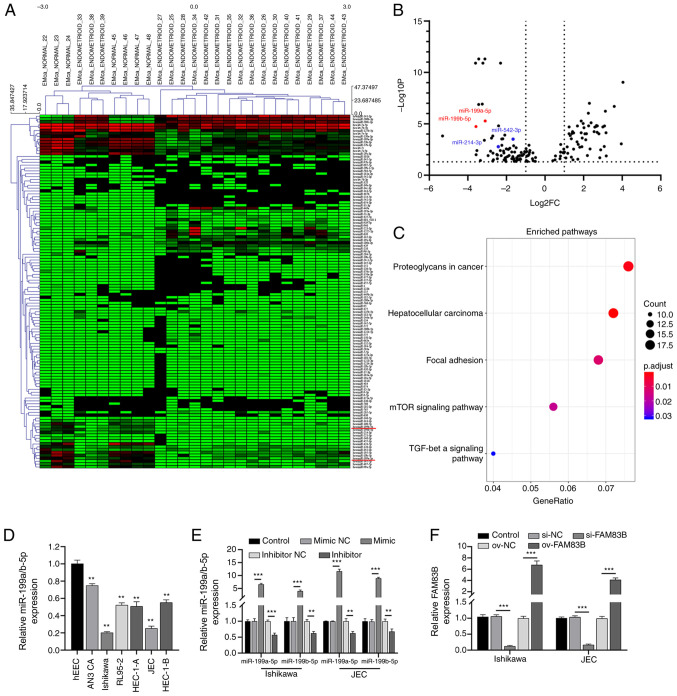
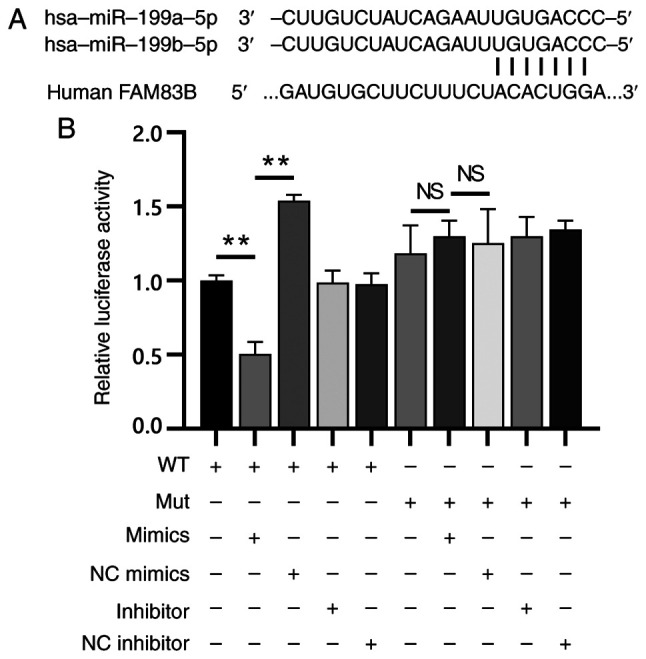
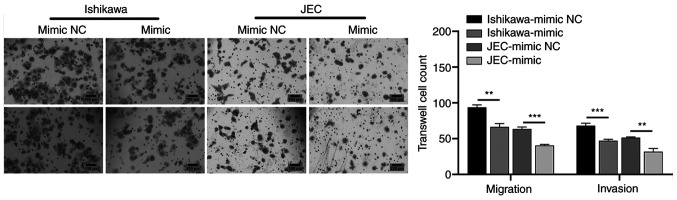
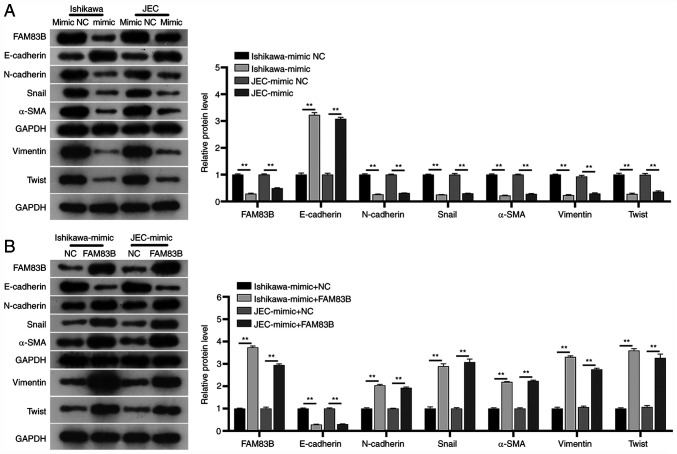
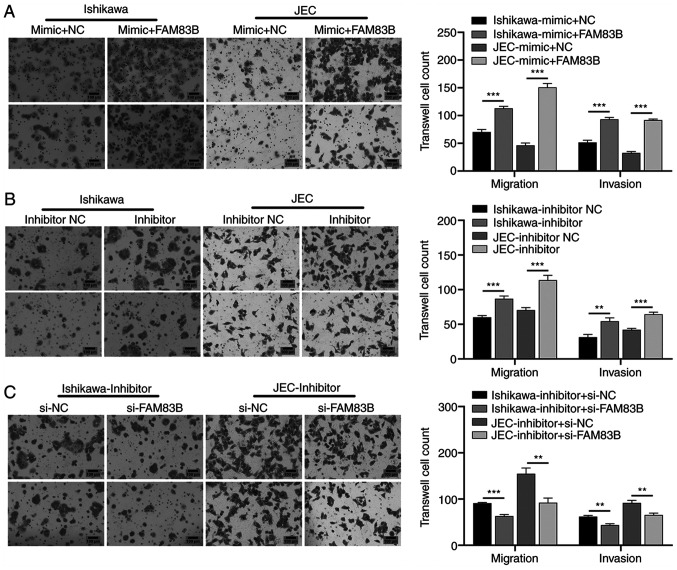
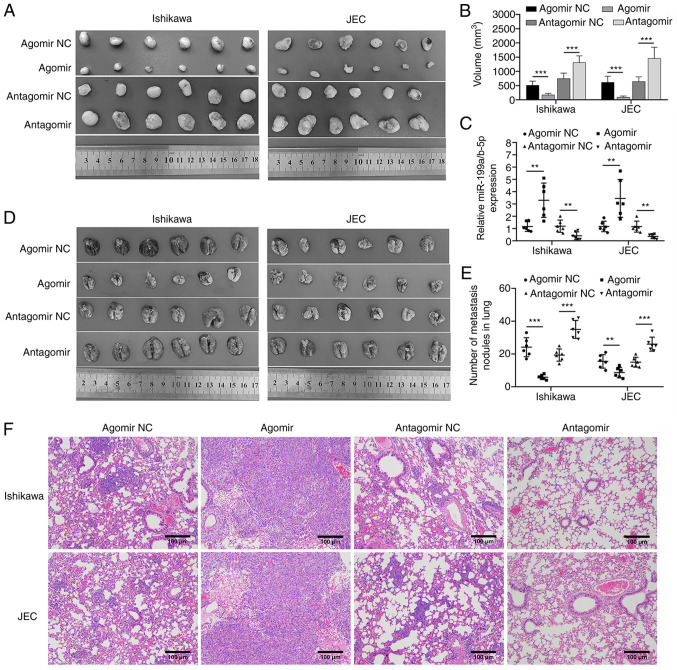
Our previous study demonstrated the role of family with sequence similarity 83, member B () in endometrial cancer tumorigenesis and metastasis. is involved in epithelial‑to‑mesenchymal transition (EMT). However, the regulatory network of EMT, which promotes endometrial cancer cell metastasis, involving microRNAs (miRNAs/miRs) and , has not been elucidated. To investigate the potential mechanism underlying miR‑199a/b‑5p in endometrial cancer, the effect of miR‑199a/b‑5p and its targeted gene on the biological behaviour of endometrial cancer cells was assessed. The Gene Expression Omnibus dataset analysis results revealed that the expression levels of 150 miRNAs in non‑cancerous endometrial tissues were upregulated compared with those in endometrial cancer tissues. TargetScan predicted that the nucleotides 672‑679 of 3'‑untranslated region (UTR) were the target sites of miR‑199a/b‑5p. The differentially expressed miRNAs were enriched in several Kyoto Encyclopedia of Genes and Genomes pathways. Reverse transcription‑quantitative PCR analysis revealed that the expression levels of miR‑199a/b‑5p in the endometrial non‑cancerous cell lines were significantly upregulated compared with those in the six endometrial cancer cell lines. miR‑199a/b‑5p inhibited the EMT signaling pathway by regulating the expression levels of E‑cadherin, N‑cadherin, Snail, α‑smooth muscle actin, vimentin and Twist. This suggested that miR‑199a/b‑5p inhibited endometrial cancer cell proliferation and migration through the inhibition of the EMT signaling pathway. Furthermore, the nucleotides 672‑679 of the 3'‑UTR were demonstrated to be the binding site of miR‑199a/b‑5p. These results suggested that miR‑199a/b‑5p inhibited endometrial cancer cell proliferation and metastasis by targeting the 3'‑UTR of , which is involved in the EMT signaling pathway.
我们之前的研究表明,序列相似性家族 83 成员 B () 在子宫内膜癌的发生和转移中起作用。 参与上皮-间质转化 (EMT)。然而,涉及 microRNAs (miRNAs/miRs) 和 的 EMT 调控网络,促进子宫内膜癌细胞转移,尚未阐明。为了研究 miR-199a/b-5p 在子宫内膜癌中的潜在机制,评估了 miR-199a/b-5p 及其靶向基因对子宫内膜癌细胞生物学行为的影响。基因表达综合数据库分析结果显示,150 种非癌性子宫内膜组织中的 miRNA 表达水平较子宫内膜癌组织上调。TargetScan 预测 3'非翻译区 (UTR) 的核苷酸 672-679 是 miR-199a/b-5p 的靶位。差异表达的 miRNAs 富集在几个京都基因与基因组百科全书通路中。逆转录-定量 PCR 分析显示,在子宫内膜非癌细胞系中,miR-199a/b-5p 的表达水平明显上调,而在 6 种子宫内膜癌细胞系中则下调。miR-199a/b-5p 通过调节 E-钙黏蛋白、N-钙黏蛋白、Snail、α-平滑肌肌动蛋白、波形蛋白和 Twist 的表达水平来抑制 EMT 信号通路。这表明 miR-199a/b-5p 通过抑制 EMT 信号通路抑制子宫内膜癌细胞的增殖和迁移。此外,UTR 的核苷酸 672-679 被证明是 miR-199a/b-5p 的结合位点。这些结果表明,miR-199a/b-5p 通过靶向参与 EMT 信号通路的 3'UTR 抑制子宫内膜癌细胞的增殖和转移。