Institute of Physiology and Pathophysiology, Paracelsus Medical University, Strubergasse 21, A-5020, Salzburg, Austria.
Gastein Research Institute, Paracelsus Medical University, Salzburg, Austria.
Int J Biometeorol. 2021 Jul;65(7):1151-1160. doi: 10.1007/s00484-021-02095-z. Epub 2021 Mar 1.
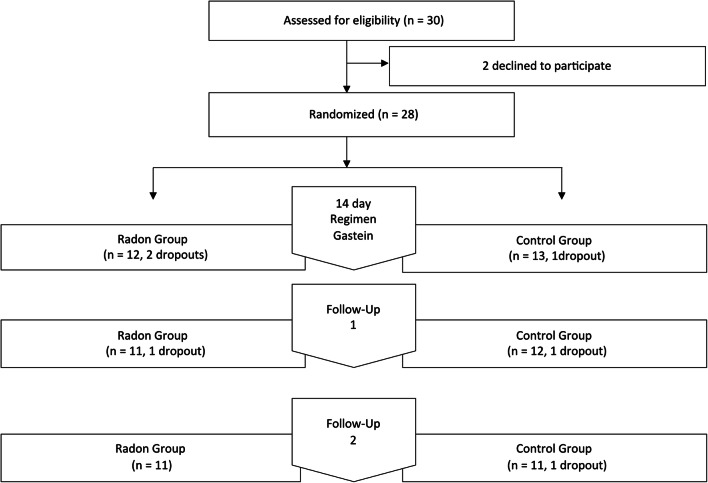
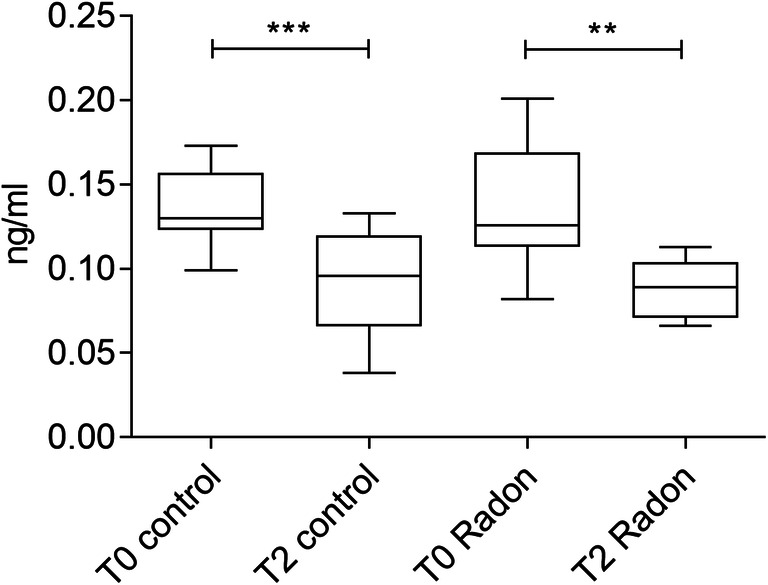
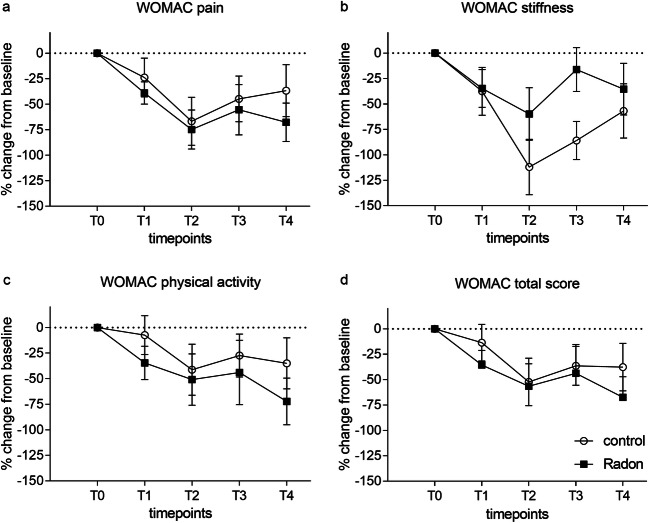
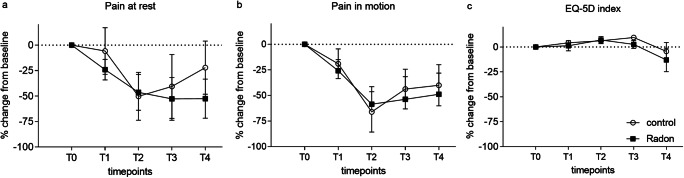
Multimodal therapies comprising spa applications are widely used as non-pharmaceutical treatment options for musculoskeletal diseases. The purpose of this randomized, controlled, open pilot study was to elucidate the involvement of the endocannabinoid system in a multimodal therapy approach. Twenty-five elderly patients with knee osteoarthritis (OA) received a 2-week spa therapy with or without combination of low-dose radon therapy in the Bad Gastein radon gallery. A 10-point numerical rating scale (pain in motion and at rest), WOMAC questionnaire, and the EuroQol-5D (EQ-5D) questionnaire were recorded at baseline, and during treatment period at weeks one and two, and at 3-month and 6-month follow-ups. Plasma levels of the endocannabinoid anandamide (AEA) were determined at baseline and at 2 weeks, and serum levels of several cartilage metabolism markers at all five time-points. A significant and sustained reduction of self-reported knee pain was observed in the study population, but no further significant effect of the additional radon therapy up and above base therapy. This pain reduction was accompanied by a significant reduction of AEA plasma levels during treatment in both groups. No significant differences were seen in serum marker concentrations between the groups treated with or without radon, but a small reduction of serum cartilage degradation markers was observed during treatment in both groups. This is the first study investigating AEA levels in the context of a non-pharmacological OA treatment. Since the endocannabinoid system represents a potential target for the development of new therapeutics, further studies will have to elucidate its involvement in OA pain.
多模式疗法包括水疗应用,被广泛用作治疗肌肉骨骼疾病的非药物治疗选择。本随机、对照、开放先导研究的目的是阐明内源性大麻素系统在多模式治疗方法中的作用。25 名老年膝骨关节炎(OA)患者接受了为期 2 周的水疗,或在巴德加斯坦氡画廊中接受低剂量氡治疗与水疗的联合治疗。在基线时、治疗第 1 周和第 2 周、3 个月和 6 个月随访时,使用 10 分数字评分量表(运动时和休息时的疼痛)、WOMAC 问卷和 EuroQol-5D(EQ-5D)问卷进行记录。在基线和第 2 周测定内源性大麻素大麻素(AEA)的血浆水平,在所有 5 个时间点测定几种软骨代谢标志物的血清水平。研究人群的自我报告膝关节疼痛显著且持续减轻,但额外的氡治疗除基础治疗外没有进一步显著效果。这种疼痛减轻伴随着两组治疗过程中血浆 AEA 水平的显著降低。接受或不接受氡治疗的两组之间的血清标志物浓度没有显著差异,但两组在治疗过程中均观察到血清软骨降解标志物的轻微减少。这是第一项研究内源性大麻素系统在非药物性 OA 治疗中的作用。由于内源性大麻素系统代表了开发新治疗方法的潜在靶点,因此需要进一步的研究来阐明其在 OA 疼痛中的作用。