Department of Neurology, Institute of Neurology, Ruijin Hospital, Shanghai Jiao Tong University School of Medicine, Shanghai, China.
First School of Clinical Medicine, Wenzhou Medical University, Wenzhou, China.
J Diabetes Investig. 2021 Oct;12(10):1835-1844. doi: 10.1111/jdi.13535. Epub 2021 Mar 23.
AIMS/INTRODUCTION: Diabetes has been considered as a 'pro-thrombotic state' with enhanced platelet reactivity. Abnormality in platelet aggregation has been found in patients with its most common chronic complication - diabetic peripheral neuropathy (DPN). The purpose of this study was to investigate the potential association of platelet indices with nerve conduction function and the presence of DPN in Chinese patients with type 2 diabetes mellitus.
This study involved a total of 211 inpatients with type 2 diabetes mellitus and 55 healthy individuals for whom nerve conduction studies were carried out. DPN was diagnosed according to the American Diabetes Association recommendation. Clinical data were retrospectively collected.
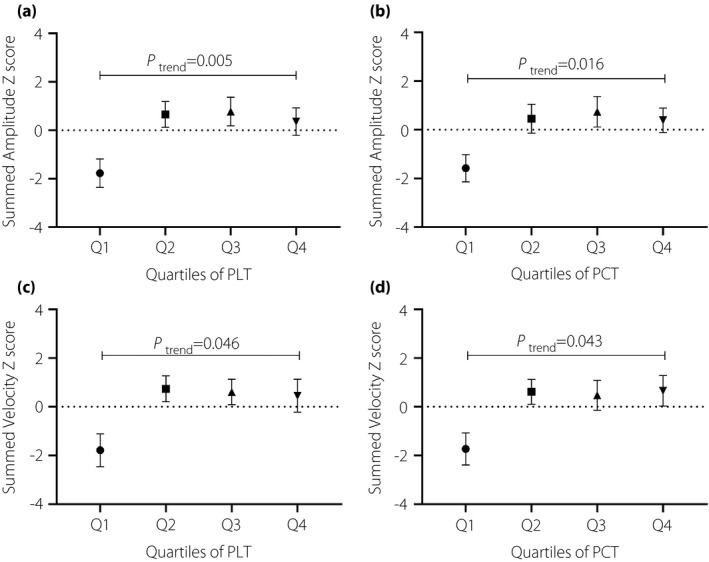
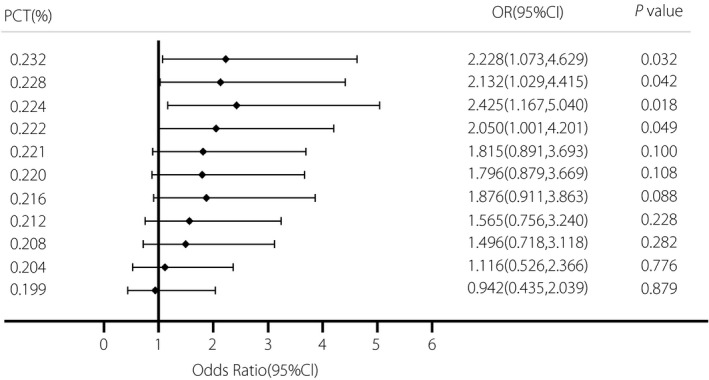
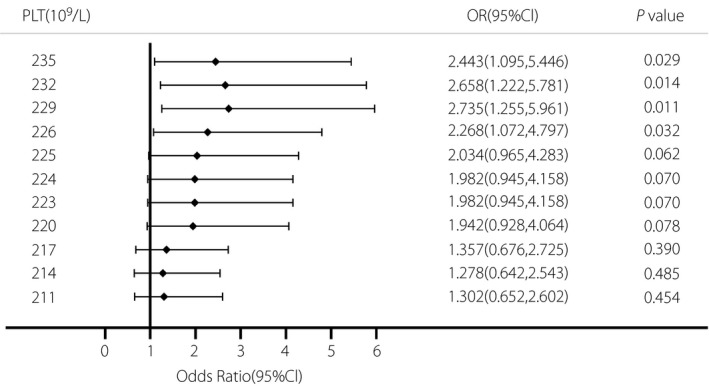
Patients with diabetes in whom neuropathy developed had lower levels of platelet count (PLT) and plateletcrit (PCT) than healthy controls (P < 0.05). Statistically significant associations of low PLT and PCT levels with the reduction of summed amplitude/velocity Z-score, and the prolongation of F-wave minimum latency in nerve conduction studies were found. Furthermore, after multivariate adjustment, logistic regression analysis showed that low levels of PLT (odds ratio 2.268, 95% confidence interval 1.072-4.797; P < 0.05; PLT <226 vs PLT ≥226) and PCT (odds ratio 2.050, 95% confidence interval 1.001-4.201; P < 0.05; PCT <0.222 vs PCT ≥0.222) in type 2 diabetes mellitus patients were risk factors for the presence of DPN.
Lower PLT and PCT levels are closely associated with poorer peripheral nerve conduction functions and the presence of neuropathy in patients with type 2 diabetes mellitus, which suggests that PLT and PCT might be potential biomarkers for showing DPN.
目的/引言:糖尿病被认为是一种“促血栓形成状态”,具有增强的血小板反应性。在其最常见的慢性并发症——糖尿病周围神经病变(DPN)患者中,已经发现血小板聚集异常。本研究旨在探讨血小板指数与神经传导功能和中国 2 型糖尿病患者 DPN 之间的潜在关联。
本研究共纳入 211 例 2 型糖尿病住院患者和 55 例健康对照者进行神经传导研究。根据美国糖尿病协会的建议诊断 DPN。回顾性收集临床资料。
发生神经病变的糖尿病患者的血小板计数(PLT)和血小板压积(PCT)水平低于健康对照组(P<0.05)。统计学分析发现,PLT 和 PCT 水平与神经传导研究中总和幅度/速度 Z 评分降低以及 F 波最小潜伏期延长呈显著相关。此外,经过多变量调整后,逻辑回归分析显示,PLT 水平较低(比值比 2.268,95%置信区间 1.072-4.797;P<0.05;PLT<226 与 PLT≥226)和 PCT 水平较低(比值比 2.050,95%置信区间 1.001-4.201;P<0.05;PCT<0.222 与 PCT≥0.222)是 2 型糖尿病患者 DPN 存在的危险因素。
较低的 PLT 和 PCT 水平与 2 型糖尿病患者外周神经传导功能较差和神经病变的发生密切相关,这表明 PLT 和 PCT 可能是 DPN 的潜在生物标志物。