Samargandy Saad, Matthews Karen A, Brooks Maria M, Barinas-Mitchell Emma, Magnani Jared W, Janssen Imke, Kazlauskaite Rasa, El Khoudary Samar R
Graduate School of Public Health, University of Pittsburgh, Pittsburgh, PA.
Department of Psychiatry, University of Pittsburgh, Pittsburgh, PA.
Menopause. 2021 Mar 1;28(6):626-633. doi: 10.1097/GME.0000000000001755.
To characterize abdominal visceral adipose tissue (VAT) trajectory relative to the final menstrual period (FMP), and to test whether menopause-related VAT accumulation is associated with greater average, common carotid artery intima-media thickness (cIMT) and/or internal carotid artery intima-media thickness (ICA-IMT).
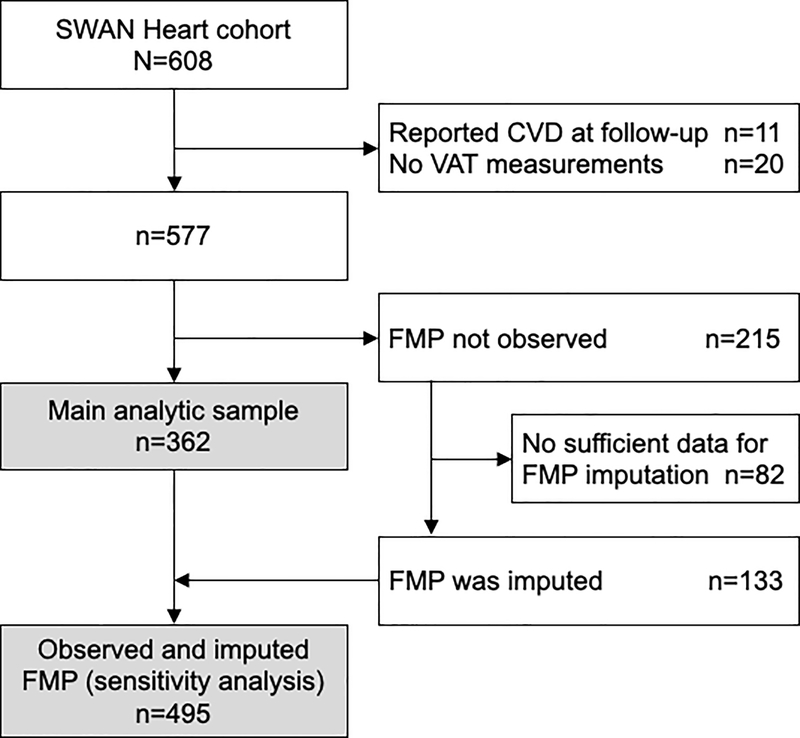
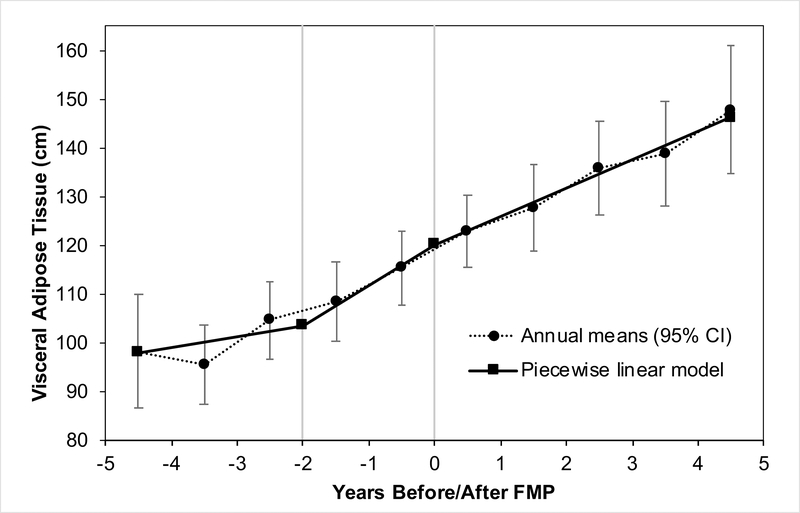
Participants were 362 women (at baseline: age was (mean ± SD) 51.1 ± 2.8 y; 61% White, 39% Black) with no cardiovascular disease from the Study of Women's Health Across the Nation Heart study. Women had up to two measurements of VAT and cIMT over time. Splines revealed a nonlinear trajectory of VAT with two inflection points demarcating three time segments: segment 1: >2 years before FMP; segment 2: 2 years before FMP to FMP; and segment 3: after FMP. Piecewise-linear random-effects models estimated changes in VAT. Random-effects models tested associations of menopause-related VAT with each cIMT measure separately. Estimates were adjusted for age at FMP, body mass index, and sociodemographic, lifestyle, and cardiovascular disease risk factors.
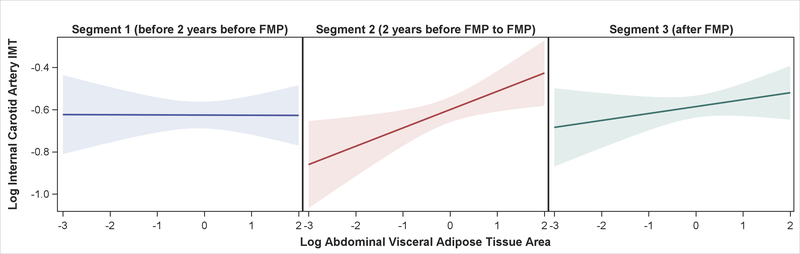
VAT increased significantly by 8.2% (95% CI: 4.1%-12.5%) and 5.8% (3.7%-7.9%) per year in segments 2 and 3, respectively, with no significant change in VAT within segment 1. VAT predicted greater ICA-IMT in segment 2, such that a 20% greater VAT was associated with a 2.0% (0.8%-3.1%) greater ICA-IMT. VAT was not an independent predictor of ICA-IMT in the other segments or of the other cIMT measures after adjusting for covariates.
Women experience an accelerated increase in VAT starting 2 years before menopause. This menopause-related increase in VAT is associated with greater risk of subclinical atherosclerosis in the internal carotid artery.
描述相对于末次月经(FMP)的腹部内脏脂肪组织(VAT)轨迹,并检验与绝经相关的VAT积累是否与更高的平均、颈总动脉内膜中层厚度(cIMT)和/或颈内动脉内膜中层厚度(ICA-IMT)相关。
参与者为来自全国女性健康心脏研究的362名无心血管疾病的女性(基线时:年龄为(均值±标准差)51.1±2.8岁;61%为白人,39%为黑人)。女性随时间最多进行了两次VAT和cIMT测量。样条显示VAT的非线性轨迹有两个拐点,划分出三个时间段:第1段:FMP前>2年;第2段:FMP前2年至FMP;第3段:FMP后。分段线性随机效应模型估计VAT的变化。随机效应模型分别检验与绝经相关的VAT与每种cIMT测量值之间的关联。估计值针对FMP时的年龄、体重指数以及社会人口统计学、生活方式和心血管疾病风险因素进行了调整。
第2段和第3段VAT每年分别显著增加8.2%(95%置信区间:4.1%-12.5%)和5.8%(3.7%-7.9%),第1段VAT无显著变化。第2段VAT可预测更大的ICA-IMT,VAT增加20%与ICA-IMT增加2.0%(0.8%-3.1%)相关。调整协变量后,VAT在其他时间段不是ICA-IMT的独立预测因子,也不是其他cIMT测量值的独立预测因子。
女性在绝经前2年开始VAT加速增加。这种与绝经相关的VAT增加与颈内动脉亚临床动脉粥样硬化风险增加有关。