Müschen Lars Hendrik, Osmanovic Alma, Binz Camilla, Jendretzky Konstantin F, Ranxha Gresa, Bronzlik Paul, Abu-Fares Omar, Wiehler Flavia, Möhn Nora, Hümmert Martin W, Gingele Stefan, Götz Friedrich, Stangel Martin, Skripuletz Thomas, Schreiber-Katz Olivia, Petri Susanne
Department of Neurology, Hannover Medical School, 30625 Hannover, Germany.
Department of Diagnostic and Interventional Neuroradiology, Hannover Medical School, 30625 Hannover, Germany.
Brain Sci. 2021 Feb 26;11(3):296. doi: 10.3390/brainsci11030296.
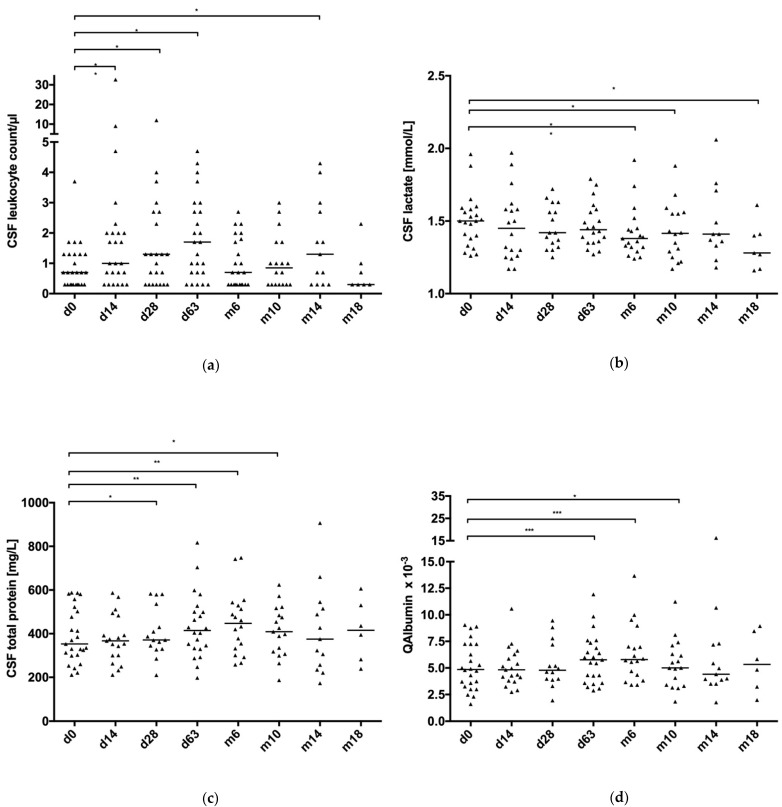
Approval of nusinersen, an intrathecally administered antisense oligonucleotide, for the treatment of 5q-spinal muscular atrophy (SMA) marked the beginning of a new therapeutic era in neurological diseases. Changes in routine cerebrospinal fluid (CSF) parameters under nusinersen have only recently been described in adult SMA patients. We aimed to explore these findings in a real-world setting and to identify clinical and procedure-associated features that might impact CSF parameters. Routinely collected CSF parameters (leukocyte count, lactate, total protein, CSF/serum albumin quotient (QAlbumin), oligoclonal bands) of 28 adult SMA patients were examined for up to 22 months of nusinersen treatment. Total protein and QAlbumin values significantly increased in the first 10 months, independent of the administration procedure. By month 14, no further increases were detected. Two patients developed transient pleocytosis. In two cases, positive oligoclonal bands were found in the beginning and in four patients throughout the whole observation period. No clinical signs of inflammatory central nervous system disease were apparent. Our data confirm elevated CSF total protein and QAlbumin during nusinersen treatment. These alterations may be caused by both repeated lumbar punctures and the interval between procedures rather than by the medication itself. Generally, there were no severe alterations of CSF routine parameters. These results further underline the safety of nusinersen therapy.
鞘内注射反义寡核苷酸药物诺西那生钠获批用于治疗5q型脊髓性肌萎缩症(SMA)标志着神经疾病治疗新时代的开端。诺西那生钠治疗下成人SMA患者常规脑脊液(CSF)参数的变化直到最近才被报道。我们旨在实际临床环境中探究这些发现,并确定可能影响CSF参数的临床及操作相关特征。对28例接受诺西那生钠治疗长达22个月的成人SMA患者的常规收集的CSF参数(白细胞计数、乳酸、总蛋白、CSF/血清白蛋白商(QAlbumin)、寡克隆带)进行了检查。在最初10个月内,总蛋白和QAlbumin值显著升高,与给药方式无关。到第14个月时,未检测到进一步升高。两名患者出现短暂性脑脊液细胞增多。在两例患者中,最初发现寡克隆带阳性,在整个观察期内有4例患者呈阳性。未出现炎症性中枢神经系统疾病的临床体征。我们的数据证实了诺西那生钠治疗期间CSF总蛋白和QAlbumin升高。这些改变可能是由重复腰椎穿刺及操作间隔时间引起的,而非药物本身。总体而言,CSF常规参数无严重改变。这些结果进一步强调了诺西那生钠治疗的安全性。