Gingele Stefan, Hümmert Martin W, Alvermann Sascha, Jendretzky Konstantin F, Bönig Lena, Brieskorn Marina, Schwenkenbecher Philipp, Sühs Kurt-Wolfram, Müschen Lars H, Osmanovic Alma, Schreiber-Katz Olivia, Stangel Martin, Petri Susanne, Skripuletz Thomas
Department of Neurology, Hannover Medical School, Hanover, Germany.
Front Neurol. 2019 Jul 11;10:735. doi: 10.3389/fneur.2019.00735. eCollection 2019.
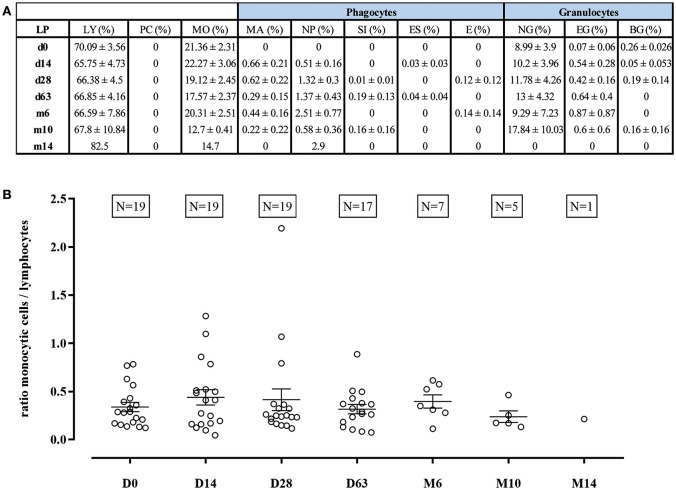
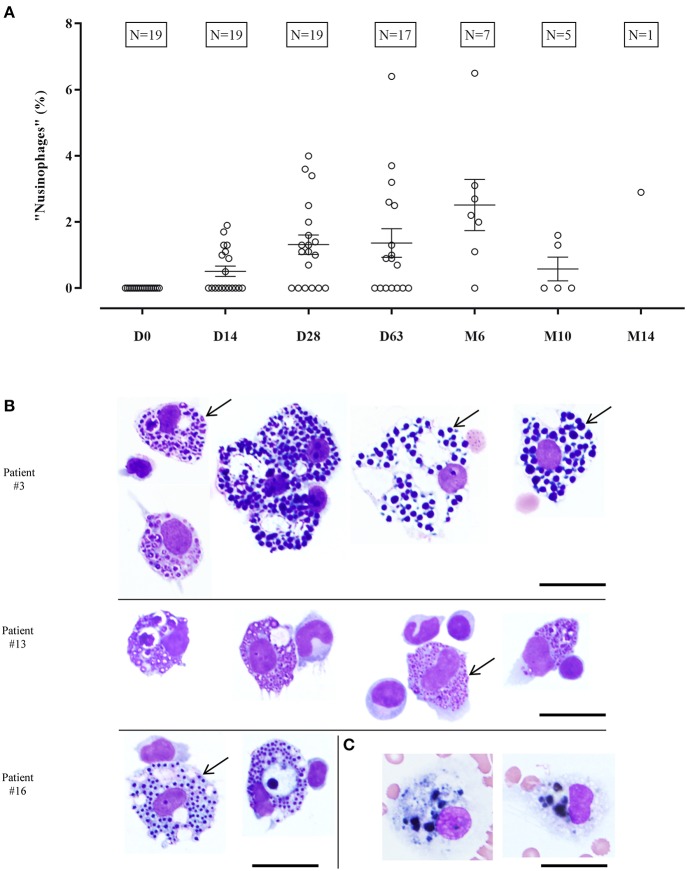
Spinal muscular atrophy (SMA) is an autosomal recessive neurodegenerative disorder characterized by degeneration of spinal motor neurons leading to muscular weakness. The antisense oligonucleotide nusinersen was approved for the treatment of patients with 5q-associated SMA. Treatment must be repeatedly administered intrathecally by lumbar puncture. So far, data regarding cerebrospinal fluid (CSF) parameters are sparse and examinations of CSF cytology during nusinersen treatment are completely missing. 87 CSF samples from 19 adult SMA patients who underwent repeated lumbar punctures for intrathecal injections of nusinersen were investigated. CSF specimens were quantitatively assessed regarding leukocyte subpopulations by routine cytology after Pappenheim staining. A control group with 38 CSF samples from 10 patients with repeated lumbar punctures due to other diseases was used. Treatment with nusinersen did not result in persistent inflammatory cellular changes or a relevant shift of leukocyte subpopulations in the CSF. During nusinersen therapy unique macrophages with numerous sharply defined purple and granular inclusions were detected in all patients. These macrophages were not found in CSF of patients with other diseases who underwent repeated lumbar punctures. Routine CSF cytology performed by experienced personnel represents an important and feasible tool for safety monitoring during treatment with intrathecally administered therapeutics. Analysis of leukocyte subpopulations did not raise safety concerns during nusinersen therapy. The potential significance of the unique phagocytic cells for disease course and treatment response needs to be further elucidated in the future.
脊髓性肌萎缩症(SMA)是一种常染色体隐性神经退行性疾病,其特征为脊髓运动神经元变性,导致肌肉无力。反义寡核苷酸诺西那生钠已被批准用于治疗5q相关的SMA患者。治疗必须通过腰椎穿刺反复鞘内给药。到目前为止,关于脑脊液(CSF)参数的数据稀少,并且完全缺乏诺西那生钠治疗期间CSF细胞学检查。对19例接受反复腰椎穿刺鞘内注射诺西那生钠的成年SMA患者的87份CSF样本进行了研究。在帕彭海姆染色后,通过常规细胞学对CSF标本的白细胞亚群进行定量评估。使用了一个对照组,该组有来自10例因其他疾病接受反复腰椎穿刺的患者的38份CSF样本。诺西那生钠治疗并未导致CSF中持续的炎症细胞变化或白细胞亚群的相关改变。在诺西那生钠治疗期间,在所有患者中均检测到具有大量清晰界定的紫色和颗粒状内含物的独特巨噬细胞。在接受反复腰椎穿刺的其他疾病患者的CSF中未发现这些巨噬细胞。由经验丰富的人员进行的常规CSF细胞学检查是鞘内给药治疗期间安全监测的重要且可行的工具。在诺西那生钠治疗期间,白细胞亚群分析未引发安全担忧。这些独特吞噬细胞对疾病进程和治疗反应的潜在意义需要在未来进一步阐明。