Zhang Ming-Yue, Zhang Xiao-Hui, Ayala James, Hou Rong
Chengdu Research Base of Giant Panda Breeding, Chengdu 610081, China.
Sichuan Key Laboratory of Conservation Biology for Endangered Wildlife, Chengdu 610081, China.
Animals (Basel). 2021 Feb 26;11(3):626. doi: 10.3390/ani11030626.
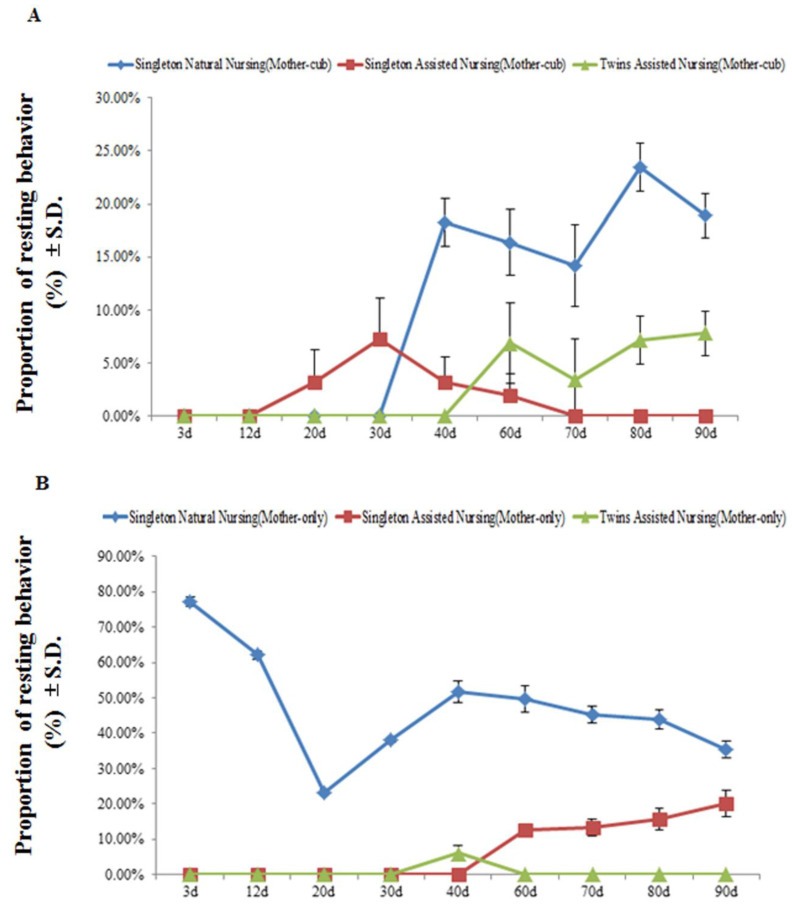
Throughout the life history of giant pandas, we have found that captive and wild giant pandas have significantly different parenting experiences. To summarize the breeding history of the Chengdu Research Base of Giant Panda Breeding over the past 30 years, we found that the parenting experience is related to the natural mating ability of captive male giant pandas. However, there are few studies on the effects of different nursing methods on the behavioral expression of captive giant pandas, mainly focusing on the behavioral development of captive giant panda cubs, but the effects on the behavioral adaptive expression and stress of adult females have not been reported. From the perspective of adult female giant pandas in the nursery period, this experiment attempts to clarify whether different nursing methods in the cub-rearing period will affect the behavioral adaptive expression of the dams. We aim to understand whether confinement mode may cause stress problems in adult captive giant pandas, and provide a scientific basis for improving the design parameters of nursery pens and improving the welfare level of captive giant pandas. Based on the current results, we find that, in the current captive environment, singleton and parent rearing are kinds of nursing methods that are in accordance with the characteristics of the natural nursing of giant pandas and have little effect on the mother-cub relationship and welfare of captive adult female giant pandas.
在大熊猫的整个生活史中,我们发现圈养大熊猫和野生大熊猫有着显著不同的育幼经历。为总结成都大熊猫繁育研究基地过去30年的繁殖历史,我们发现育幼经历与圈养雄性大熊猫的自然交配能力有关。然而,关于不同育幼方式对圈养大熊猫行为表达的影响的研究较少,主要集中在圈养大熊猫幼崽的行为发育上,但对成年雌性大熊猫行为适应性表达和应激的影响尚未见报道。从育幼期成年雌性大熊猫的角度出发,本实验试图阐明育幼期不同的育幼方式是否会影响母兽的行为适应性表达。我们旨在了解圈养模式是否会给成年圈养大熊猫带来应激问题,并为改进育幼圈舍的设计参数和提高圈养大熊猫的福利水平提供科学依据。基于目前的结果,我们发现,在当前的圈养环境下,单只饲养和亲子饲养是符合大熊猫自然育幼特点的育幼方式,对圈养成年雌性大熊猫的母婴关系和福利影响较小。