Xiao Yunyu, Lindsey Michael A
School of Social Work, Indiana University-Purdue University Indianapolis, Indianapolis, IN46202.
School of Social Work, Indiana University-Bloomington, Bloomington, IN47401.
Psychol Med. 2021 Mar 3;52(15):1-12. doi: 10.1017/S0033291721000465.
Examining social networks, characterized by interpersonal interactions across family, peer, school, and neighborhoods, offer alternative explanations to suicidal behaviors and shape effective suicide prevention. This study examines adolescent social networks predicting suicide ideation and attempt trajectories transitioning to adulthood, while revealing differences across racial/ethnic, sex, sexual identity, and socioeconomic status.
Participants included 9421 high school students (Mage = 15.30 years; 54.58% females, baseline) from Waves I-IV of the National Longitudinal Study of Adolescent to Adult Health, 1994-2008. Latent class growth analyses were conducted to identify suicide ideation and attempt trajectories. Multivariate multinomial logistic regressions examined the relationships between social network characteristics during adolescence and suicidal trajectories. Interaction terms between social networks and sociodemographic characteristics were included to test moderation effects.
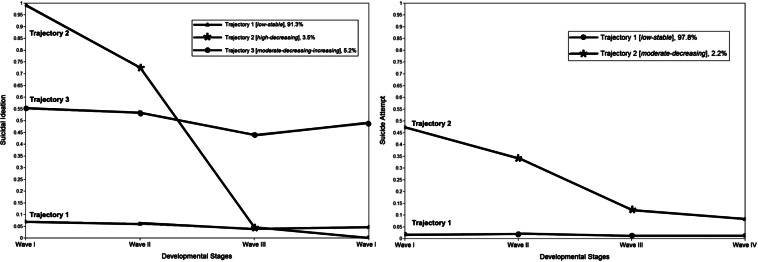
Three suicidal ideation trajectories (low-stable, high-decreasing, moderate-decreasing-increasing) and two suicide attempt trajectories (low-stable, moderate-decreasing) were identified. Greater family cohesion significantly reduced the probability of belonging to high-decreasing (Trajectory 2) and moderate-decreasing-increasing (Trajectory 3) suicidal ideation trajectories, and moderate-decreasing (Trajectory 2) suicide attempt trajectory. Race/ethnicity, sex, and sexual identity significantly moderated the associations between social networks (household size, peer network density, family cohesion, peer support, neighborhood support) and suicidal trajectories.
Social networks during adolescence influenced the odds of belonging to distinct suicidal trajectories. Family cohesion protected youth from being in high-risk developmental courses of suicidal behaviors. Social networks, especially quality of interactions, may improve detecting adolescents and young adults at-risk for suicide behaviors. Network-based interventions are key to prevent suicidal behaviors over time and suicide intervention programming.
研究以家庭、同伴、学校和社区中的人际互动为特征的社会网络,可为自杀行为提供不同的解释,并形成有效的自杀预防措施。本研究考察了预测青少年自杀意念及向成年期过渡的自杀未遂轨迹的社会网络,同时揭示了不同种族/族裔、性别、性取向和社会经济地位之间的差异。
参与者包括来自1994 - 2008年全国青少年健康纵向研究第一至四波的9421名高中生(平均年龄 = 15.30岁;54.58%为女性,基线)。进行潜在类别增长分析以确定自杀意念和自杀未遂轨迹。多变量多项逻辑回归分析考察了青少年时期社会网络特征与自杀轨迹之间的关系。纳入社会网络与社会人口学特征之间的交互项以检验调节效应。
确定了三种自杀意念轨迹(低稳定型、高下降型、中度下降 - 上升型)和两种自杀未遂轨迹(低稳定型、中度下降型)。更强的家庭凝聚力显著降低了属于高下降型(轨迹2)和中度下降 - 上升型(轨迹3)自杀意念轨迹以及中度下降型(轨迹2)自杀未遂轨迹的概率。种族/族裔、性别和性取向显著调节了社会网络(家庭规模、同伴网络密度、家庭凝聚力、同伴支持、邻里支持)与自杀轨迹之间的关联。
青少年时期的社会网络影响了属于不同自杀轨迹的几率。家庭凝聚力保护青少年避免陷入自杀行为的高风险发展进程。社会网络,尤其是互动质量,可能有助于更好地发现有自杀行为风险的青少年和年轻人。基于网络的干预措施是长期预防自杀行为和自杀干预规划的关键。