Department of Community Medicine and Global Health, Institute of Health and Society, Faculty of Medicine, University of Oslo, Oslo, Norway
Department of Community Medicine and Global Health, Institute of Health and Society, Faculty of Medicine, University of Oslo, Oslo, Norway.
BMJ Open. 2021 Mar 2;11(3):e042561. doi: 10.1136/bmjopen-2020-042561.
To investigate whether urban-rural location and socioeconomic factors (income, education and employment) are associated with body mass index (BMI) and waist-hip ratio (W/H-ratio), and to further explore if the associations between urban-rural location and BMI or W/H-ratio could be mediated through variations in socioeconomic factors.
Cross-sectional, WHO STEPS survey of non-communicable disease risk factors.
Urban and rural areas of Myanmar.
A total of 8390 men and women aged 25 to 64 years included during the study period from September to December 2014. Institutionalised people (Buddhist monks and nuns, hospitalised patients) and temporary residents were excluded.
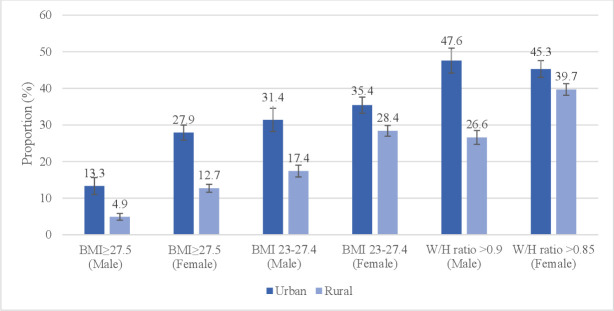
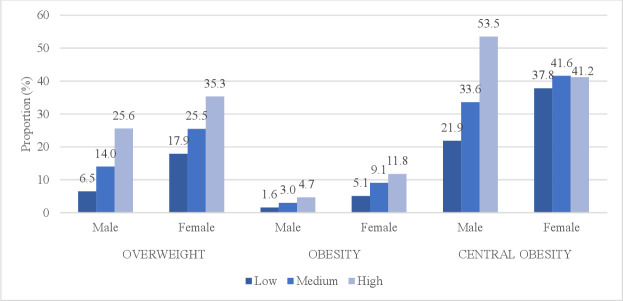
The prevalence of overweight and obesity was higher in the urban areas and increased with increasing socioeconomic status (SES) score. Mean BMI was higher among urban residents (ß=2.49 kg/m; 95% CI 2.28 to 2.70; p<0.001), individuals living above poverty line, that is, ≥US$1.9/day (ß=0.74 kg/m; 95% CI 0.43 to 1.05; p<0.001), and those with high education attainment (ß=1.48 kg/m; 95% CI 1.13 to 1.82; p<0.001) when adjusting for potential confounders. Similarly, greater W/H-ratio was observed in participants living in an urban area, among those with earnings above poverty line, and among unemployed individuals. The association between urban-rural location and BMI was found to be partially mediated by a composite SES score (9%), income (17%), education (16%) and employment (16%), while the association between urban-rural location and W/H-ratio was found to be partially mediated by income (12%), education (6%) and employment (6%).
Residents living in urban locations had higher BMI and greater W/H-ratio, partially explained by differences in socioeconomic indicators, indicating that socioeconomic factors should be emphasised in the management of overweight and obesity in the Myanmar population. Furthermore, new national or subnational STEPS surveys should be conducted in Myanmar to observe the disparity in trends of the urban-rural differential.
调查城乡地理位置和社会经济因素(收入、教育和就业)是否与体重指数(BMI)和腰臀比(W/H-ratio)有关,并进一步探讨城乡地理位置与 BMI 或 W/H-ratio 的关联是否可以通过社会经济因素的变化来解释。
横断面、世界卫生组织非传染性疾病危险因素 STEPS 调查。
缅甸城乡地区。
在 2014 年 9 月至 12 月期间的研究期间,共纳入了 8390 名年龄在 25 至 64 岁的男性和女性。被排除在外的有:机构化人员(僧侣和修女、住院病人)和临时居民。
城市地区超重和肥胖的患病率较高,且随着社会经济地位(SES)评分的增加而增加。城市居民的平均 BMI 较高(ß=2.49kg/m;95%CI 2.28 至 2.70;p<0.001),生活在贫困线以上的人(ß=0.74kg/m;95%CI 0.43 至 1.05;p<0.001),以及受教育程度较高的人(ß=1.48kg/m;95%CI 1.13 至 1.82;p<0.001)。同样,在调整潜在混杂因素后,在城市地区居住、收入超过贫困线和失业的参与者中,观察到更大的 W/H-ratio。城乡地理位置与 BMI 的关联部分通过复合 SES 评分(9%)、收入(17%)、教育(16%)和就业(16%)来解释,而城乡地理位置与 W/H-ratio 的关联部分通过收入(12%)、教育(6%)和就业(6%)来解释。
居住在城市地区的居民 BMI 较高,W/H-ratio 较大,部分原因是社会经济指标的差异,这表明在缅甸人群中管理超重和肥胖时应强调社会经济因素。此外,缅甸应开展新的国家或国家以下 STEPS 调查,以观察城乡差异趋势的差异。