Wang Jun, Guan Jie, Liu Minbo, Cui Yongfeng, Zhang Yuhang
Department of Orthopedic, Xiaoshan 1st People's Hospital, No. 199 Shixin South Road, Hangzhou, 311200, Zhejiang, China.
Sci Rep. 2021 Mar 2;11(1):4949. doi: 10.1038/s41598-021-84601-2.
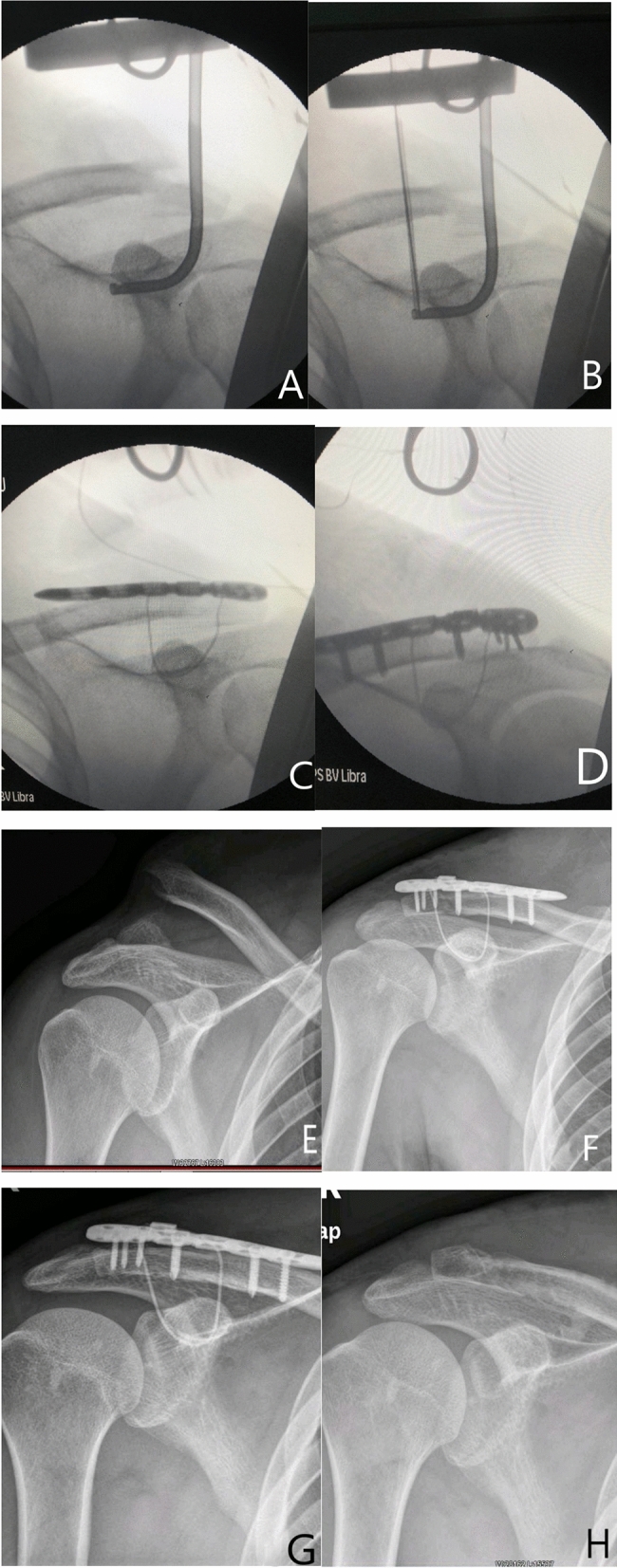
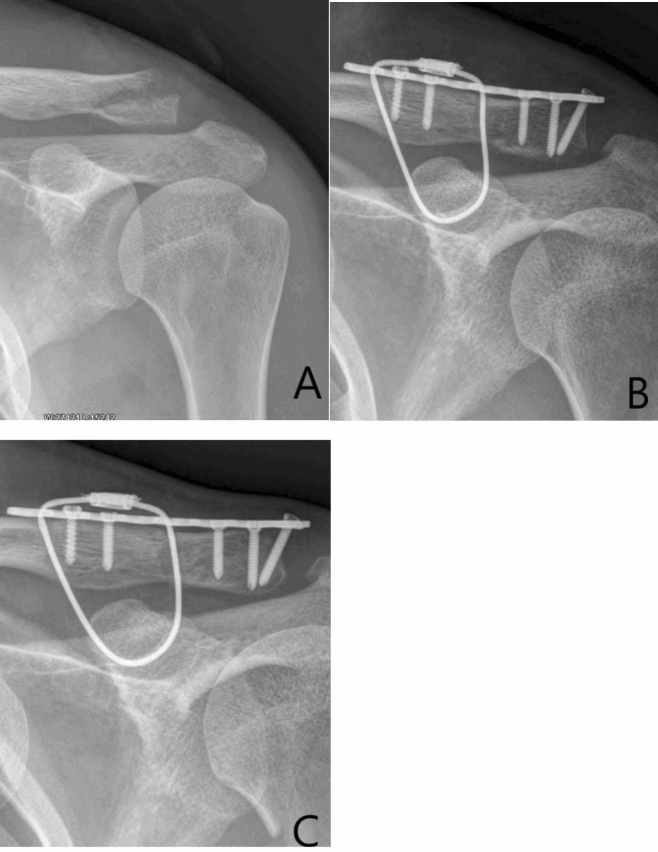
To observe and compare the curative effect of a locking plate plus titanium cable under the Guide device and clavicular hook plate in the treatment of Neer type II distal clavicle fractures. A prospective cohort study was conducted to analyse the clinical data of 36 patients with distal clavicle fractures from January 2016 to January 2019. The results were analysed. According to the random number method, the patients were divided into two groups: the titanium cable group (fixed with a titanium cable in combination with a locking plate) and hook plate group (fixed with a clavicular hook plate only). Under the guidance of a special device (for which a patent was obtained), in the titanium cable group, the coracoclavicular ligament was fixed with tension reduction, and then the distal clavicular fracture was fixed with a locking plate. In the hook plate group, the distal clavicle fracture was fixed with a hook plate. The incision length, operation time, bleeding volume and VAS score before, 1 week after and 1 year after the operation were compared between the two groups. The effect of the operation was evaluated by the Constant-Murley score before and 1 year after the operation. X-ray films were taken 2 days, 3 months, half a year and 1 year after the operation to observe the reduction and healing of fractures. At the same time, complications were recorded. The amount of bleeding was the same in the two groups. The operation time in the hook plate group was relatively short, and the difference was statistically significant (P < 0.05). The VAS score in the titanium cable group was significantly lower than that in the hook plate group one year after the operation. The Constant-Murley score in the titanium cable group and hook plate group was significantly higher 1 year after the operation. The number of postoperative complications in the titanium cable group was significantly lower than that in the hook plate group. The treatment of Neer type II distal clavicle fractures with a titanium cable plus a locking plate has a good curative effect, few complications and good postoperative recovery and thus is worth popularizing.
观察并比较导向装置下锁定钢板加钛缆与锁骨钩钢板治疗NeerⅡ型锁骨远端骨折的疗效。进行一项前瞻性队列研究,分析2016年1月至2019年1月36例锁骨远端骨折患者的临床资料,并对结果进行分析。根据随机数字法,将患者分为两组:钛缆组(采用钛缆联合锁定钢板固定)和钩钢板组(仅采用锁骨钩钢板固定)。在一种特殊装置(已获专利)的引导下,钛缆组先进行喙锁韧带张力复位固定,然后用锁定钢板固定锁骨远端骨折。钩钢板组则用钩钢板固定锁骨远端骨折。比较两组的切口长度、手术时间、出血量以及术前、术后1周和术后1年的视觉模拟评分(VAS)。采用Constant-Murley评分评估术前和术后1年的手术效果。术后2天、3个月、半年和1年拍摄X线片,观察骨折复位及愈合情况。同时记录并发症。两组出血量相同。钩钢板组手术时间相对较短,差异有统计学意义(P<0.05)。术后1年钛缆组VAS评分显著低于钩钢板组。术后1年钛缆组和钩钢板组Constant-Murley评分均显著升高。钛缆组术后并发症数量显著低于钩钢板组。钛缆加锁定钢板治疗NeerⅡ型锁骨远端骨折疗效良好,并发症少,术后恢复好,值得推广。