Takeuchi Tsutomu, Tanaka Yoshiya, Tanaka Sakae, Kawakami Atsushi, Song Yeong-Wook, Chen Yi-Hsing, Rokuda Mitsuhiro, Izutsu Hiroyuki, Ushijima Satoshi, Kaneko Yuichiro
Division of Rheumatology, Department of Internal Medicine, Keio University School of Medicine, Tokyo, Japan.
The First Department of Internal Medicine, School of Medicine, University of Occupational and Environmental Health, Japan, Kitakyushu, Japan.
Rheumatol Ther. 2021 Mar;8(1):425-442. doi: 10.1007/s40744-021-00280-5. Epub 2021 Mar 3.
This final analysis of a long-term extension (LTE) study assessed the safety, tolerability, and effectiveness of peficitinib (ASP015K), a pan-Janus kinase inhibitor, in Asian patients with rheumatoid arthritis (RA).
Patients had previously completed the 12-week phase 2b (RAJ1), or 52-week phase 3 (RAJ3 and RAJ4) peficitinib studies in Japan, Korea, and Taiwan, and received oral peficitinib 50 or 100 mg/day. Dose increase to 150 mg/day or reduction to 50 mg/day was permitted. Efficacy endpoints included American College of Rheumatology (ACR)20/50/70 response rates, 28-joint Disease Activity Score with C-reactive protein (DAS28-CRP), and ACR components. Safety endpoints included treatment-emergent adverse events (TEAEs), and incidence rates (IRs) of adverse events of special interest per 100 patient-years (PY).
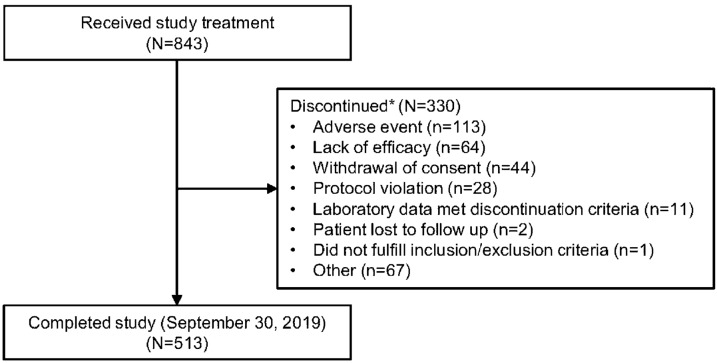
Overall, 843 patients received peficitinib for a mean 32.0 months (maximum 85.2 months), and most (64.4%) received peficitinib 100 mg/day as a maximum dose. Respective ACR20/50/70 response rates were maintained from baseline (week 0 of LTE; 71.6, 52.1, and 34.7%) to end of treatment (78.7, 63.3, and 44.1%); continuous improvements in ACR components and DAS28-CRP were observed from the baselines of preceding studies and throughout the LTE. Overall, 796/843 (94.4%) patients experienced TEAEs; most were severity grade 1/2. Most common TEAEs were nasopharyngitis (47.0%) and herpes zoster (17.3%). Drug-related TEAEs leading to permanent discontinuation occurred in 140 (16.6%) patients, and IRs (95% confidence interval) per 100 PY of serious infections, herpes zoster-related disease, and malignancies were 2.7 (2.1, 3.4), 7.3 (6.2, 8.6), and 1.2 (0.9, 1.8), respectively. Two deaths occurred during the study; one each from diffuse large B cell lymphoma and pneumonia, which were, respectively considered probably and possibly related to study drug.
Improvements in effectiveness variables were maintained during this long-term study of peficitinib in Asian patients with RA; peficitinib was generally well tolerated over a mean 32 months' duration.
ClinicalTrials.gov. NCT01638013, retrospectively registered on 11 July 2012 https://clinicaltrials.gov/ct2/show/NCT01638013 .
这项长期扩展(LTE)研究的最终分析评估了泛JAK激酶抑制剂培非替尼(ASP015K)在亚洲类风湿关节炎(RA)患者中的安全性、耐受性和有效性。
患者此前已在日本、韩国和台湾完成了为期12周的2b期(RAJ1)或52周的3期(RAJ3和RAJ4)培非替尼研究,并接受了每日50或100毫克的口服培非替尼治疗。允许将剂量增加至每日150毫克或减少至每日50毫克。疗效终点包括美国风湿病学会(ACR)20/50/70缓解率、28关节疾病活动评分(DAS28-CRP)以及ACR各组成部分。安全性终点包括治疗中出现的不良事件(TEAE)以及每100患者年(PY)中特殊关注不良事件的发生率(IR)。
总体而言,843例患者接受了培非替尼治疗,平均治疗时间为32.0个月(最长85.2个月),大多数患者(64.4%)最大剂量为每日100毫克培非替尼。从基线(LTE第0周;分别为71.6%、52.1%和34.7%)到治疗结束(分别为78.7%、63.3%和44.1%),ACR20/50/70缓解率得以维持;在前瞻性研究的基线期以及整个LTE期间,均观察到ACR各组成部分和DAS28-CRP持续改善。总体而言,796/843(94.4%)例患者出现了TEAE;大多数为1/2级严重程度。最常见的TEAE为鼻咽炎(47.0%)和带状疱疹(17.3%)。导致永久停药的药物相关TEAE发生在140例(16.6%)患者中,每100 PY中严重感染、带状疱疹相关疾病和恶性肿瘤的IR(95%置信区间)分别为2.7(2.1,3.4)、7.3(6.2,8.6)和1.2(0.9,1.8)。研究期间发生了两例死亡;一例死于弥漫性大B细胞淋巴瘤,另一例死于肺炎,分别被认为可能和有可能与研究药物有关。
在这项针对亚洲RA患者的培非替尼长期研究中,有效性变量持续改善;培非替尼在平均32个月的疗程中总体耐受性良好。
ClinicalTrials.gov。NCT01638013,于2012年7月11日进行回顾性注册https://clinicaltrials.gov/ct2/show/NCT01638013 。