Keio University School of Medicine, Tokyo, Japan.
University of Occupational and Environmental Health, Japan, Kitakyushu, Japan.
Arthritis Res Ther. 2020 Mar 12;22(1):47. doi: 10.1186/s13075-020-2125-2.
Peficitinib (ASP015K), a novel oral Janus kinase inhibitor, has demonstrated efficacy and safety for the treatment of rheumatoid arthritis (RA) in randomized, controlled trials of up to 52 weeks' duration. However, safety and effectiveness after long-term treatment have not been assessed.
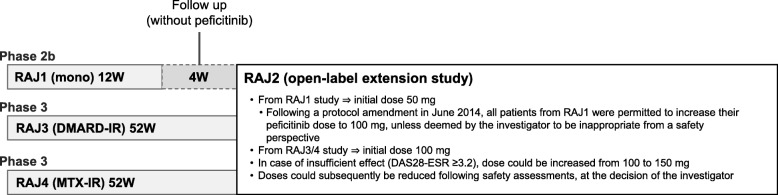
This was an interim analysis of an ongoing open-label, multicenter extension study in RA patients who completed phase 2b (RAJ1; 12 weeks) and phase 3 (RAJ3 and RAJ4; 52 weeks) peficitinib studies in Asia (mainly Japan). Eligible patients (n = 843) received oral peficitinib once daily (100 mg, or 50 mg for patients transferring from RAJ1). The peficitinib dose could be increased (up to 150 mg) or reduced (to 50 mg) at the discretion of the investigator. Efficacy variables assessed included American College of Rheumatology (ACR) response rates, ACR components, and disease activity score in 28 joints based on C-reactive protein (DAS28-CRP).
Results up to May 2018 are summarized. Mean peficitinib duration of exposure was 22.7 months and the maximum dose was 100 mg in most (66.5%) patients. ACR responses were maintained during the extension study, with ACR20/50/70 response rates of 71.6%, 52.1%, and 34.7% at week 0 and 78.9%, 61.4%, and 42.7% at end of treatment, respectively. ACR components and DAS28-CRP showed improvements from baselines of the preceding studies and continued to show improvements during the extension study. Treatment-emergent adverse events (TEAEs) were reported in 757/843 (89.8%) patients, the most common being nasopharyngitis (39.7%) and herpes zoster (11.7%). The majority of TEAEs were severity grade 1/2. Drug-related TEAEs leading to permanent study drug discontinuation occurred in 55/843 (6.5%) patients. Regarding AEs of special interest, the incidence per 100 patient-years of serious infections was 2.3 (95% CI 1.6 - 3.1), herpes zoster-related disease 6.8 (95% CI, 5.6 - 8.3), and malignancies 1.1 (95% CI, 0.7 - 1.8). One death from diffuse large B cell lymphoma during the study and one death from uterine sarcoma after the study were considered probably and possibly related to study drug, respectively.
The effectiveness of peficitinib was maintained or improved during long-term administration and treatment up to 6 years was well tolerated in Asian patients with RA.
ClinicalTrials.gov, NCT01638013, registered retrospectively 11 July 2012.
Peficitinib(ASP015K)是一种新型的口服 Janus 激酶抑制剂,在长达 52 周的随机对照试验中已证明对类风湿关节炎(RA)的疗效和安全性。然而,长期治疗后的安全性和有效性尚未得到评估。
这是一项正在进行的亚洲 RA 患者开放标签、多中心扩展研究的中期分析,这些患者完成了 2b 期(RAJ1;12 周)和 3 期(RAJ3 和 RAJ4;52 周)的 peficitinib 研究。符合条件的患者(n=843)接受每日一次口服 peficitinib(100mg,或从 RAJ1 转移过来的患者为 50mg)。研究者可以根据需要增加(最高 150mg)或减少(至 50mg)剂量。评估的疗效变量包括美国风湿病学会(ACR)应答率、ACR 成分和基于 C 反应蛋白(DAS28-CRP)的 28 个关节疾病活动度评分。
总结了截至 2018 年 5 月的数据。中位 peficitinib 暴露时间为 22.7 个月,大多数(66.5%)患者的最大剂量为 100mg。在扩展研究期间,ACR 应答得到维持,ACR20/50/70 应答率分别为 0 周时的 71.6%、52.1%和 34.7%,治疗结束时为 78.9%、61.4%和 42.7%。ACR 成分和 DAS28-CRP 显示出在前序研究基线的改善,并在扩展研究期间继续改善。757/843(89.8%)例患者报告了治疗出现的不良事件(TEAE),最常见的是鼻咽炎(39.7%)和带状疱疹(11.7%)。大多数 TEAEs 为严重程度 1/2 级。55/843(6.5%)例患者因药物相关 TEAEs 导致永久性停药。关于特殊关注的 AE,每 100 患者-年严重感染的发生率为 2.3(95%CI 1.6-3.1),带状疱疹相关疾病为 6.8(95%CI 5.6-8.3),恶性肿瘤为 1.1(95%CI 0.7-1.8)。研究期间有 1 例弥漫性大 B 细胞淋巴瘤死亡,1 例子宫肉瘤死亡,分别被认为可能与研究药物有关。
在亚洲 RA 患者中,Peficitinib 的有效性在长期治疗期间得到维持或改善,最长治疗 6 年时耐受性良好。
ClinicalTrials.gov,NCT01638013,于 2012 年 7 月 11 日回顾性注册。