School of Medicine, University of Washington, Seattle, Washington, United States of America.
Department of Radiology, University of Washington, Seattle, Washington, United States of America.
PLoS One. 2021 Mar 3;16(3):e0246149. doi: 10.1371/journal.pone.0246149. eCollection 2021.
Cardiac PET can provide quantitative myocardial blood flow (MBF) estimates. The frequency and clinical significance of discordant ischemia information between quantitative and qualitative parameters is unclear.
This retrospective, cohort study analyzed 256 Rb-82 stress-rest PET/CT studies. Global MBF and myocardial flow reserve (MFR) were estimated in absolute units for quantitative results and sum-stress and difference scores were used for qualitative results. Four groups of patients were evaluated based on a specific definition of concordant and discordant quantitative and qualitative results.
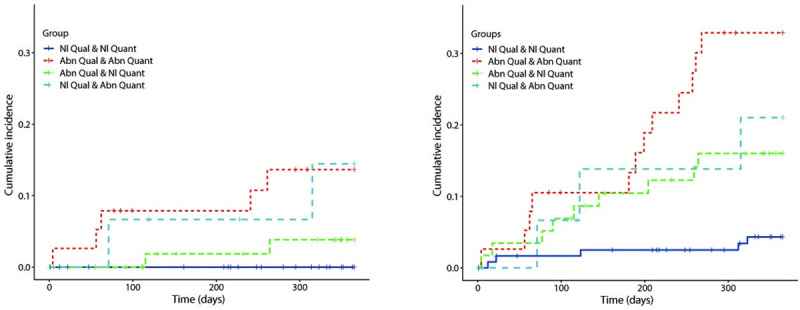
31% of cases demonstrated discordance. Factors associated with microvascular disease were more common in the groups with abnormal quantitative results, regardless of the qualitative findings. Patients with concordant abnormal results had a significantly increased risk of myocardial infarction, heart failure, percutaneous intervention, and all-cause-mortality at 1 year compared to patients with concordant normal results. In patients with discordant results of abnormal quantitative and normal qualitative findings, there was a higher prevalence of heart failure than in controls (12.5% vs 0%, p = 0.01).
Discordance in qualitative and quantitative ischemia measures from PET is common, and further study is needed to clarify its prognostic implications. Moreover, quantitative estimation of MBF and MFR appears to add value to qualitative visual interpretation by supporting qualitative findings when results are concordant. Abnormal quantitative findings, regardless of concordance or discordance with qualitative findings, occurred in patients with risk factors associated with diffuse disease and with increased risk of heart failure admission.
心脏 PET 可提供定量心肌血流(MBF)估计。定量和定性参数之间缺血信息不一致的频率和临床意义尚不清楚。
这项回顾性队列研究分析了 256 例 Rb-82 应激-静息 PET/CT 研究。绝对单位用于定量结果的估计,全球 MBF 和心肌血流储备(MFR),定性结果使用总和应激和差值评分。根据定量和定性结果的特定定义,评估了四组患者。
31%的病例存在不一致。无论定性结果如何,与微血管疾病相关的因素在定量结果异常的组中更为常见。与定量结果正常且一致的患者相比,定量结果异常且一致的患者在 1 年内发生心肌梗死、心力衰竭、经皮介入和全因死亡率的风险显著增加。在定量结果异常且定性结果正常的患者中,心力衰竭的发生率高于对照组(12.5%比 0%,p=0.01)。
PET 缺血定性和定量测量的不一致很常见,需要进一步研究阐明其预后意义。此外,当结果一致时,MBF 和 MFR 的定量估计似乎通过支持定性发现为定性视觉解释增加了价值。异常的定量发现,无论与定性发现是否一致,都发生在与弥漫性疾病相关的危险因素和心力衰竭入院风险增加的患者中。