Department of Physical Therapy, Faculty of Health Science, Kio University, Koryo, Kitakatsuragi-gun, Nara, Japan.
Health Promotion Center, Kio University, Koryo, Kitakatsuragi-gun, Nara, Japan.
PLoS One. 2021 Mar 3;16(3):e0247296. doi: 10.1371/journal.pone.0247296. eCollection 2021.
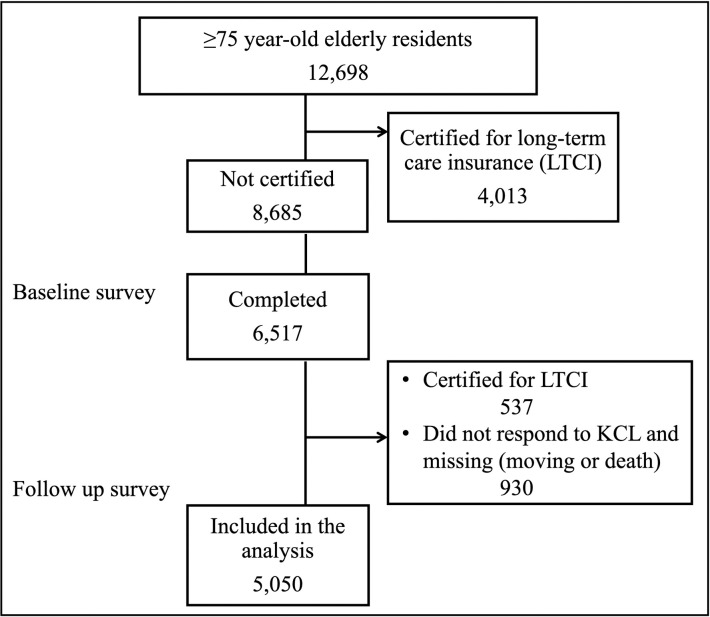
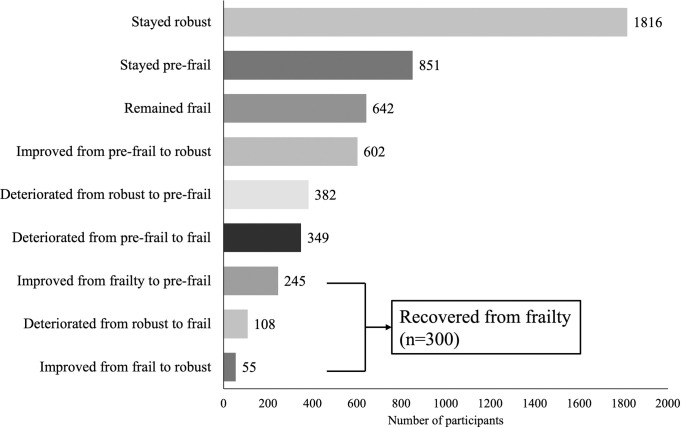
Frailty is considered to be a complex concept based mainly on physical vulnerability, but also vulnerabilities in mental/psychological and social aspects. Frailty can be reversible with appropriate intervention; however, factors that are important in recovering from frailty have not been clarified. The aim of the present study was to identify factors that help an individual reverse frailty progression and characteristics of individuals that have recovered from frailty. Community-dwelling people aged ≥75 years who responded to the Kihon Checklist (KCL) were enrolled in the study. The KCL consists of 25 yes/no questions in 7 areas: daily-life related activities, motor functions, nutritional status, oral functions, homebound, cognitive functions, and depressed mood. The number of social activities, degree of trust in the community, degree of interaction with neighbors, and subjective age were also evaluated. Frailty was assessed based on the number of checked items: 0-3 for robust, 4-7 for pre-frailty, and ≥8 for frailty. A total of 5050 participants were included for statistical analysis. At the time of the baseline survey in 2016, 18.7% (n = 942) of respondents had frailty, and the follow-up survey showed that the recovery rate from frailty within 2 years (median 24 months) was 31.8% (n = 300). Multiple logistic regression analysis showed that exercise-based social participation (odds ratio [OR] 2.0, 95% confidence interval [CI] 1.2-3.4; P<0.01) and self-rated health (OR 1.2, CI 1.0-1.5; P = 0.02) were related to reversing frailty progression. Principal component analysis indicated that the main factors constituting the first principal component (contribution rate, 18.3%) included items related to social capital, such as interaction with neighbors, trust in the community, and number of social participation activities. Our results demonstrate that exercise-based social participation and high self-rated health have associations with reversing frailty progression. Individuals that recovered from frailty are characterized by high individual-level social capital components (i.e., trust in community, interaction with neighbors, and social participation).
衰弱被认为是一个复杂的概念,主要基于身体脆弱性,但也包括心理/心理和社会方面的脆弱性。衰弱可以通过适当的干预来逆转;然而,尚未明确有助于从衰弱中恢复的重要因素。本研究的目的是确定有助于个体逆转衰弱进展的因素和从衰弱中恢复的个体的特征。本研究纳入了对《健康检查表》(KCL)做出回应的年龄≥75 岁的社区居民。KCL 由 7 个领域的 25 个是/否问题组成:日常生活相关活动、运动功能、营养状况、口腔功能、足不出户、认知功能和抑郁情绪。还评估了社会活动数量、对社区的信任程度、与邻居的互动程度以及主观年龄。衰弱程度根据检查项目的数量评估:0-3 分为健壮,4-7 分为衰弱前期,≥8 分为衰弱。共有 5050 名参与者进行了统计分析。在 2016 年基线调查时,18.7%(n=942)的受访者患有衰弱,随访调查显示,在 2 年内(中位随访 24 个月)从衰弱中恢复的比例为 31.8%(n=300)。多因素逻辑回归分析显示,基于锻炼的社会参与(比值比[OR]2.0,95%置信区间[CI]1.2-3.4;P<0.01)和自我报告健康状况(OR 1.2,CI 1.0-1.5;P=0.02)与衰弱进展的逆转有关。主成分分析表明,构成第一主成分(贡献率 18.3%)的主要因素包括与社会资本相关的项目,如与邻居的互动、对社区的信任和社会参与活动的数量。我们的结果表明,基于锻炼的社会参与和较高的自我报告健康状况与衰弱进展的逆转有关。从衰弱中恢复的个体的特征是高水平的个体层面社会资本组成部分(即对社区的信任、与邻居的互动和社会参与)。