Department of Oral Biology, University of Florida, Gainesville, Florida, USA.
Department of Oral Biology, University of Florida, Gainesville, Florida, USA
mSphere. 2021 Mar 3;6(2):e01308-20. doi: 10.1128/mSphere.01308-20.
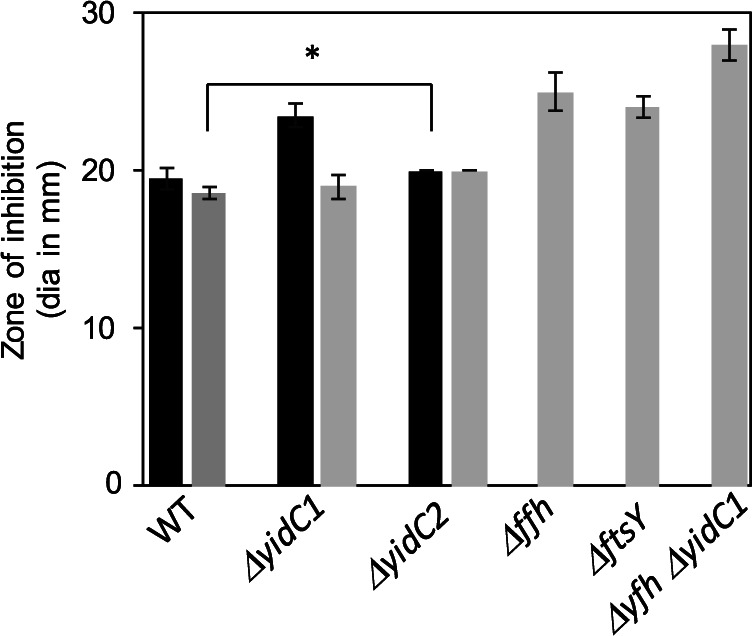
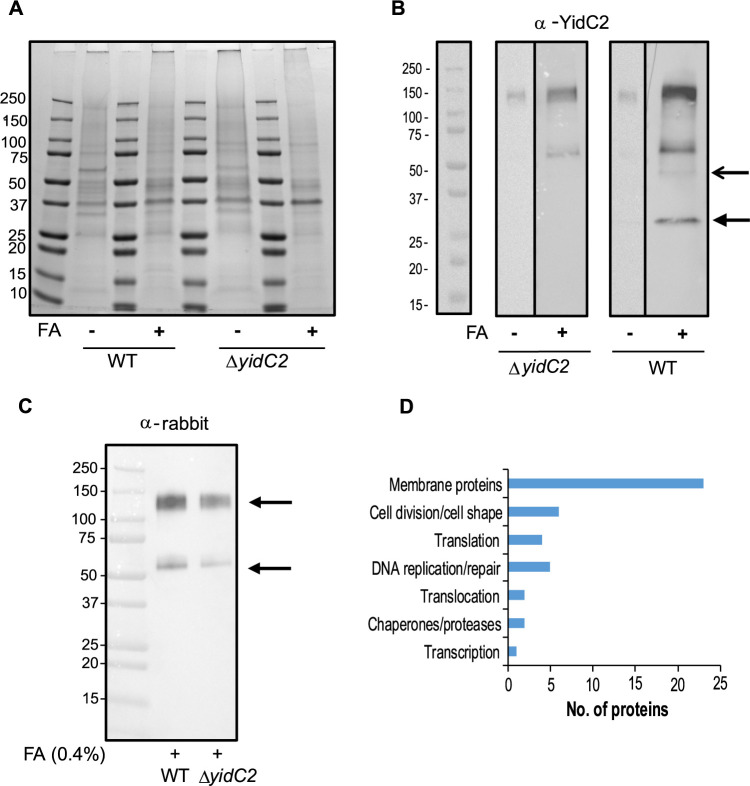
Virulence properties of cariogenic depend on integral membrane proteins. Bacterial cotranslational protein trafficking involves the signal recognition particle (SRP) pathway components Ffh and FtsY, the SecYEG translocon, and YidC chaperone/insertases. Unlike , survives loss of the SRP pathway and has two paralogs. This study characterized YidC1 and YidC2 interactomes to clarify respective functions alone and in concert with the SRP and/or Sec translocon. Western blots of formaldehyde cross-linked or untreated lysates were reacted with anti-Ffh, anti-FtsY, anti-YidC1, or anti-YidC2 antibodies followed by mass spectrometry (MS) analysis of gel-shifted bands. Cross-linked lysates of wild-type and Δ strains were reacted with anti-YidC2-coupled Dynabeads, and cocaptured proteins were identified by MS. Last, YidC1 and YidC2 C-terminal tail-captured proteins were subjected to two-dimensional (2D) difference gel electrophoresis and MS analysis. Direct interactions of putative YidC1 and YidC2 binding partners were confirmed by bacterial two-hybrid assay. Our results suggest YidC2 works preferentially with the SRP pathway, while YidC1 is preferred for SRP-independent Sec translocon-mediated translocation. YidC1 and YidC2 autonomous pathways were also apparent. Two-hybrid assay identified interactions between holotranslocon components SecYEG/YajC and YidC1. Both YidC1 and YidC2 interacted with Ffh, FtsY, and chaperones DnaK and RopA. Putative membrane-localized substrates HlyX, LemA, and SMU_591c interacted with both YidC1 and YidC2. Identification of several Rgp proteins in the YidC1 interactome suggested its involvement in bacitracin resistance, which was decreased in Δ and SRP-deficient mutants. Collectively, YidC1 and YidC2 interactome analyses has further distinguished these paralogs in the Gram-positive bacterium is a prevalent oral pathogen and major causative agent of tooth decay. Many proteins that enable this bacterium to thrive in its environmental niche and cause disease are embedded in its cytoplasmic membrane. The machinery that transports proteins into bacterial membranes differs between Gram-negative and Gram-positive organisms, an important difference being the presence of multiple YidC paralogs in Gram-positive bacteria. Characterization of a protein's interactome can help define its physiological role. Herein, we characterized the interactomes of YidC1 and YidC2. Results demonstrated substantial overlap between their interactomes but also revealed several differences in their direct protein binding partners. Membrane transport machinery components were identified in the context of a large network of proteins involved in replication, transcription, translation, and cell division/cell shape. This information contributes to our understanding of protein transport in Gram-positive bacteria in general and informs our understanding of pathogenesis.

致龋菌的毒力特性取决于整合膜蛋白。细菌共翻译蛋白转运涉及信号识别颗粒 (SRP) 途径成分 Ffh 和 FtsY、SecYEG 易位体和 YidC 伴侣/插入酶。与 不同, 可以在缺失 SRP 途径的情况下存活下来,并且有两个 。本研究通过鉴定 YidC1 和 YidC2 互作组,阐明了它们各自的功能以及与 SRP 和/或 Sec 易位体的协同作用。用甲醛交联或未交联的 裂解物进行 Western blot 反应,然后用抗 Ffh、抗 FtsY、抗 YidC1 或抗 YidC2 抗体进行反应,再用质谱 (MS) 分析凝胶迁移带。用抗 YidC2 偶联的 Dynabeads 反应野生型和 Δ 株的交联裂解物,并通过 MS 鉴定共捕获的蛋白质。最后,对 YidC1 和 YidC2 C 端尾巴捕获的蛋白质进行二维 (2D) 差异凝胶电泳和 MS 分析。通过细菌双杂交实验证实了假定的 YidC1 和 YidC2 结合伴侣的直接相互作用。我们的结果表明,YidC2 更倾向于与 SRP 途径一起工作,而 YidC1 则更适合于非依赖 SRP 的 Sec 易位体介导的易位。也明显存在 YidC1 和 YidC2 的自主途径。细菌双杂交实验鉴定了全转位体成分 SecYEG/YajC 和 YidC1 之间的相互作用。YidC1 和 YidC2 均与 Ffh、FtsY 和伴侣 DnaK 和 RopA 相互作用。假定的膜定位底物 HlyX、LemA 和 SMU_591c 与 YidC1 和 YidC2 均相互作用。YidC1 互作组中鉴定出几种 Rgp 蛋白表明其参与杆菌肽抗性,在 Δ 和 SRP 缺陷突变体中该抗性降低。总的来说,YidC1 和 YidC2 互作组分析进一步区分了革兰氏阳性菌中的这些同源物 是一种普遍存在的口腔病原体,也是导致龋齿的主要病原体。使这种细菌在其环境小生境中茁壮成长并导致疾病的许多蛋白质都嵌入其细胞质膜中。在革兰氏阴性菌和革兰氏阳性菌之间,将蛋白质输送到细菌膜中的机制不同,革兰氏阳性菌的一个重要区别是存在多个 YidC 同源物。对蛋白质相互作用组的特性分析有助于确定其生理作用。在此,我们对 YidC1 和 YidC2 的相互作用组进行了表征。结果表明,它们的互作组之间存在大量重叠,但它们的直接蛋白结合伴侣也存在一些差异。在涉及复制、转录、翻译和细胞分裂/细胞形状的大量蛋白质网络中鉴定出了膜转运机制成分。这些信息有助于我们了解一般革兰氏阳性菌中的蛋白质转运,并为我们了解 发病机制提供信息。