Department of Biological Sciences, University of Cincinnati, Cincinnati, OH 45221;
Santa Fe Institute, Santa Fe, NM 87501.
Proc Natl Acad Sci U S A. 2021 Mar 9;118(10). doi: 10.1073/pnas.2022912118.
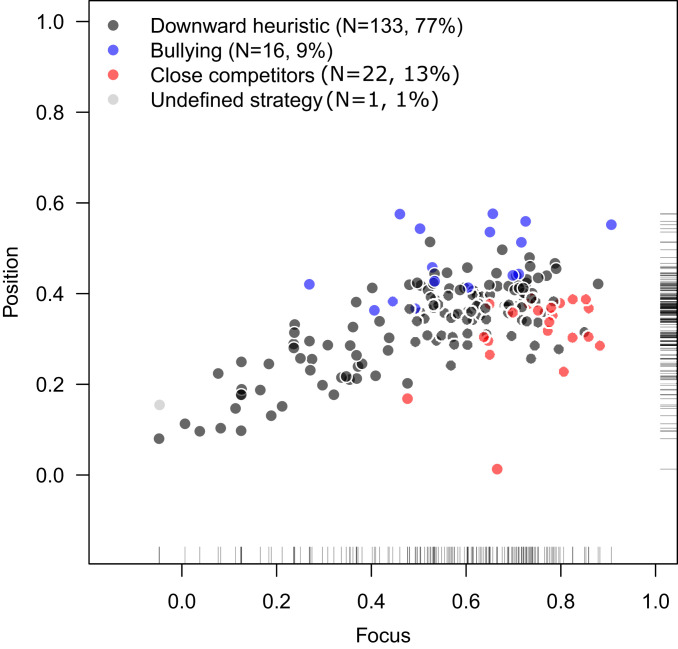
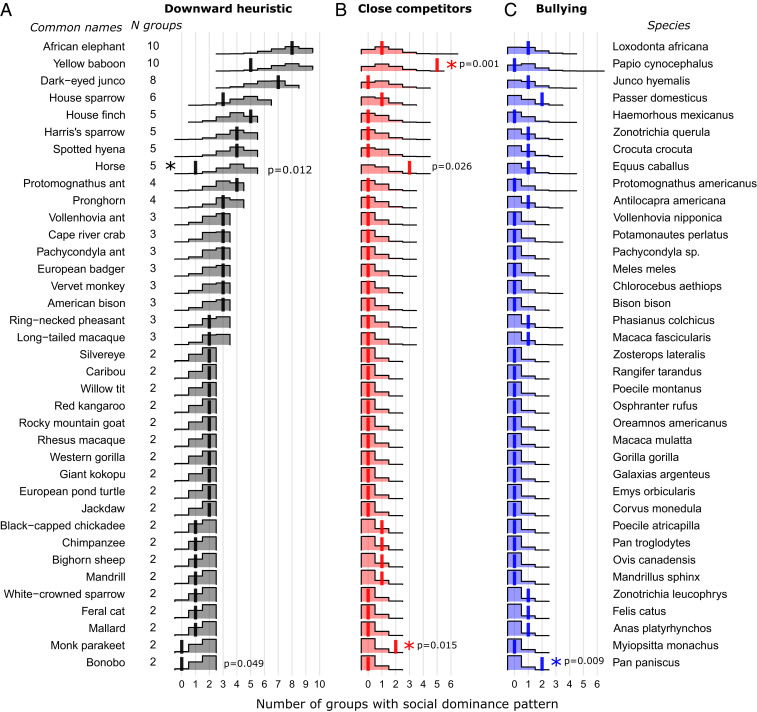
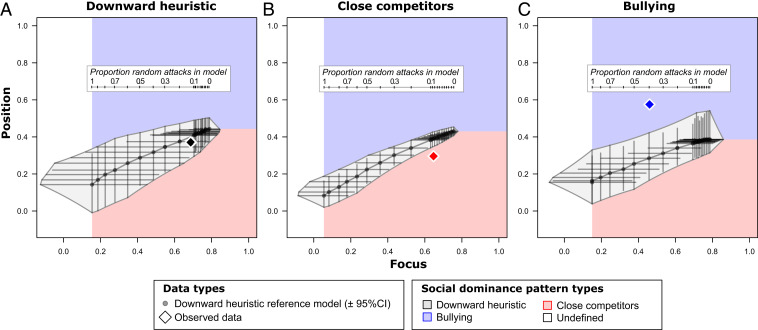
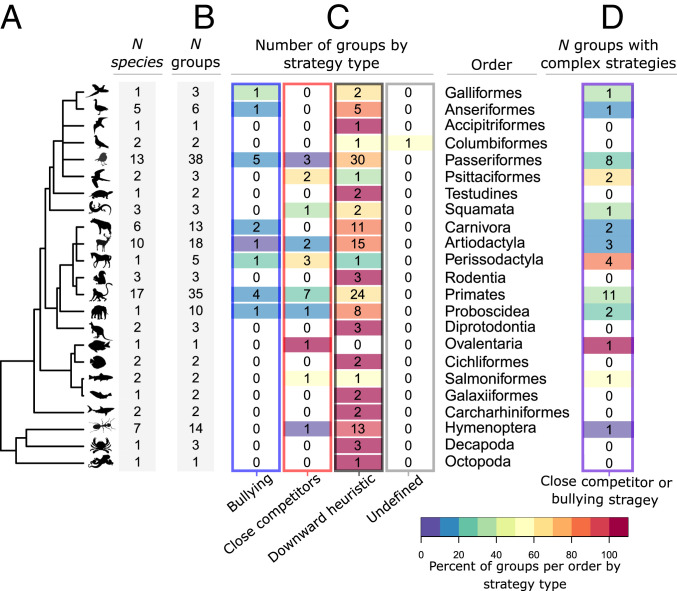
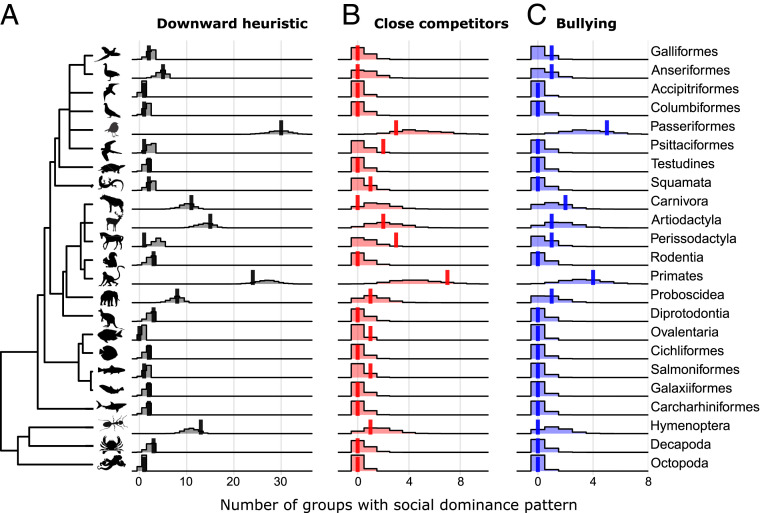
Members of a social species need to make appropriate decisions about who, how, and when to interact with others in their group. However, it has been difficult for researchers to detect the inputs to these decisions and, in particular, how much information individuals actually have about their social context. We present a method that can serve as a social assay to quantify how patterns of aggression depend upon information about the ranks of individuals within social dominance hierarchies. Applied to existing data on aggression in 172 social groups across 85 species in 23 orders, it reveals three main patterns of rank-dependent social dominance: the downward heuristic (aggress uniformly against lower-ranked opponents), close competitors (aggress against opponents ranked slightly below self), and bullying (aggress against opponents ranked much lower than self). The majority of the groups (133 groups, 77%) follow a downward heuristic, but a significant minority (38 groups, 22%) show more complex social dominance patterns (close competitors or bullying) consistent with higher levels of social information use. These patterns are not phylogenetically constrained and different groups within the same species can use different patterns, suggesting that heuristic use may depend on context and the structuring of aggression by social information should not be considered a fixed characteristic of a species. Our approach provides opportunities to study the use of social information within and across species and the evolution of social complexity and cognition.
社会性物种的成员需要在群体中做出适当的决策,包括与谁、如何以及何时互动。然而,研究人员很难检测到这些决策的输入,特别是个体对其社交环境的实际了解程度。我们提出了一种方法,可以作为一种社会测定方法,量化攻击模式如何取决于个体在社会支配等级中的地位信息。将其应用于 85 个物种在 23 个目下的 172 个社会群体的现有攻击数据中,揭示了三种主要的依赖等级的社会支配模式:向下启发式(对低等级的对手进行统一攻击)、接近竞争者(攻击自我排名略低的对手)和欺凌(攻击自我排名低得多的对手)。大多数群体(133 个群体,77%)遵循向下启发式,但少数群体(38 个群体,22%)表现出更复杂的社会支配模式(接近竞争者或欺凌),这与更高水平的社会信息使用一致。这些模式不受系统发育的限制,同一物种内的不同群体可以使用不同的模式,这表明启发式的使用可能取决于上下文,而社会信息的结构不应被视为物种的固定特征。我们的方法为研究物种内和跨物种的社会信息使用以及社会复杂性和认知的进化提供了机会。