Islam Md Ziaul, Farjana Sharmin, Efa Syeda Sumaiya
Dept. of Community Medicine, National Institute of Preventive and Social Medicine (NIPSOM), Mohakhali, Dhaka, 1212, Bangladesh.
Dept. of Obstetrics and Gynecology, Shaheed Suhrawardy Medical College Hospital, Sher-E-Bangla Nagar, Dhaka, 1207, Bangladesh.
Heliyon. 2021 Feb 13;7(2):e06256. doi: 10.1016/j.heliyon.2021.e06256. eCollection 2021 Feb.
The care of children with cancer creates emotional, financial, and social impacts for their families. Information on the impact of childhood cancer (CC) on the family is scarce in Bangladesh. Thus, the study was set out to assess the impact of CC on the families in the local context.
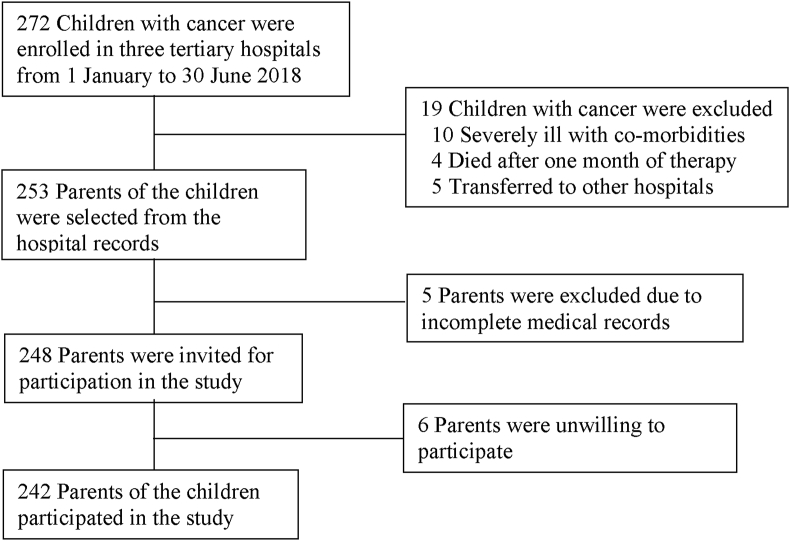
This cross-sectional study was conducted from January to June 2018 in three purposively selected tertiary hospitals. All the children diagnosed and treated at those hospitals during the study period were eligible for this study. Children undergoing bone marrow transplantation, or those who were seriously ill, or those transferred to another hospital, or those who died were excluded or whose parents were not willing to participate. A total of 242 children were enrolled in the study and their parents were included in the interview. Measures included socio-demographic attributes, financial burden, personal strain, social impact, mastery, and treatment cost. Informed written consent was obtained from the parents and a face-to-face interview was conducted using a semi-structured questionnaire based on (i) About you and your-family and (ii) the Impact-On-Family (IOF) scale. High scores of the scale correlated to high impact. Medical records were reviewed to collect data on the pattern of CC and treatment costs.
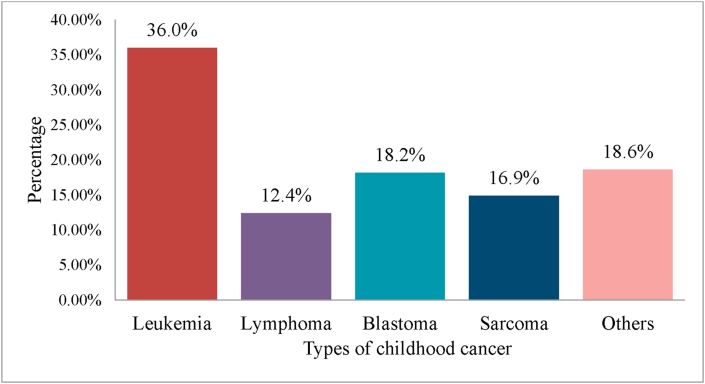
Major CCs included leukemia (36.0%), blastoma (18.2%), sarcoma (14.9%), and lymphoma (12.4%). The weighted score was highest for mastery (3.63) followed by financial burden (3.33), personal strain (3.27), and social impact (3.21) domains. The difference of IOFS score was significant by family type (p < 0.05), father's occupation (p < 0.05), type (p < 0.01) and duration of cancer (p < 0.01), and treatment cost (p˂0.01). Families adopted diverse coping strategies including changed lifestyle (98.3%), sought social support (86.0%), rely more on religion (98.8%), and reduced family investment (83.9%) to adjust the impact.
The impact of CC on the family is evident at many levels. In particular, mean scores of financial burden, personal strain, social impact, and mastery domains of the IOF scale were significantly associated with the employment status of parents, residing place, treatment cost, type, and duration of cancer. The study findings could contribute to devising impact-reducing intervention programs in Bangladesh.
癌症患儿的照料给其家庭带来了情感、经济和社会影响。在孟加拉国,关于儿童癌症(CC)对家庭影响的信息匮乏。因此,本研究旨在评估在当地背景下CC对家庭的影响。
本横断面研究于2018年1月至6月在三家经目的抽样选取的三级医院开展。研究期间在这些医院确诊并接受治疗的所有儿童均符合本研究条件。接受骨髓移植的儿童、病情严重的儿童、转至其他医院的儿童、死亡儿童或其父母不愿参与者被排除。共有242名儿童纳入研究,其父母参与访谈。测量指标包括社会人口学特征、经济负担、个人压力、社会影响、掌控感和治疗费用。获得了父母的知情书面同意,并使用基于(i)关于您和您的家庭以及(ii)家庭影响(IOF)量表的半结构化问卷进行面对面访谈。该量表得分越高,影响越大。查阅医疗记录以收集CC模式和治疗费用的数据。
主要的CC类型包括白血病(36.0%)、母细胞瘤(18.2%)、肉瘤(14.9%)和淋巴瘤(12.4%)。掌控感领域的加权得分最高(3.63),其次是经济负担(3.33)、个人压力(3.27)和社会影响(3.21)领域。IOFS得分在家庭类型(p<0.05)、父亲职业(p<0.05)、癌症类型(p<0.01)、癌症持续时间(p<0.01)和治疗费用(p˂0.01)方面存在显著差异。家庭采取了多种应对策略,包括改变生活方式(98.3%)、寻求社会支持(86.0%)、更多地依赖宗教(98.8%)和减少家庭投入(83.9%)以应对影响。
CC对家庭的影响在多个层面都很明显。特别是,IOF量表的经济负担、个人压力、社会影响和掌控感领域的平均得分与父母的就业状况、居住地点、治疗费用、癌症类型和持续时间显著相关。研究结果有助于在孟加拉国制定减少影响的干预项目。