Division of Genetics, Department of Pediatrics, University of California, San Diego, La Jolla, California, United States of America.
Biostatistics Research Center, Herbert Wertheim School of Public Health and Human Longevity Science, University of California, San Diego, La Jolla, California, United States of America.
PLoS One. 2021 Mar 4;16(3):e0247846. doi: 10.1371/journal.pone.0247846. eCollection 2021.
Development of noninvasive methodology to reproducibly measure tissue cystine crystal load to assess disease status and guide clinical care in cystinosis, an inherited lysosomal storage disorder characterized by widespread cystine crystal accumulation.
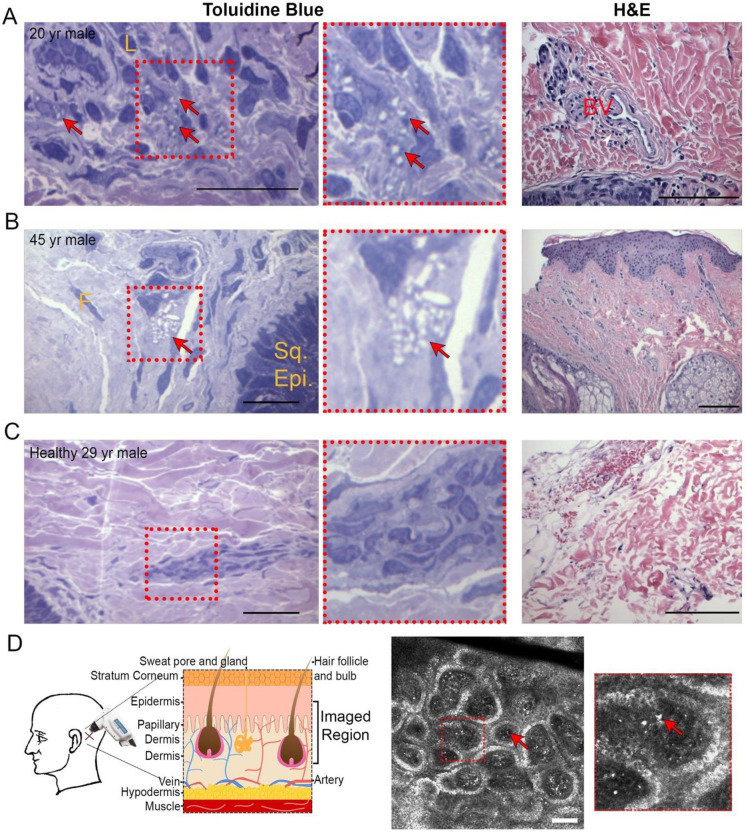
To develop an unbiased and semi-automated imaging methodology to quantify dermal cystine crystal accumulation in patients to correlate with disease status.
DESIGN, SETTING AND PARTICIPANTS: 101 participants, 70 patients and 31 healthy controls, were enrolled at the University of California, San Diego, Cystinosis Clinics, Rady Children's Hospital, San Diego and at the annual Cystinosis Research Foundation family conference for an ongoing prospective longitudinal cohort study of cystinosis patients with potential yearly follow-up.
Intradermal reflectance confocal microscopy (RCM) imaging, blood collection via standard venipuncture, medical record collection, and occasional skin punch biopsies.
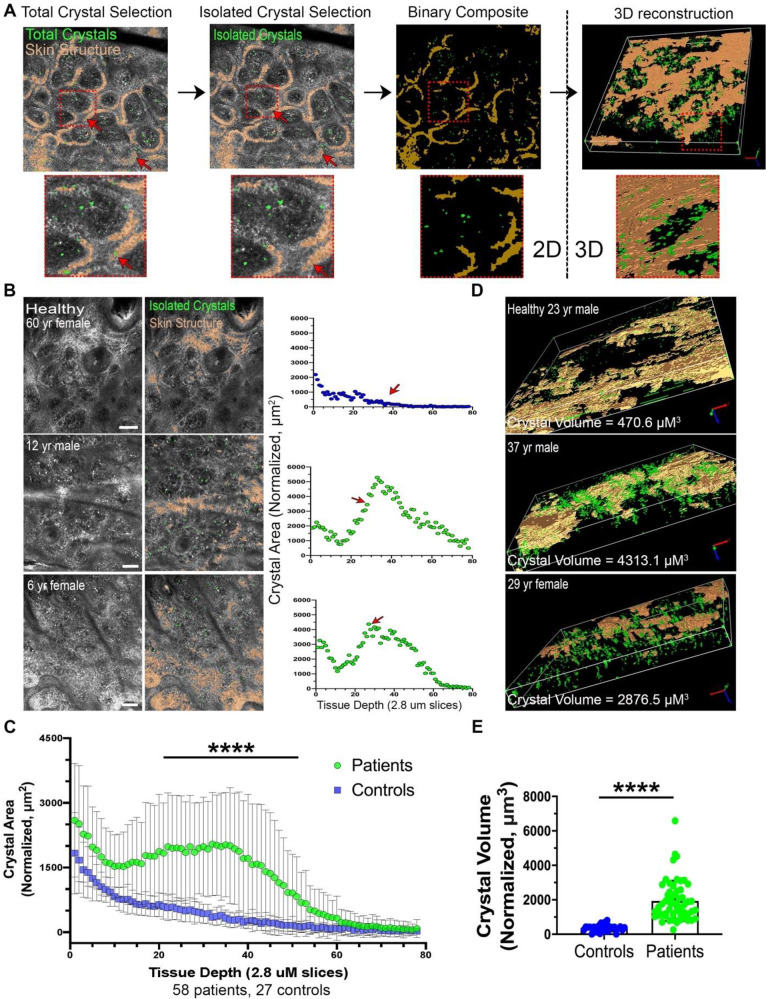
The primary outcome was to establish an automated measure of normalized confocal crystal volume (nCCV) for each subject. Secondary analysis examined the association of nCCV with various clinical indicators to assess nCCV's possible predictive potential.
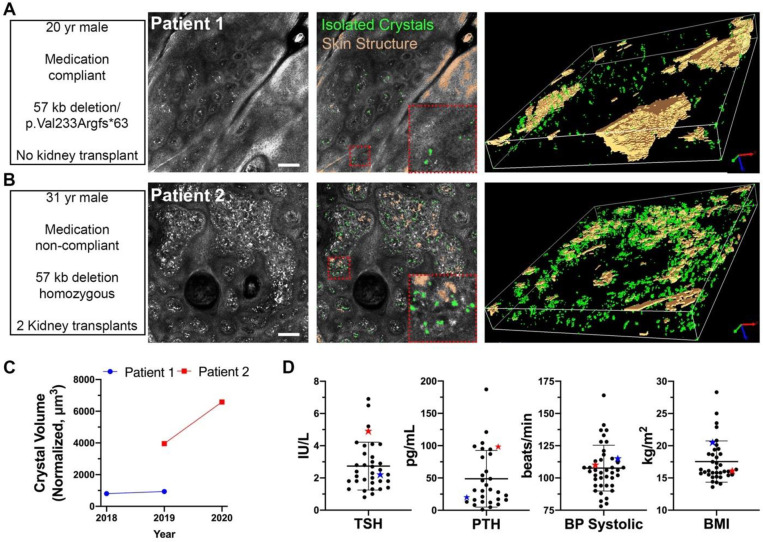
Over 2 years, 57 patients diagnosed with cystinosis (median [range] age: 15.1 yrs [0.8, 54]; 41.4% female) were intradermally assessed by RCM to produce 84 image stacks. 27 healthy individuals (38.7 yrs [10, 85]; 53.1% female) were also imaged providing 37 control image stacks. Automated 2D crystal area quantification revealed that patients had significantly elevated crystal accumulation within the superficial dermis. 3D volumetric analysis of this region was significantly higher in patients compared to healthy controls (mean [SD]: 1934.0 μm3 [1169.1] for patients vs. 363.1 μm3 [194.3] for controls, P<0.001). Medical outcome data was collected from 43 patients with infantile cystinosis (media [range] age: 11 yrs [0.8, 54]; 51% female). nCCV was positively associated with hypothyroidism (OR = 19.68, 95% CI: [1.60, 242.46], P = 0.02) and stage of chronic kidney disease (slope estimate = 0.53, 95%CI: [0.05, 1.00], P = 0.03).
This study used non-invasive RCM imaging to develop an intradermal cystine crystal quantification method. Results showed that cystinosis patients had increased nCCV compared to healthy controls. Level of patient nCCV correlated with several clinical outcomes suggesting nCCV may be used as a potential new biomarker for cystinosis to monitor long-term disease control and medication compliance.
开发一种非侵入性的方法来重现性地测量组织胱氨酸晶体负荷,以评估疾病状态并指导胱氨酸病的临床护理,胱氨酸病是一种遗传性溶酶体贮积症,其特征是广泛的胱氨酸晶体积累。
开发一种无偏倚和半自动化的成像方法来定量评估患者皮肤中的胱氨酸晶体积累,以与疾病状态相关联。
设计、设置和参与者:在加利福尼亚大学圣地亚哥分校、圣地亚哥 Rady 儿童医院的胱氨酸病诊所,以及胱氨酸病研究基金会的年度家庭会议上,共招募了 101 名参与者,其中 70 名患者和 31 名健康对照者,他们参与了一项正在进行的前瞻性纵向队列研究,对胱氨酸病患者进行潜在的年度随访。
皮肤内反射共聚焦显微镜(RCM)成像、通过标准静脉穿刺采集血液、病历采集和偶尔的皮肤打孔活检。
主要结果是为每个受试者建立一个正常化的共聚焦晶体体积(nCCV)的自动测量方法。二级分析检查了 nCCV 与各种临床指标的关联,以评估 nCCV 的潜在预测潜力。
在 2 年的时间里,对 57 名确诊的胱氨酸病患者(中位数[范围]年龄:15.1 岁[0.8,54];41.4%为女性)进行了 RCM 皮内评估,产生了 84 个图像堆栈。还对 27 名健康个体(38.7 岁[10,85];53.1%为女性)进行了成像,提供了 37 个对照图像堆栈。自动化的 2D 晶体面积定量显示,患者的浅层真皮中晶体积累明显升高。与健康对照组相比,该区域的 3D 体积分析明显更高(患者的平均[标准差]:1934.0 μm3[1169.1],健康对照组为 363.1 μm3[194.3],P<0.001)。对 43 名患有婴儿胱氨酸病的患者(中位数[范围]年龄:11 岁[0.8,54];51%为女性)收集了 nCCV 数据。nCCV 与甲状腺功能减退症呈正相关(比值比[OR]=19.68,95%置信区间[CI]:[1.60,242.46],P=0.02)和慢性肾脏病的分期(斜率估计值=0.53,95%CI:[0.05,1.00],P=0.03)。
本研究使用非侵入性的 RCM 成像技术开发了一种皮内胱氨酸晶体定量方法。结果表明,胱氨酸病患者的 nCCV 高于健康对照组。患者的 nCCV 水平与多种临床结果相关,表明 nCCV 可能作为胱氨酸病的一种潜在新生物标志物,用于监测长期疾病控制和药物依从性。